“I need printing on my packaging, but I do not know which type is best.” That sentence was heard on the first day of a client visit, and the real question behind it was: What Is Gravure Printing? The client was the owner of a Canadian brand based in Toronto, and a new range of premium biltong was planned for grocery and specialty retail stores. Zip-lock stand-up pouches with a premium look were needed, but the best printing type was not known. This blog gives the full answer to what is gravure printing, from confusion to decision, with benefits, cost, and results. Keep scrolling to see how the decision was made and what changed on the shelf.
The Client’s Confusion About Printing Type
What Is Gravure Printing for Packaging?
The client and the first request are introduced below, along with the first question of what is gravure printing.
Who the Client Was and What Needed to Be Printed
The client was the owner of Oronto Biltong Co., and about 300,000 pouches were expected each month. The owner said, “I want the best result, but I do not want to overspend.” Stand-up pouches are a popular choice for premium dried meat snacks because of their shelf appeal and practical storage. When the client asked for stand-up pouches, we presented our own samples first to demonstrate the available quality and printing options. To understand how detailed pouch printing is achieved, let’s explore what Is gravure printing and how it contributes to high-volume packaging production. Explore Custom Stand Up Pouches Canada for strong shelf visibility and professional product presentation.
Explained Every Printing Type to the Client
What Is Gravure Printing Compared With Other Methods?
Each printing type was explained in simple words to help the client compare gravure, flexographic, digital, offset, screen and UV printing. Understanding what is gravure printing helped clarify how order volume, material, artwork requirements, setup costs and print quality influence the choice of printing method.
-
Gravure Printing
The gravure printing process uses engraved cylinders to transfer ink onto the packaging material. It is generally considered for high-volume orders where consistent colour, detailed artwork and long runs are important.
-
Flexographic Printing
Flexographic printing uses flexible printing plates and has a relatively quick setup compared with gravure. This makes it suitable for short to medium runs where faster setup matters.
Most buyers get confused between these two, but gravure and flexo serve very different purposes. For a detailed discussion, read our next guide, Gravure Printing Vs Flexo to compare print quality, setup costs, production speed, and the best option for your packaging needs.
-
Digital Printing
Digital printing does not require traditional cylinders or plates. Very small runs can be produced economically, although the cost per pouch may be higher than gravure at large volumes.
-
Offset Printing
Offset printing is mainly associated with paper and paperboard packaging. It suits detailed graphics on paper-based packs.
-
Screen Printing
Screen printing is generally chosen for specialty needs such as specific ink effects, bold coverage or distinctive printed details.
-
UV Printing
UV printing uses ultraviolet light to cure the ink during printing. It is considered for specialty packaging where sharp graphics or specific surface finishes are required.
Gravure vs Flexo vs Digital Printing Comparison
| Factor | Gravure | Flexo | Digital |
| Best run length | Long | Short to medium | Very short |
| Setup | Cylinders (7–14 days) | Plates (quick) | None |
| Fine detail and gradients | Excellent | Good | Very good |
| Colour consistency | 1–3% variation | 2–5% variation | Good |
| Cost per pouch at volume | Lowest | Medium | Highest |
| Design changes | New cylinder needed | Easy | Easiest |
Suggestion: Select Gravure, But Why Was Gravure Best for the Packaging?
What Is Gravure Printing Best Suited For?
The suggestion was explained in plain words, so what is gravure printing was no longer a mystery. Gravure was recommended because the volume was high, the artwork was detailed, and monthly reorders were planned. Film choice matters here too. Discover Flexible Pouches Wholesale printed for long runs and premium artwork.
Why the Other Printing Types Did Not Suit the Packaging
Each type was checked against the client’s volume, artwork and film to determine what is gravure printing best suited for compared with other methods. Digital was set aside because the volume was high, and flexo because smooth gradients and strict colour control were required. Offset was not suited to laminated structures, and screen and UV printing were too slow for monthly reorders.
What Is Gravure Printing? Explained in Simple Words
What Is Gravure Printing in Practice?
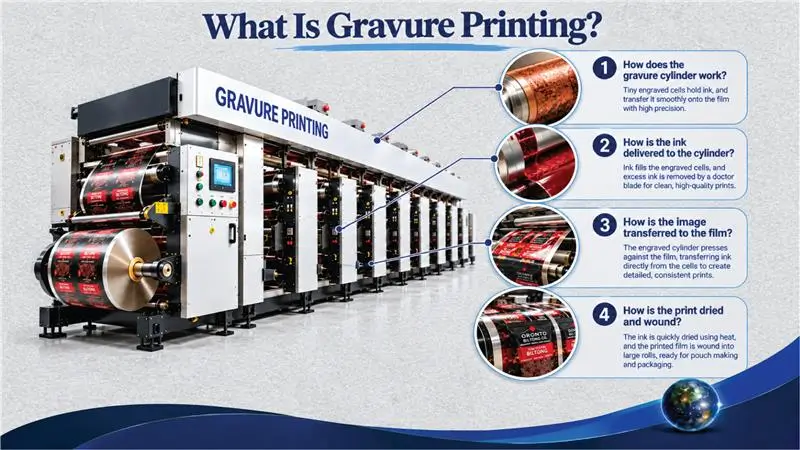
In the gravure printing process, the image is engraved into a metal cylinder and then transferred onto film. “So, what is gravure printing exactly?” the client asked. The process, also called rotogravure, was explained in four steps:
- Prepress: The artwork is separated into colours.
- Engraving: A steel base is plated with copper, then engraved by laser or electromechanical engraving before proofing.
- Chrome plating: A chrome surface is applied for long life, and a separate cylinder is prepared for each colour.
- Cell structure: The cylinder carries millions of tiny cells, and the cell volume controls how much ink is held.
To understand what is gravure printing, the process begins as the cylinder rotates through an ink bath and a doctor blade removes excess ink. The remaining ink transfers onto the film in a smooth layer. The film is fed from a roll for continuous, high-speed printing. Ink viscosity is controlled, registration is checked, and each colour is dried before the next is applied.
Film strength matters just as much as print quality. A printed pouch has to survive filling, shipping and handling, and a stiff, strong film he pack standing upright and the print undamaged. Get these BOPET Bag options selected for strength and stiffness. The benefits of gravure are explained next.
“Good things come in small packages.” — Aesop
Sustainable Demand and Eco-Friendly Ink Usage
Canadian buyers increasingly ask for responsible packaging, and regulations support this shift. Understanding what is gravure printing also involves considering the environmental and food-safety requirements associated with inks and films. Materials intended for food contact must meet applicable Health Canada requirements. In Ontario, producers are also responsible for packaging end-of-life management under the Blue Box Regulation (O. Reg. 391/21), encouraging greater consideration of recyclable mono-material structures. Solvent-based inks are common in gravure printing, but solvent recovery systems reduce VOC emissions, while water-based and low-VOC inks may be considered for eco-friendly packaging. Current requirements should be confirmed with the relevant authorities before production.
Advantages and Disadvantages of Gravure for Packaging
What Is Gravure Printing’s Main Advantage?
Understanding what is gravure printing also involves reviewing its advantages and disadvantages, starting with the benefits that best match the client’s needs.
Advantages
- Fine detail: Logos, small text and QR codes print sharply.
- Clarity: Print quality is raised across the whole pouch, and colours are matched to the approved sample.
- Consistency: Colour stays the same in every batch, which improves brand perception on the shelf.
- Lower cost: For high volumes, the cylinder cost is spread over long runs, giving a lower cost per pouch.
Disadvantages
- Higher upfront cost: Cylinders must be engraved before printing starts.
- Lead time: Cylinder preparation takes 7 to 14 days.
- Design changes: A new cylinder is needed for every artwork change.
- Minimum run: About 5,000 metres is recommended.
- Solvent inks: VOC emissions must be controlled through solvent recovery.
Cost and the Sample That Changed the Decision
What Is Gravure Printing’s Cost at High Volume?
The cost per pouch and a side-by-side sample were presented to demonstrate what is gravure printing in practical terms. At 300,000 pouches per month, the cylinder cost was spread across the order volume, resulting in a lower cost per pouch for gravure printing over twelve months. Both samples featured the same artwork and were placed side by side. The client held the sample for a minute and asked, “Is this the same artwork? It looks like a completely different pack.” Impressed by the print quality and cost efficiency, the client placed an order for 300,000 pouches.
Recent Work Done on Gravure Printing (Samples)
[IMAGE ROW: four columns of gravure-printed pouch samples]
Results After Choosing Gravure
After the switch, clear changes in shelf appeal, colour and reorders were noticed. Retailers commented on the gloss and sharpness, and the product stood out on the shelf. Shape and finish drew attention too. See how Shape Bag designs are used to stand out. The same colour was maintained across every batch, so the brand’s reputation was protected. Because the cylinders were ready, reorders started quickly and delivery was completed in 10 days.
Features and Other Demands Implementation
Beyond printing, the client’s pouches included features that suit biltong:
- Aluminium foil inner barrier: Blocks oxygen, light and moisture to protect freshness and shelf life.
- Resealable zipper: Lets customers reopen and close the pouch, keeping the product fresh after opening.
- Tear notch and clear window: Easy opening, plus a view of the product.
- Matte finish with gloss highlights: A premium look on the shelf.
The client also planned a larger family-size biltong pack for bulk buyers. Since more fill volume was needed, we showed own samples first, so have a look at them now. Our Bottom Gusset Bags were chosen for the larger fill volumes, with the same gravure print quality.
Lessons for Your Packaging: Is Gravure Right for You?
Now that what is gravure printing and its practical applications are clearly understood, these lessons can guide your choice. Gravure is preferred when volumes are high, premium photography or fine text is included, and consistent colour is needed across repeat orders. Laminated structures are commonly used for meat snacks and other food products, while fill volume also influences the choice of pouch style. For products that need a stable, upright display, explore Gusseted Sticker Mylar Bags as another packaging option. Digital or flexo is preferred for very short runs, frequent design changes, and simple artwork. Recyclable packaging is also requested more often, so mono-material options are worth considering.
Now that the benefits, costs, and limitations of the gravure printing process are clear, the next step is to review your artwork, order volume, and packaging requirements. The right printing type can then be chosen for your needs, whether you are planning a new pouch or a repeat order. For reliable Canadian Custom Packaging, contact our team today for a free quote and printing consultation.
Conclusion
Through this experience, trust was built with the client, leading to further orders that were also fulfilled in full. This successful collaboration established a strong business relationship that continues to this day. Therefore, what is gravure printing is now answered clearly, with each step explained. Gravure is preferred for long runs, detailed artwork, and repeat orders, while other printing types are more suitable for very short runs. The best decision is made after reviewing the artwork, order volume, and budget together. Read the answers below to clear up any remaining doubts.
Frequently Asked Questions (FAQs)
What is gravure printing?
In gravure, also known as rotogravure printing, the image is engraved into a metal cylinder, and ink is held in tiny cells. The ink is then moved onto the film in a smooth, even layer.
Is gravure suitable for food products like biltong?
Yes. Food-safe inks and laminated structures are selected for each job, and compliance with applicable Canadian standards is confirmed before production starts.
What is the minimum order quantity?
A run of about 5,000 metres is recommended so the cylinder cost is spread properly.
Which printing type gives better colour?
When comparing what is gravure printing with other methods, colour consistency is an important factor. Gravure is generally more consistent over long runs. Colour variation is typically 2–5% in flexo, compared with 1–3% in gravure.
Are samples offered before the order is placed?
Yes, a side-by-side sample is offered on request. Both types are printed on the same artwork, so the difference is clear before you decide.
Are solvent inks safe for the environment?
Solvents are commonly used, so recovery systems control emissions. Water-based and low-VOC inks are also available where eco-friendly packaging is requested.
Which products are suited to gravure?
Biltong, droëwors, jerky, dried fruit, nuts, snack mixes, tea and spices are commonly packed in gravure-printed pouches. Explore check out Custom Smell Proof Bags offered for aroma control.
Where to buy gravure printed packaging?
Universal Packaging offers gravure-printed packaging in custom sizes and finishes. The order is guided from artwork to delivery, and a free sample is arranged on request.
Which printing type is best for stand-up pouches?
For long runs and laminated structures, gravure is usually preferred. For short runs and frequent changes, digital or flexo is usually preferred. The final choice is made after volume and artwork are reviewed.
Is gravure more expensive than other types?
The upfront cost is higher because cylinders must be engraved. At high volumes, that cost is spread widely, and a lower cost per pouch is often reached.
How long does cylinder preparation take?
It depends on the number of colours and the artwork, and is usually 7 to 14 days. The schedule is confirmed before the order is placed.