Freshness of products depends on suitable packaging, but how can moisture, oxygen, and light gradually affect the quality and shelf life of packaged goods? Snäsk, a brand from Quebec, Canada, wanted its products to keep their texture, flavour and quality during storage, transportation and retail display. After reading positive reviews of Universal Packaging, the owner, Oliver Trajkovski, approached Zack Brown, a packaging expert with 10 years of experience. The main concerns involved light exposure, weak barrier protection and the selection of suitable laminate layers. Finding the best materials for small mylar bags became essential to solving the problem. Oliver had already decided on aluminium foil, so the remaining question was how to made the right laminate around it. Scroll down to see how the best materials for small mylar bags were chosen.
Previous Packaging Experience and Concerns About Freshness
Snäsk’s products had specific storage requirements. Their texture, flavour, and overall quality needed to stay consistent throughout the expected shelf life. However, Oliver noticed that the previous packaging did not provide enough protection against moisture, oxygen, and light. The earlier pouch structure had limitations in maintaining the desired quality, which made the best materials for small mylar bags an important question for the brand. The main concerns included:
- Moisture Penetration: Insufficient resistance to moisture raised concerns about changes in texture and quality.
- Oxygen Exposure: The existing laminate needed better protection against oxygen transmission.
- Light Exposure: Light passing through the pouch could affect flavour and quality during retail display.
- Strength of the Outer Material: The film structure needed further examination for durability and suitability for lamination.
- Barrier Performance: Oliver wanted a stronger combination of materials, which is what the best materials for small mylar bags were expected to deliver.
Before recommending the best materials for small mylar bags for this application, Zack needed to understand whether the existing structure provided adequate barriers.
Why Small Formats Need the Best Materials for Small Mylar Bags
Small pouches hold less product and have proportionally more film and seal area around it than large pouches do. Any weakness in the film, the seals, or the barrier layer therefore has a bigger effect on freshness. This is why the best materials for small mylar bags were chosen more carefully than the materials for bulk packaging.
A small bag also passes through many hands, from the warehouse to the shelf and then into a customer’s pocket or bag, so durability and resealing matter as much as barrier performance. The best materials for small mylar bags therefore have to balance protection, strength, and sealing reliability.
Observation by Zack Brown: Four Possible Reasons Behind Loss of Freshness
Zack began by reviewing the existing pouch structure, material specifications, sealing conditions, and storage requirements. He also discussed with the brand to understand how the products were stored before reaching customers. His observations focused on four possible causes of freshness-related problems, and they shaped the best materials for small mylar bags for Snäsk.
1. Moisture Transmission Through the Packaging
Moisture transmission was one of the main concerns. Changes in moisture levels may affect texture and overall quality, so the water vapour transmission rate (WVTR) of the complete laminate needed consideration. Any list of the best materials for small mylar bags has to start with strong moisture resistance. Explore Wholesale Mylar Bags and their flexible size options, resulting in better shelf presentation.
2. Oxygen Transmission Through the Film
Oxygen exposure may contribute to the deterioration of certain ingredients and to changes in flavour. The oxygen transmission rate (OTR) of the existing structure needed examination to determine whether a stronger barrier was necessary.
3. Insufficient Barrier Properties of the Existing Laminate
A printing layer alone does not provide the same protection as a complete high-barrier laminate. Zack therefore considered PET, metallized PET and aluminium foil as possible components of the Best Materials for Small Mylar Bags. Explore Custom Mini Mylar Bags and their compact dimensions, resulting in convenient storage and organised presentation of small products.
4. Heat-Seal and Lamination Performance
Even a high-barrier material may not preserve product quality when seals are weak or the laminate has defects. The bonding between layers and the integrity of the heat seals were therefore included in the review.
Packaging arranged laboratory checks to examine moisture and oxygen transmission, alongside inspection of the existing pouch seals. These observations clarified the best materials for small mylar bags when preservation of freshness was the priority.
Comparing Different Materials Before Selecting the Best Materials for Small Mylar Bags
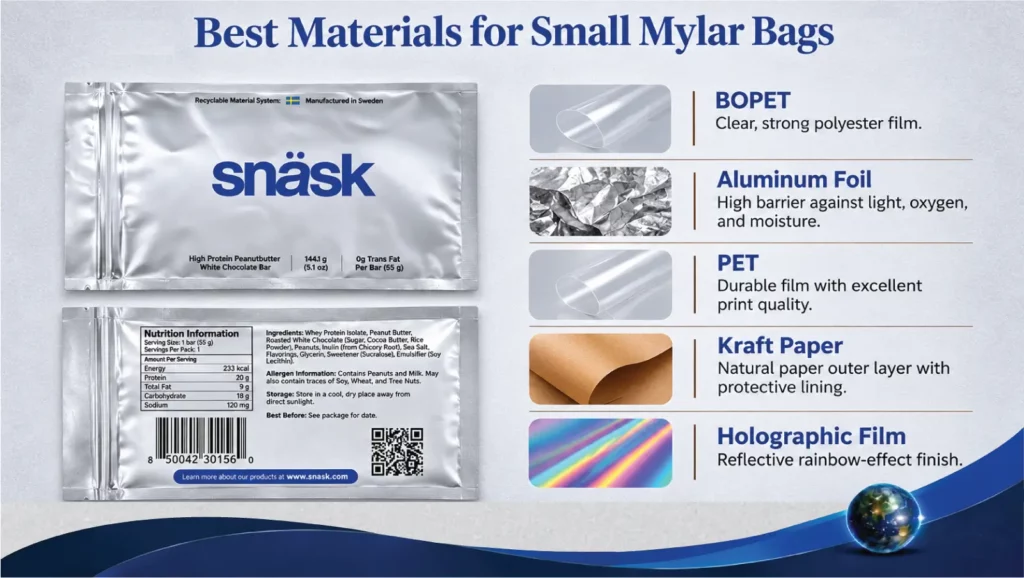
Zack discussed several materials with Oliver to explain their characteristics. The comparison focused on moisture resistance, oxygen protection, light protection, suitability for lamination, durability and printing requirements. Each material was judged on how well it could contribute to the Best Materials for Small Mylar Bags.
1. BOPP Film
Packaging Expert began the discussion with BOPP, pointing out that Biaxially Oriented Polypropylene was already familiar to Oliver from other flexible packaging. He explained that its good moisture resistance, smooth printing surface and lightweight structure made it attractive. However, the laboratory results showed that its oxygen protection was limited, so Zack told Oliver that an additional barrier layer would be needed for stronger protection. After reviewing the results together, they agreed not to use BOPP as the standalone barrier material, although it remained part of the wider discussion on the Best Materials for Small Mylar Bags.
2. Metallized PET
Next, Zack introduced metallized PET and showed Oliver samples with a thin aluminium coating deposited on the surface. During the discussion, he noted that the test results showed improved moisture and oxygen barriers compared with ordinary PET, along with reduced light transmission and a reflective appearance. He also warned Oliver that the performance depended on the quality of the metallization and the complete laminate. Metallized PET proved to be a strong option among the Best Materials for Small Mylar Bags, but Oliver preferred the stronger overall protection of foil. Zack then showed him Die Cut Mylar Bags and their customised shapes, which offered distinctive packaging and improved shelf appeal.
3. PET Film
Packaging Expert then turned to PET film and walked Oliver through its handling and printing performance. During the conversion trials, PET showed good mechanical strength, stable dimensions and a suitable surface for high-quality graphics, and it coped well with everyday handling. Zack explained that it was commonly used as the outer printing layer in laminated pouches. However, the barrier tests showed that ordinary PET alone could not deliver the high barriers Snäsk required, so Oliver agreed that an additional barrier layer was necessary. PET therefore earned its place among the best materials for small mylar bags as the printed outer layer rather than as the barrier.
4. Aluminium Foil
Zack presented aluminium foil, and the test results made the strongest impression on Oliver. The samples showed excellent protection against moisture, oxygen and light, provided the foil layer remained intact. Zack explained that the foil would need lamination with appropriate outer and inner films to protect it and make the pouch sealable. Satisfied with the results, Oliver selected aluminium foil as the barrier layer, making it central to the best materials for small mylar bags for Snäsk. Zack also examined Mylar Bags DIY and their customisable design options, which resulted in creative packaging with a personalised appearance.
“My motto is strong packaging, clear addressing.” — Halldór Laxness
Comparison of the Best Materials for Small Mylar Bags at a Glance
| Material | Advantages | Limitations |
| BOPP Film | Good moisture resistance, smooth printing surface and lightweight structure. | Additional barrier layers was generally needed for stronger oxygen protection. |
| PET Film | Good mechanical strength, dimensional stability, printability and resistance to everyday handling. | Commonly used as the outer printing layer; needs a barrier layer for high protection. |
| Metallized PET | Improved moisture and oxygen barriers, reduced light transmission and a reflective appearance. | Performance depends on the quality of metallization and the complete laminate. |
| Aluminium Foil | Excellent moisture and oxygen barriers with almost complete light protection when intact. | Requires lamination with suitable outer and inner films. |
Final Recommendation by Zack Brown: A Foil-Based High-Barrier Laminate
After comparing the materials, and in line with Oliver’s choice of foil, Zack recommended a laminate with a PET outer printing layer, an aluminium foil middle layer and a food-grade PE inner sealing layer. PET was selected for printing quality, strength and dimensional stability. Aluminium foil was chosen for its excellent protection against moisture, oxygen and light, and PE was chosen for reliable heat sealing. This three-layer structure was Zack’s central recommendation among the best materials for small mylar bags for the brand. Explore Custom Printed Mylar Bags and their high-quality printing finishes, resulting in attractive graphics.
Additional Suggestions From the Packaging Expert
Zack discussed improvements beyond the foil laminate. These included reliable heat sealing to prevent leakage, and he recommended a blurred transparent window on the backside of the silver pouch to offer a partial view of the product. The remaining surface was kept opaque to protect the contents from light exposure. A resealable zipper, tear notches, and reliable heat sealing were also discussed. Food-grade PE was specified for the inner contact layer, while accurate dimensions and a clean sealing area were considered essential. These details contributed to better presentation and satisfaction for the customer.
Artwork Preparation With the Universal Packaging Designers
Once the specification was approved, Kevin connected the owner with Justin Daniel, a packaging designer at Universal Packaging. Determining the best material also involved careful artwork preparation. Justin revised the mock-ups, graphics arrangement, colour separation, text positioning and printing registration. He explained how rotogravure and digital printing differ in artwork preparation and production quantities. Pantone references, image resolution, text readability and finish compatibility were reviewed. Explore Printed Stand Up Pouches and their upright structure with custom graphics, resulting in attractive shelf presentation and stronger recognition of the brand.
Approval of the Updated Packaging Requirements by Oliver
After reviewing Zack’s recommendations, Oliver agreed with the proposed foil laminate. The updated requirements included:
- Aluminium foil middle barrier layer.
- Food-grade PE inner sealing layer.
- Suitable moisture, oxygen, and light barrier performance.
- Reliable heat sealing.
- Zipper for resealing.
- Notches for easy tear opening.
- Blurred transparent window on the backside.
Zack explained that the complete laminate needed testing to confirm its suitability. The final selection of the best materials for small mylar bags was therefore based on the required barrier performance, sealing reliability, and expected storage conditions.
Preparing the Foil Mylar Bag Mock-Ups with Zack Recommendation
The sampling stage was arranged to examine the proposed structure and to confirm that it met the agreed requirements. It also gave a practical view of how the best materials for small mylar bags behave during printing and pouch formation.
-
Preparation of the PET Film:
The outer PET film was examined for thickness, surface quality and suitability for the selected printing process, to support reliable ink adhesion and consistent reproduction of the approved artwork.
-
Gravure Printing:
Engraved cylinders transferred the selected ink colours onto the PET film according to the approved artwork. Registration marks, colour consistency and alignment were checked before the next stage.
-
Lamination:
The printed PET layer was bonded with the aluminium foil and the food-grade PE inner layer. Adhesive application and bonding conditions were reviewed to achieve consistent adhesion between all three layers.
-
Formation of the Pouch:
A pouch-making machine converted the laminated roll into small bag samples with the required dimensions. The process was examined for accurate cutting, alignment, and consistency of shape.
-
Zipper and Heat Sealing:
A suitable zipper was fitted near the opening for resealing. Heat-sealing conditions were adjusted for the PE inner layer, with attention to seal consistency and prevention of leakage. Compare Ziplock Mylar Bags and their resealable closures, resulting in convenient repeated access and better product freshness.
-
Inspection of the Sample:
The finished samples were checked for printing alignment, dimensions, wrinkles, lamination quality and sealing consistency. The zipper, tear notches, and overall appearance were also reviewed before the samples were presented for approval. Consider Smell Proof Mylar Bags and their odour-barrier construction, resulting in discreet storage and improved odour control.
Universal Packaging Launches Advanced Gravure Printing
The usage of Gravure Printing seems suitable to cover up these demands. But now, Danial James expanded its Canadian gravure printing operations with the CERUFLEX 500 in 2026. Earlier equipment included the BOBST NOVA RS 5002 in 2024 and the previous CERUFLEX gravure models in 2025. The latest model features printing speeds of up to 500 metres per minute, shaftless cylinders, intelligent inking, and fast job changeovers.
Additional printing equipment includes Uteco ONYX and Comexi FW, while a location in Mississauga is planned soon according to operational requirements. For more high-quality printing with today’s market demands, this approach to that advanced machinery is on peak. Danial James, Managing Director of Universal Packaging, says, “Advanced printing technology strengthens our commitment to consistent colour reproduction, reliable print quality, and meeting the changing packaging requirements of our customers.”
Additional Quality Checks by Packaging Expert
During sampling, the team paid particular attention to lamination consistency and the performance of the complete barrier structure, because the best materials for small mylar bags also determine the level of protection of the finished laminate. Zack arranged additional checks:
- The thickness of the film and complete laminate was measured with a digital gauge.
- OTR testing examined oxygen transmission, and WVTR testing measured moisture transmission.
- Bonding between the layers was tested.
- A seal strength tester checked heat-seal performance.
- OTR and WVTR results were interpreted according to the relevant temperature and humidity conditions.
Final Approval of the Sample and Six-Month Follow-Up
After the additional checks, the revised mock-up was reviewed again. Oliver examined the zipper, tear notches, dimensions and printed information before approving the design. A six-month follow-up was planned to compare stored samples against the initial product quality, focusing on texture, flavour, moisture levels, laminate condition and heat-seal integrity. This follow-up will also provide a practical way to evaluate the best materials for small mylar bags over the expected storage period. The results will show whether the agreed barrier requirements continue to be met throughout storage. Contact the experts at Universal Packaging to get the right solution for your brand.
Creating Distinctive Artwork for the Brand
Oliver benefited from packaging expert guidance and gained a clearer understanding of suitable materials for its doypack pouches. However, the discussion also raised another demand: better design printed for a different product. Choosing the right design with a string material became the next important consideration among 10 valuable packaging insights. Zack explained that another Canadian brand had faced a similar challenge with moisture protection. He, with the experinece of 10 years gives the guidance on selecting suitable materials to maintain product quality during storage. Read More
Conclusion
Choosing the best materials for small mylar bags requires careful consideration of moisture resistance, oxygen protection, light protection, sealing performance, and durability. For Snäsk, Zack Brown recommended a PET outer layer, an aluminium foil barrier layer and a food-grade PE inner layer, matching Oliver choice of foil. Metallized PET and BOPP were reviewed, but neither offered the same combined protection against moisture, oxygen and light. Testing, sealing checks and a six-month follow-up were added so that the structure is confirmed in practice and not only on paper. Inspired by the packaging journey of Snäsk? Your brand can also benefit from custom packaging with free design support, affordable pricing and solutions selected according to your product requirements.