The client came in with a clear demand: flexo printing for his laminated frozen-food pouches. That request was heard on the first day of a client visit, yet the outcome between Gravure Printing Vs Fexo was very different. The client was the owner of a frozen-food manufacturer in Mississauga, Ontario, and a new line of salt and vinegar potato frozen products was planned for retail shelves. However, the artwork was reviewed first, and the monthly pouch volume was asked about. In this blog, the customer demand, the suggestions made, the side-by-side test, the eco-friendly choices, and the lessons for choosing the right method are shared. So let’s explore the full journey!
Client Demand: Just Apply Flexo Printing
The client and his first request are introduced, along with the reason why flexo was chosen at the start. Because a tight budget was set, flexo was requested, as it was believed to be cheaper. Everything began with flexo, and the first stage of gravure printing vs flexo is described below.
Who the Client Was and What He Wanted?
The client was the owner of Delissitude Gluten Free Perogies, a mid-sized frozen-food manufacturer in Mississauga, Ontario, producing frozen potato chips, popcorn, and puffed frozen foods. About 300,000 pouches were expected each month in a laminated structure. His words were direct: “Flexo is what I want. Everyone tells me it is cheaper.” Because strong visibility was needed on crowded freezer shelves, explore Stand Up Pouches designed for strong shelf visibility. Next, the reasons behind his choice are shared.
Why Thought Flexo Was the Right Choice?
First, lower setup costs had been heard about. Second, a press had been used by a friend for a small run of banners. Flexo was also believed to be suitable for every kind of printing job. However, the total cost over twelve months had not been calculated. Find out what was recommended instead next!
Our Recommendation: Apply Gravure Printing Instead Of Flexo
The reasons for the recommendation are shared below in simple points, so the logic behind the difference between flexo and gravure printing is understood.
Why Gravure Was Suggested Instead of Flexo?
Flexo is well suited to printing flexes, posters, and sheets, but it is not suited to flexible packaging. Since flexible packaging was being made, and not flexes, posters, or sheets, gravure was recommended instead of flexo. After the artwork was reviewed, this direction was confirmed. Smooth gradients were included, so high-resolution graphics were needed. Gradients are reproduced smoothly in gravure, and the quality of the print is raised across the pouch. Moreover, colour consistency is maintained across very long runs, and the same printing cylinders are reused for every reorder. As a result, the presentation of the product is improved, and the visibility of the product is increased on the shelf. Discover Flexible Pouches printed for long runs and premium artwork. Next, the eco-friendly side of the recommendation is explained.
Eco-Friendly Inks for a Sustainable Era
A move toward a sustainable era was being made by the client’s business, so eco-friendly inks were requested for the pouches. In gravure, low-VOC inks are used, and solvent recovery systems are installed, so emissions are controlled and solvents are captured for reuse. Waste is reduced in this way, and the requirements of the brand are met without any compromise on the quality of the print.
Eco-friendly inks are also matched with mono-material structures, so recycling is made easier. Design for recycling is followed, de-inking is checked, and post-consumer recycled content is evaluated. Because reverse printing is used, the ink is sealed between the layers, so direct contact between the ink and the food is avoided. For food contact, compliance is checked against the Food and Drugs Act, Section B.23.001 of the Food and Drug Regulations of Health Canada, and the Safe Food for Canadians Regulations, while environmental claims are checked against CAN/CSA-ISO 14021 and the guidance of the Competition Bureau of Canada.
The Difference Between Gravure Printing vs Flexo, Explained
Both methods were explained step by step, so every question was answered before any decision was made.
What Is Gravure Printing (Rotogravure)?
“What exactly is gravure?” he asked. Through cylinder engraving, millions of microscopic cells are formed, and each colour is engraved separately. The process was explained simply: the cylinder is rotated through an ink bath, and the cells are filled; then excess ink is removed with a doctor blade, and finally, during ink transfer, the ink is moved onto BOPP film or PET film. Reverse printing is used on laminated pouches, unlike surface printing, so the durability of the print is increased as the ink is sealed between layers. Learn more about BOPET Packaging solutions selected for strength and stiffness. Next, the other side is explained.
This was the point where gravure printing vs flexo became clearer. The next question was simple: What Is Gravure Printing, and how does the process work on flexible packaging?
What Is Flexo Printing?
“And how is flexo different?” was his next question. A flexo press was shown to him. On it, the image is raised on photopolymer plates, and ink is metered through an anilox roll. Lower plate costs are involved. Moreover, rollstock is printed efficiently, and paper substrates are handled well. Both methods are used in the printing industry, but each is suited to different purposes. Flexo is suited to flexes, posters, and sheets, while gravure is suited to flexible packaging. In flexo, water-based inks are common, while in gravure, low-VOC eco-friendly inks are used along with solvent recovery systems. Before printing, surface treatment such as corona treatment is applied, so ink adhesion is improved. Read on to compare them.
Difference Explained in Simple Words
“So in gravure printing vs flexo, gravure is for long runs, and flexo is for short runs?” he asked.
“Mostly, yes,” was our answer. “The difference is simple. Gravure is for flexible packaging, such as pouches, along with long runs, premium artwork and repeat orders. Flexo is for flexes, posters and sheets, along with short runs and frequent design changes. Since pouches are being made, and not flexes, posters or sheets, gravure is preferred.” Now the problems found in his plan are revealed.
Problems Spotted in the Customer’s Plan During the Gravure Printing vs Flexo Review
Flexo is made for flexes, posters, and sheets, and not for flexible packaging. Three problems were therefore found in his flexo plan, and each one is explained below.
-
Photo and Gradient Quality on His Artwork
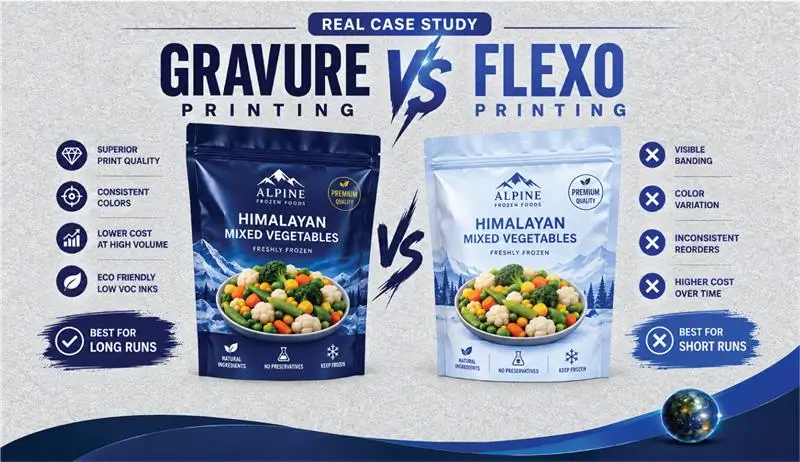
In flexo, fine tonal transitions are harder to reproduce, and visible banding is sometimes seen. Flexo has been improved a great deal; however, smoother tones are still obtained in gravure. Metallic effects are also reproduced with strong brilliance. Colour was the next concern.
-
Colour Consistency Risk on Monthly Reorders
In flexo, plates and settings are prepared again for each job, so small shifts are often noticed between batches. In gravure, the same cylinders are reused, so spot colours and Pantone colours are matched steadily. CMYK printing is kept stable through colour matching, ink viscosity is controlled, and registration accuracy is maintained. This was the point where gravure printing vs flexo became clearer for him. The cost was the last concern.
-
The Real Cost Per Pouch at the Required Volume
A higher upfront cost is involved for gravure. However, at 300,000 pouches per month, the cylinder cost is spread widely. In addition, printing speed is kept steady, while repeated plate replacements and colour corrections are avoided. The cost per pouch was calculated as lower for gravure and higher for flexo, so the long term was valued in the gravure vs flexographic printing comparison. The side-by-side test is described next.
Side-by-Side Test: Gravure Printing vs Flexo on His Own Artwork
Both samples were printed on the same artwork; the results are shown in the table below, and the client’s reaction is shared next.
| Factor | Flexo | Gravure |
| Gradient quality | Good, banding sometimes seen | Excellent, smooth tones |
| Colour variation across batches | 2–5% | 1–3% |
| Cost per pouch at 300,000 pouches | Higher | Lower |
The Moment the Client Changed His Mind
The samples were held by him for a minute: “Is this the same artwork? It is seen as a completely different pack.” The gradient was seen as smooth. After gravure printing vs flexo was seen on his own artwork, the decision was made on the same day, and a gravure order of 300,000 pouches was placed. See what happened after the switch.
Results After Switching to Gravure
After the switch, the results of gravure printing vs flexo were noticed in shelf appeal, colour, and reorders.
-
Better Shelf Appeal
The difference in gloss and sharpness was noticed immediately by retailers. As a result, the perception of the brand was improved, and a more premium product was believed by buyers. See how Shaped Bags are used to stand out on the shelf. Next, the colour results are described.
-
Consistent Colour Across Batches
The same colour was maintained across every batch. The reputation of the brand was protected, and trust was built. Read on for the effect on reorders.
-
Faster Reorders and Lower Long-Term Cost
Because the cylinders were already prepared, reorders were started without new preparation, and delivery was completed in 15 days. The lessons for your own project are listed next.
Clear Idea for Your Brand: Is Gravure Right in Gravure Printing vs Flexo?
These lessons are used to choose the right method, so the same mistake is avoided in your packaging project.
When Gravure Is the Smarter Choice
In Gravure Printing vs Flexo, gravure is preferred for flexible packaging when monthly volumes are high (200,000 to 300,000+ pouches), when premium photography or gradients are included, and when identical colour is needed in every batch. Moreover, laminated structures with a PE film sealing layer are used for food packaging. Have a look at these Gusseted Bags chosen for larger fill volumes. However, a place is still kept for flexo, as explained next.
When Flexo Still Makes Sense
In Gravure Printing vs Flexo, flexo is preferred for flexible packaging, posters, and sheets, particularly for short runs, frequent design changes, and simple artwork. Custom Sticker Mylar Bags are also suitable for flexo printing when sticker-style graphics are needed for small-batch runs. Tactile finishes are added within a limited budget.
Other Demands After Printing
After printing, more demands were raised by the client, and extra features and finishes were added to the pouches. The following features were selected:
- Resealable zipper: A resealable zipper was added, so freshness is maintained after opening.
- Tear notches: Tear notches were included for easy opening.
- Matte finish with spot gloss: A matte finish with spot gloss was selected for a premium look.
- Clear window: A clear window was placed, so the frozen chips were seen by buyers.
- English and French labelling: Space for English and French labelling was planned, so the pouches were prepared for Canadian retail shelves.
- Metallic effects on the logo: Metallic effects were kept on the logo, so attention was drawn on the shelf.
Each feature was confirmed on the sample before the final order was placed.
Final Result and Review of the Customer
When the first printed pouches were delivered, the customer was shocked. Within 6 months, the perception of the brand was improved among retailers, shelf appeal was raised, and reorders were placed with confidence. Progress toward upcoming sustainable demands was also made, because eco-friendly inks were used and mono-material structures were planned for the next run. In gravure printing vs flexo, the decision was called by him the best step taken for the business.
Conclusion
All of this has been covered in a different style, from a client story and a side-by-side test to reorder results. Each point is explained clearly for a confident decision. As a result, it is shown that in gravure printing vs flexo, flexo is preferred for flexes, posters, sheets, short runs and frequent changes, while gravure is preferred for flexible packaging, long runs, premium artwork and repeat orders. The decision is best made after the artwork, volume, and budget are reviewed together. Read the answers below to clear the last doubts. Looking for Custom Packaging Vancouver for your next packaging project? Get flexible packaging options matched to your artwork, volume, and printing requirements. Ready to discuss your project? Contact Now.
Frequently Asked Questions (FAQs)
What is the difference between gravure and flexo printing?
In gravure, the design is engraved into a metal cylinder, and ink is held in tiny cells. In flexo, the design is raised on a flexible plate, and ink is applied to the film. As a result, a different look, cost, and run length are associated with each method.
For my packaging, gravure printing or flexo printing which is better?
For flexible packaging, long runs, and laminated films, gravure is usually preferred. For flexes, posters, sheets, short runs, and frequent changes, flexo is usually preferred. The final choice is made after the volume and the artwork are reviewed together.
Is gravure more expensive than flexo?
A higher upfront cost is involved because cylinders must be engraved. At high volumes, however, that cost is spread widely, and a lower cost per pouch is often reached. In gravure printing vs flexo , the monthly volume is therefore the main factor to be reviewed.
Which method is associated with more consistent colour?
More consistent colour over very long runs is generally achieved in gravure, because the same cylinders are reused. In flexo, the results are influenced more by the press and the operator, so small shifts are sometimes noticed.
What minimum quantity is recommended for gravure?
A minimum run of about 5,000 metres is recommended, so that the cylinder cost is spread properly. A lower cost per pouch is then reached across the full order.
Which products are suited to gravure?
Frozen foods, biscuits, tea, spices, and frozen food are commonly packed in gravure printed pouches. Check out Smell Proof Bags offered for aroma control.
Are samples offered before the order is placed?
Yes, a side-by-side sample is offered on request. Both methods are printed on the same artwork, so the difference is seen clearly before the decision is made.
Where to buy gravure printed pouches?
Gravure printed pouches are offered by Universal Packaging, where custom sizes and finishes are provided. The order is guided from artwork to delivery, and a free sample is arranged on request.