Why do some coffee cups get remembered while others get forgotten within seconds of being thrown away? The answer often lies in one small, easily overlooked option of packaging that is closest to the customer’s hand and that is fully designed custom sleeves. In this guide on how to design custom paper sleeves for branding, every detail from material to Canadian compliance numbers is broken down step by step. The full result behind how to design custom paper sleeves for branding, starting with material choices. First, let’s have a quick overview of what we read in that blog is discussed below:
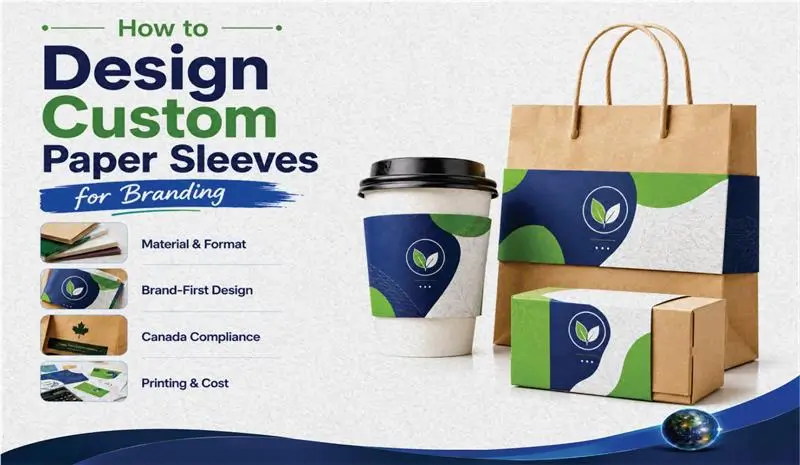
A Quick Look Before Diving In
- Material First: kraft paper, paperboard, and cardstock are weighed before any design work begins.
- Design Rules: contrast, colour count, and seam placement are treated as the design foundation.
- Logo Priority: brand name and logo are given top visual weight over decorative elements.
- Canada Compliance: SOR/2022-138 and other Canadian standards are checked before packaging materials are finalized.
- Printing Method: digital or offset printing is chosen based on order volume and budget.
- Cost Drivers: ink colours, finish, and volume are what move pricing up or down.
- Final Step: everything above is tied together before a supplier is approached for production.
“Customers will occasionally buy products not because they want them but because of how they are presented to them.” — James Clear
Choosing Sleeve Material And Format
The first step in designing custom paper sleeves for branding is choosing the right material and format. Kraft Paper Coffee Sleeves are popular because they create a natural and simple look. Brown kraft paper is often used for eco-friendly branding, while white kraft paper gives products a cleaner and more premium appearance. Paperboard and cardstock are better for heavier products or gift packaging because they provide extra strength. Recycled and FSC-certified paper are suitable for brands that want to highlight responsible sourcing.
Die-cut packaging can also be used to create unique shapes for cups, bags, or boxes. Paper weight and thickness must be selected carefully because thin paper may lose its shape, while overly thick paper can increase costs. Different benefits are associated with Kraft Paper Sleeves Packaging, cardstock, recycled stock, and coated paperboard, which may make material selection difficult. Before the stock for a packaging project is finalized, our complete guide to the Best Materials for Custom Packaging Sleeves should be reviewed for a detailed comparison of durability, print quality, sustainability, and cost.
Custom Paper Sleeve Design Principles
Once material is finalized, custom sleeve design moves to the centre of attention, and this is where how to design Custom Gift Card Sleeves for branding truly takes shape. At this stage, packaging design decisions are guided by four core principles, each addressing a different aspect of how a sleeve is perceived.
-
High Contrast For Visibility
A sleeve is usually seen in motion or from a distance, for example, when Coffee Cup Sleeves are carried down a busy street. For this reason, bold contrast is favoured over subtle gradients, since visibility of the product is improved through stronger colour separation rather than soft tones.
-
Minimal Color Count For Cost
Fewer ink colours are recommended, particularly for small or mid-size print runs, because printing costs are reduced when a limited palette is maintained rather than a full-spectrum design.
-
Avoiding Seam And Fold Distortion
Important text and logo are kept away from the seam, glue tab, or wrap-around curve of a sleeve, since distortion is caused in those zones once the sleeve is wrapped around its final shape. A packaging dieline is typically requested from the printer beforehand so these zones are clearly marked.
-
Consistent Brand Design
Colours, fonts, and logo lockups are matched across all packaging so that a single sleeve is recognized as part of a larger, cohesive system rather than a standalone item. Similarly, brand colours and Pantone colour matching are relied upon so that the same shade is reproduced accurately across every print run.
Now that the core design principles behind how to design custom paper sleeves for branding are laid out, the next question naturally becomes: where exactly should the logo sit, and what content matters most? That is answered next.
Logo Placement And Content Hierarchy
Content on a sleeve is not placed randomly; a clear hierarchy is followed, and this hierarchy is one of the most overlooked steps in how to design custom paper sleeves for branding, so that the most important information is seen first.
- Primary Focus: the logo or brand name is given the most visual weight and is positioned where it remains visible once a product is held or displayed, rather than hidden along a seam.
- Secondary Message: a short tagline or value proposition is added underneath the logo when extra context is needed, though this is kept optional depending on space.
- Functional Details: ingredients, care instructions, or a QR code printing element are placed lower on the sleeve, since this information is referenced only when needed rather than at first glance.
- Background Layer: decorative patterns or textures are treated as the lowest priority, so that visibility of the product itself is never competed with.
A well-structured hierarchy makes sure a customer’s eye is guided naturally from brand recognition down to functional detail. For compact branded packaging, view Kraft Paper Gift Card Sleeves for a refined presentation.
Sleeve Printing And Production Tips
Production is where every earlier decision in how to design custom paper sleeves for branding is finally tested against reality. Firstly, a die-line template is requested from the printer before final artwork is submitted, since folds, seams, and glue tabs are shown precisely on this template.
- Printing Method: digital printing is generally selected for smaller batches, whereas offset printing is chosen once larger volumes are involved, since cost per unit is lowered at scale.
- Finish Selection: a matte finish is often preferred for an understated, premium look, while a gloss finish is chosen when colours need to appear sharper and more vibrant.
- Premium Add-Ons: embossing, foil stamping, and spot UV coating are used sparingly on Food Sleeve Packaging and similar formats, since these techniques are reserved for elements that need extra emphasis, such as a logo.
- Ink Choice: water-based inks are increasingly requested, since environmental compliance is easier to demonstrate when these inks are used instead of solvent-based alternatives.
Print-ready artwork, correct paper thickness, and custom sizes are all confirmed with the supplier before a full run is committed to, since a physical proof is far more reliable than a digital mockup alone.
Canada Packaging Regulations And Certifications
Compliance should be considered early when designing custom paper sleeves for branding, especially for products sold in Canada. Kraft paper sleeves and food-related packaging in Canada are expected to comply with applicable requirements under the Safe Food for Canadians Regulations (SFCR), SOR/2018-108, and the Food and Drug Regulations (FDR), C.R.C., c. 870. The SFCR establishes requirements related to food safety, packaging suitability, and preventive controls, while Health Canada oversees the safety assessment of materials that come into contact with food.
The Consumer Packaging and Labelling Act (CPLA) and Consumer Packaging and Labelling Regulations (CPLR) establish requirements for accurate product information and bilingual labelling. Commonly adopted quality and safety certifications include ISO 22000:2018, BRCGS Packaging Materials Standard, HACCP-based food safety systems, and ISO 9001:2015. For recyclable paper and plastic packaging materials, applicable recycling identification and sustainability standards may also be followed where relevant.
Custom Sleeve Printing Cost Breakdown
The final piece of how to design custom paper sleeves for branding, is influenced by several interconnected factors rather than a single variable.
- Material Cost: kraft paper sleeve packaging is generally priced lower than coated or laminated stock, since fewer processing steps are involved.
- Print Complexity: costs are increased whenever multiple ink colours, foil stamping, or embossing are added, whereas a simple one-colour design keeps costs contained.
- Order Volume: unit pricing is reduced significantly at higher volumes, particularly once offset printing thresholds are reached rather than smaller digital runs.
- Finishing And Coating: additional charges are applied when a gloss finish, spot UV coating, or die-cut packaging shape is requested, compared to a standard rectangular sleeve.
A realistic budget is built by weighing material, print complexity, and finish together, rather than focusing on any single line item in isolation. For affordable Custom Packaging For Small Companies, contact experts now for a personalized solution.
Conculsion
Custom paper sleeves are designed and resulting a lasting impression when material selection, design, printing quality, and Canadian packaging requirements are considered together. Moreover, careful planning throughout each stage strengthens the presentation of the product and the reputation of the brand, while production costs are minimized through proper preparation. A professional appearance is achieved through a well-designed sleeve, and customer satisfaction is supported through consistent printing quality, durable materials, and reliable manufacturing standards.
Frequently Asked Questions (FAQs)
What are custom paper sleeves used for?
Custom paper sleeves are used to wrap around cups, bags, bottles, or boxes, giving a plain package a branded, recognizable look, which is the core idea behind how to design custom paper sleeves for branding.
Is kraft paper the best material for branded paper sleeves?
Kraft paper is widely preferred for its natural look and lower cost, though coated paperboard is chosen instead when a more premium finish is needed.
Can sleeve designs be fully personalized for a business?
Yes, sleeve designs are fully personalized, including size, colour, finish, and logo placement, so that specific needs of the brand are met.
What is the ideal paper weight for a sleeve?
Paper weight is typically selected based on the product being wrapped, with heavier gsm chosen for hot beverages and lighter options used for retail packaging.
Are eco-friendly and compostable sleeve options offered?
Yes, eco-friendly packaging options, including recyclable packaging and compostable packaging, are available and certified under standards such as ASTM D6400.
Can a QR code be added to a custom sleeve?
Yes, QR code printing is commonly added to sleeves, linking customers directly to a website, menu, or loyalty program.
What is the minimum order quantity for custom sleeves?
Minimum order quantities vary by supplier and printing method, with digital printing generally allowing smaller runs than offset printing.
Where can custom paper sleeves be bought?
Custom paper sleeves are supplied by Universal Packaging, where material, size, and finish are tailored according to individual project requirements, rounding out this complete look at how to design custom paper sleeves for branding.