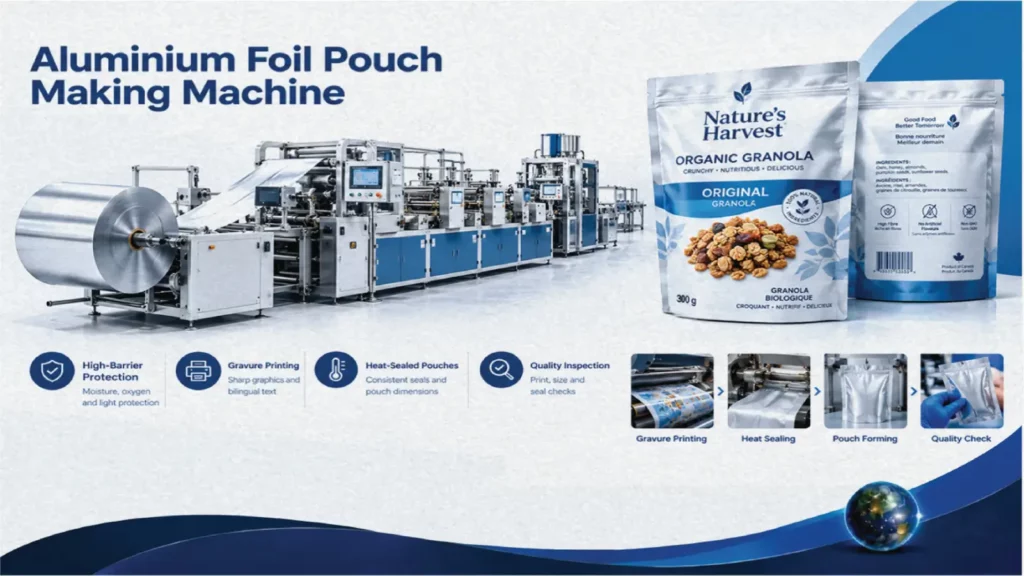
A pouch containing the client’s products is expected to preserve freshness and crispness for weeks on the shelf, making moisture protection and reliable seals essential. The client, a Montreal-based granola brand owner, discussed product protection, seal integrity, and bilingual packaging information with the team at Universal Packaging. Based on these priorities, aluminium foil laminated pouches were recommended, with suitable sealing specifications and space. After discussing the recommendations and the client’s preferences, the team demonstrated the working of an aluminium foil pouch making machine and prepared an initial sample for the client’s review. In this blog, the complete process is explained, from the client’s packaging challenges and recommended solutions to machine operation, printing, quality checks, and recycling.
Client Story: Packaging Need for a New Product Range
The client’s products were baked in Montreal and intended for sale in 300 g pouches across Canada. Knowledge of food packaging pouch production was limited. Because the products are sensitive to moisture and oxygen, high-barrier flexible packaging was needed to preserve their freshness and protect the reputation of the brand. Therefore, the choice of an aluminium foil pouch making machine was considered important.
Packaging Challenges Faced by the Client
The client faced packaging challenges, including poor protection, material waste, sealing issues, and low production efficiency.
Protection from Moisture, Oxygen, and Light
Protection of the client’s products was needed, and aluminium foil laminated film was reviewed by the team. As with other moisture-sensitive products, a complete barrier was required before the aluminium foil pouch making machine was discussed.
High Production Costs and Material Waste
Labour costs were raised by manual pouch making, so material waste reduction and trim recycling were planned, and an aluminium foil pouch making machine with automatic control was preferred.
Poor Printing Quality on Packaging
Clear logo, bilingual text, and the colour of the brand were expected on every pouch. Blurred text was noticed on trial pouches, so custom printed flexible packaging was looked for.
Inconsistent Pouch Sealing and Dimensions
Weak seals and uneven sizes were noticed in some samples. Therefore, the pouch dimensions and web width were measured again, and seal strength and leak testing were planned for every batch.
Large-Scale Production Efficiency
The pouch production speed (bags/min) was compared with quick changeover and low downtime, because several flavours were planned and a fast aluminium foil pouch making machine was required.
Solution Suggested: Aluminium Foil Pouch with Gravure Printing
An aluminium foil pouch with gravure printing was suggested to the client. The complete aluminium foil pouch production was planned around a PET/AL/PE multilayer structure, with a printed PET outer layer, an aluminium foil barrier, and a polyethylene heat-sealable inner layer. A comparison of metallized film vs aluminium foil was shared with the client. For cost, BOPP and CPP laminates were reviewed, and for puncture strength, PA barrier film was reviewed, but foil was finalized. Hence, the right aluminium foil pouch making machine was matched with this structure. Explore BOPET Flexible Packaging, which was chosen by another client for dry snacks.
What Is an Aluminium Foil Pouch Making Machine?
An aluminium foil pouch making machine is a converting line by which laminated roll stock is turned into finished pouches. In three-side seal pouch making, the film is folded and sealed on three edges, while four-side seal pouches are formed from two separate webs. For large orders, an automatic foil pouch making machine is preferred, as foil pouch manufacturing equipment of this type is operated with less labour and waste. For flat granola sachets and compact food packs, a 3 Side Seal Pouch Making Machine is worth exploring to understand how three sealed edges provide a compact pouch format for portion-controlled products.
Step-by-Step Process of Aluminium Foil Pouch Making Machine
The working of the aluminium foil pouch making machine was demonstrated to the client, with each production stage explained from film feeding to final pouch finishing.
Step 1: Film Roll Loading and Servo Feeding
The PET film roll is loaded onto the unwinding section of the aluminium foil pouch making machine. Servo motor film feeding maintains smooth film movement, while the tension control system helps prevent wrinkles and automatic web guiding keeps the film aligned.
Step 2: Printing Registration and Alignment
The position of the printed artwork is detected by a photoelectric registration sensor. Accurate film alignment helps maintain the correct placement of logo, product details, and bilingual text throughout production.
Step 3: Aluminium Foil Lamination and Barrier Formation
The PET film, aluminium foil, and polyethylene (PE) layers are combined to form the planned PET/AL/PE structure. The aluminium foil layer acts as a barrier against moisture, oxygen, and light, while the outer PET layer supports printing and the inner PE layer supports heat sealing.
Step 4: Pouch Forming and Bottom Gusset Creation
The laminated film is shaped according to the selected pouch format. During aluminium foil pouch forming, the bottom gusset is formed for stand-up pouches when this design is selected, while flat pouch structures are formed according to the client’s specifications.
Step 5: Zipper Application and Heat Sealing
The aluminium foil pouch making machine process includes zipper application and heat sealing for resealable packaging. The zipper is applied using compatible zipper-insertion equipment, while heat-sealing temperature and related settings are adjusted to form secure seals and maintain the integrity of the pouch structure.
Step 6: Tear Notch, Hole Punching, and Custom Shaping
The aluminium foil pouch making machine process includes tear notch punching, euro hole punching, handle holes, and custom shaping according to the pouch design. Die cutting creates specific outlines, while seal strength, print alignment, dimensions, and leakage are checked for quality.
Step 7: Final Sealing and Quality Inspection
The final seals are completed using compatible pouch-sealing equipment. Pouch dimensions, print alignment, seal strength, and leakage are checked to assess the consistency of the finished packaging.
Explore Gusseted Resealable Bags, where a client with flat, unstable coffee pouches was introduced to gusseted zip lock pouches, and a stable shelf display was achieved.
First Sample Prepared for Foil Pouch Packaging
After the working of the machine was seen, the first sample was prepared from the artwork supplied by the client. The size, seal, zipper, and window were checked by the client, and the same quality was confirmed on the aluminium foil pouch making machine. Learn more about Custom Stand Up Pouches With Window, as a client arrived with a flat pouch that did not stand on the shelf, so a stand up pouch with a window was suggested.
Role of Gravure Printing on Aluminium Foil Pouches
The role of gravure printing was proven in the first sample, as sharp logo, rich colours, and clear bilingual text were obtained on the foil. Fine details such as small ingredient lines, the granola illustration, and the brand tagline were reproduced cleanly, and no blurring was seen even at small font sizes. Because the artwork is engraved on a cylinder, the same result is repeated across thousands of pouches, so the look of the brand stays consistent from the first batch to the last. The print was registered with the seals and cuts of the aluminium foil pouch making machine, so the presentation of the product was kept neat. Colours were matched against the brand reference, and the French and English text was placed in balanced panels so that both languages could be read easily on the shelf.
Explore Gravure Printed Packages, where a tea brand wanted smooth colour blends, and the cylinder was engraved according to the artwork.
Eco-Friendly Inks for Foil Pouch Printing
solvents during printing, so the working environment is kept cleaner, and the printed layer stays sealed inside the laminate, away from direct contact with the food. A packaging recyclability assessment was also carried out, as foil laminate recycling challenges are well known. Therefore, design for recycling guidelines were reviewed, and mono-material alternative laminates were discussed for future ranges. The client was also informed about how structure, thickness, and barrier needs affect the recycling options available for each pouch. In the factory, post-industrial film scrap recovery is practised, and energy-efficient pouch converting is preferred while an aluminium foil pouch making machine is selected. Trim waste is collected during slitting and cutting, so less material is sent to landfill. Programs under extended producer responsibility (EPR) are also required in several provinces of Canada, so the brand was guided to plan its packaging with these rules in mind.
Learn more about Flexible Kraft Pouches, where a client wanting a natural look for dried fruit was offered kraft pouches with an inner barrier layer.
Quality Checks for Sealing, Size, and Strength of Pouches
The pouches were reviewed for the following points.
- Food-Contact Compliance: Checked under the Food and Drugs Act.
- Bilingual Labelling: Checked under the Safe Food for Canadians Regulations.
- Seal Strength: Every batch was inspected to identify weak edges before dispatch.
- Leak Testing: Filled and empty samples were checked for air leaks, and defective pouches were rejected.
- Dimensions of Pouch: Length, width, and gusset depth were measured against the approved drawing.
- Zipper and Tear Notch: Checked for smooth opening and closing.
- Print Registration and Colour: Reviewed under light and compared with the approved sample.
- Machine Consistency and Records: Consistent results were recorded on the aluminium foil pouch making machine, and test records were retained for future orders.
Explore Custom Smell Proof Bags With Your Logo, where a client with strongly scented herbal tea needed the odour locked in, so a barrier film with a zip lock was suggested.
Final Result: One Complete Packaging Solution
Everything that was wanted by the client, from protection to printing to consistent sealing, was found in one solution. The granola was protected from moisture, oxygen, and light, so crispness and flavour were kept for a longer time. The reputation of the brand was strengthened on the shelf, and the perception of the brand was improved through the clear presentation of the product. Sharp bilingual printing helped customers across Canada to read the information easily, and the stand-up shape kept the pouches neat on the display. Material waste and labour effort were also reduced, so the production of new flavours could be planned with confidence. Trust in the process was built when the working of the aluminium foil pouch making machine was seen by the client, as every step from film feeding to final sealing was explained clearly. Explore Shape Bag, where a client wanting a leaf-shaped pouch for a tea range was shown a die cut sample, and the same line was used for production.
Looking for a reliable packaging solution for your next product launch? Explore Custom Packaging Solutions Companies to discuss material options, printing requirements, and pouch specifications according to your needs. Contact us today to discuss your packaging project and request a quote.
Benefits of Using an Aluminium Foil Pouch Making Machine
Consistent quality, less waste, and lower labour costs are obtained when an aluminium foil pouch making machine is used. Automatic control keeps the pouch size, seal width, and cutting position the same from one pouch to the next, so fewer rejected pieces are produced. Higher speed and quick changeover help brands that run several flavours or sizes, as downtime between orders is reduced. For coffee and tea foil pouches, aroma is locked in, and for snack and dry food packaging, crispness is kept longer. The same barrier structure also protects supplements, spices, and dried fruit from humidity and light. Also, pet food packaging pouches are produced on the same line, so one machine can serve many product categories. Over time, lower waste, steady output, and longer shelf life make the whole process more cost effective for growing brands.
Conclusion
In this blog, we covered the journey of a Canadian granola brand, from the challenges to the final pouch that was placed on the shelf. A reliable solution was found when the working of an aluminium foil pouch making machine was seen and the first sample was prepared. Protection of the product, sharp gravure printing, strong seals, and consistent pouch sizes were obtained in one solution. The same approach is offered to other businesses that need packaging, and the requirements of the brand are discussed before every order is started.
Frequently Asked Questions (FAQs)
What is an aluminium foil pouch making machine used for?
It is used to turn laminated film into finished pouches. Granola, coffee, and tea are packed in them.
How are pouch making machine price and specifications decided?
Both are decided by pouch size, speed, and features. A quotation is shared after the requirements are discussed.
Why is an aluminium foil pouch making machine manufacturer with strong support preferred?
Downtime is reduced when after-sales service and spare parts are offered quickly. Test samples are also shared before ordering.
Is pharmaceutical foil packaging possible?
Yes, moisture and light are blocked completely by foil, so medicines are protected. Requirements are checked according to local rules.
Are small sachets for creams made?
Yes, cosmetic sample sachets are formed in small sizes, and creams are protected from air. Printing of the brand is also personalized.
What materials are used in foil pouches?
Layers of PET, aluminium, and polyethylene are laminated together. Moisture, oxygen, and light are blocked by this structure.
Which pouch styles are made?
Flat, stand up, and zip-lock pouches are produced. The size and shape are set according to the order.
How soon is the first sample prepared?
The timing is decided by approval of the artwork. A first sample is shared soon after the artwork is confirmed.
Is gravure printing suitable for small orders?
Gravure printing is preferred for large runs, as cylinders are engraved once. For small runs, screen and UV printing is also discussed.
Are foil pouches safe for food?
Yes, food-safe materials are used, and the pouches are reviewed according to Health Canada rules. Seals are also tested before dispatch.