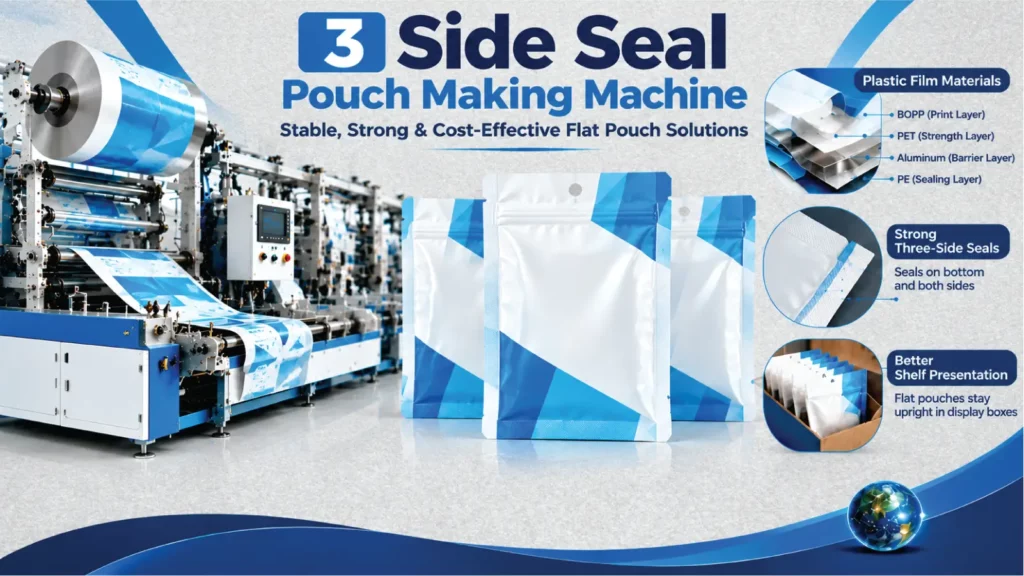
Shelf appeal is lost in seconds when wrinkled pouches and uneven corners are noticed by shoppers. In this 3 Side Seal Pouch Making Machine blog, a client was met by our team, and creasing, wrinkles, and uneven corners were being faced when 2 side seal pouches were filled, due to which the presentation of the product was affected. To resolve these issues, 3 side seal pouches were recommended by our packaging experts. The complete manufacturing process was also demonstrated, from raw film rolls to finished packaging. Our experts took a different approach: they showed the machine live and demonstrated the full journey from the film roll to the finished pouch. In this blog, the problem, the process, the materials, the printing, and the results are explained.
Client Background & Requirement
The client needed flat packaging with a fixed shape for its products displayed in retail boxes. The existing pouch format was not meeting this requirement.
Metal Product Requirements of Packaging
The metal products of the client are sold in printed pouches that are placed in display boxes, so a stable position is demanded at all times, and the reputation of the brand is weakened whenever pouches are found lying down. This 3 side seal pouch making machine guide began with repeated complaints from the shelves.
Existing 2-seal Pouch Setup
A 2 seal stand-up pouch with a bottom gusset was being used by the client. After the metal product was filled, the weight was shifted to the front and the back, and the bottom was folded forward. Before the meeting, Stand Up Pouches Custom Printed had been chosen because the format was believed to be the best option for shelves.
Request for Flat Pouches with Strong Seals
A flat style with strong seals was requested by the client. It was admitted that three-side-seal pouch manufacturing was not known before the meeting, so the format was explained by our team in simple words. Safe closure was also asked about, so Childproof Bags were discussed for items that must be kept away from children.
Packaging Problems the Client Faced
The existing packaging struggled to maintain an upright position inside retail display boxes, with the bottom bending under the weight of the metal products.
Without Seal Bottom Failing to Maintain an Upright Shape
The bottom gusset did not retain its shape under the weight of the metal products, causing the pouches to bend at the base and lose their upright position. As a result, shoppers perceived the product packaging as unstable.
Why the 2 Seal Stand-Up Pouch Failed
The stand-up format is designed for larger fills that are placed on open shelves, not for compact metal items that are packed in boxes. The presentation of the product was spoiled as a result in this 3 side seal pouch making machine case study.
Flat Pouch (3 Side Seal) Recommended by Experts
A flat pouch was recommended to address the stability problem and maintain strong seals around the products.
Flat Design with Strong Seals on Three Sides
Seals are formed on the bottom and both sides, while the top is left open for filling. The bottom is not bent by weight in the flat format, and material waste reduction is achieved when the pouch size is matched to the product.
Unawareness of 3 Side Seal Pouch Options
Surprise was expressed by the client when it was learned that flat three-seal pouches were already being produced, so a live demonstration was arranged for this 3 side seal pouch making machine. Custom Shaped Bags were also shown on the same day, because a unique presence on the shelf was wanted.
“Good things come in small packages.” — Aesop
Live Manufacturing Demonstration of the 3 Side Seal Pouch Making Machine
A live production demonstration was arranged to help the customer understand how flat pouches with three-side seals are manufactured. On the production floor, the operation of the 3 side seal pouch making machine was observed from the first film roll to the final pouch count. The linked stages of the plastic pouch converting process were explained one by one, including film feeding, pouch forming, seal formation, and cutting. Questions about the three-side-seal pouch forming machine were answered by the operators during the demonstration, allowing the customer to understand the manufacturing process and the consistency of the finished pouches.
Step-by-Step Process of 3 Side Seal Pouch Making Machine
Four production stages were demonstrated, from film starting to pouch inspection. The 3 side seal pouch manufacturing process is completed in four stages, and each stage is explained below in this 3 side seal pouch making machine case study.
Film Roll Loading and Automatic
The printed film roll is loaded on the unwind shaft, and automatic film is started by the operator. The film is kept flat through film tension control, and the artwork is aligned with the cut line by printed film registration.
Centre Folding and Width Setting
The film is folded at the centre to form the front and back panels. By pouch width and length adjustment, custom pouch dimensions are set for the client’s product.
Heat Sealing on Bottom and Both Sides
The seals are formed through a heat sealing mechanism. Through sealing temperature control, seal strength and integrity are protected, since weak seals are caused by wrong temperature, pressure, or dwell time.
Cutting and Quality Checks
Pouches are separated at the exact size by a pouch cutting and trimming system. Options such as rounded corner pouch design and tear notch integration were discussed, and perforation and easy-open features are offered where convenience is wanted. At the final stage of the 3 side seal pouch making machine process, automatic pouch counting is performed, and pouch quality inspection is completed by checking size, print, and seals through leak testing and seal testing.
Types and Controls of 3 Side Seal Pouch Making Machine:
Machine types and control systems were reviewed to explain production options and operating requirements. Explore five advanced 3-side seal pouch making machine types, their key features, and control systems for different production volumes in 2026.
TYPE 1: High-Speed Automatic 3 Side Seal Pouch Making Machine
High-speed automatic machines are suited to large production runs where consistent pouch dimensions, sealing accuracy, and reliable output are required. Automated film feeding, sealing, cutting, and counting reduce the need for repeated manual handling.
TYPE 2: Multi-Servo 3 Side Seal Pouch Making Machine
Multi-servo machines are equipped with independently controlled servo motors for film feeding, sealing movement, and cutting operations. Precise motion control is beneficial when pouch length, registration, and repeatability must be maintained across production runs.
TYPE 3: Smart PLC-Controlled 3 Side Seal Pouch Making Machine
PLC-controlled machines use programmable logic controllers to coordinate production stages. Touchscreen HMI panels allow operators to enter production settings, monitor machine status, and respond to alarms when faults or process deviations are detected.
TYPE 4: Multi-Lane 3 Side Seal Pouch Making Machine
Multi-lane machines are suitable for higher-volume production where multiple pouches are manufactured during the same production cycle. For example, the HCI FTSC-V600-3 supports one to three lanes for three-side-seal pouches, depending on the selected configuration.
TYPE 5: Automatic Zipper 3 Side Seal Pouch Making Machine
Automatic zipper pouch machines are intended for production requirements involving resealable closures. The Totani BH-60DLLSC is a four-servo model with three-side-seal, stand-up pouch, and zipper-sealing capabilities. Its stated maximum output reaches 240 cycles per minute for three-side-seal pouches, subject to material and operating conditions.
Film Structure in 3 Side Seal Pouch Making Machine
The film structure was reviewed for printing quality, sealing performance, and protection of product.
Outer Printed Film Layer
For clarity and printing response, the outer layer was chosen as BOPP packaging film, while PET laminated film was considered for strength and stiffness. Custom Printed BOPET Bags were also compared at the same stage as a clear and strong option.
Barrier and Sealing Layers
Polyethylene (PE) and polypropylene (PP) films are selected for sealing, while multilayer barrier films help limit moisture and oxygen exposure. Aluminium foil laminates and metallized films are preferred when higher product protection is required. For consistent sealing performance, material thickness and compatibility are checked before operating the 3side seal pouch making machine.
For food applications, food-grade materials and food-contact requirements are verified with the supplier. For odour-sensitive products, Custom Smell Proof Bags may be considered. For products requiring additional protection against moisture, oxygen, and light, the barrier properties of each film layer are assessed before production. For foil-based structures requiring barrier protection, explore the Aluminium Foil Pouch Making Machine process.
Additional Features, Changes, or Client Preferences
Before final approval, the client’s preferences regarding barrier protection, sealing performance, pouch thickness, and odour control were discussed as part of the 3 side seal pouch making machine process. Based on the intended use of the pouches, the film structure and sealing compatibility were reviewed. Aluminium foil laminates and metallized films were considered for products requiring additional protection, while suitable sealing layers were evaluated to maintain seal integrity. The final material structure and machine compatibility were confirmed according to the client’s product requirements and production specifications.
Canadian Pouch Packaging Regulations and Standards
Canadian pouch packaging requirements should be reviewed alongside material selection, seal performance, labelling, and environmental claims when choosing a 3 side seal pouch making machine. The Consumer Packaging and Labelling Act and its Regulations require net quantity in metric units, product identity, and dealer information, with bilingual English and French labelling for mandatory information. For food products, the Food and Drugs Act, the Food and Drug Regulations, and the Safe Food for Canadians Regulations also apply. Environmental claims must be substantiated under section 74.01 of the Competition Act, and provincial EPR requirements should be reviewed where relevant. For quality control, seal strength is usually tested by a method agreed with the film supplier, and ISO 527-3 covers tensile testing of plastic films. These standards are test methods, not product certifications, and the requirements that apply depend on the product, pouch design, and province of sale.
“Customers will occasionally buy products not because they want them but because of how they are presented to them.” — James Clear
Cost Factors and Supplier Selection for a 3 Side Seal Pouch Making Machine
Production capacity, operating costs, and supplier reliability were considered during the evaluation.
Production Speed and Output
Decisions in this 3 side seal pouch making machine case study are guided by production speed and output capacity, because orders are delivered on time only when targets are met.
Investment and Return
For converters considering their own 3 side seal pouch making machine, machine prices and operating costs are compared, and the return on investment (ROI) is calculated over the expected years of use. Careful packaging supplier selection is also important, as the quality of the film and the level of after-sales service depend on the supplier.
3 Side Seal Pouch Making Machine: Results
The flat pouch addressed the stability issue and improved product presentation in retail display boxes. Key results included:
- Stable Pouch Positioning: The pouches remained upright in display boxes, with no tipping observed during the reported evaluation.
- Improved Visibility of Product : A consistent upright position improved the visibility of the metal products on retail shelves.
- Stronger Reputation: Improved shelf presentation supported the reputation of the brand.
- Satisfaction with the New Packaging: Satisfaction was achieved with the flat pouch format, and the case study concluded with a more stable packaging solution.
For reliable pouch packaging guidance, connect with Universal Packaging to discuss your requirements of product, material preferences, and printing needs. Our team is ready to help you explore packaging options for your business. Ready to discuss your packaging project? Contact Us Today!
Conclusion
The 3 side seal pouch making machine process was reviewed to address the stability problems associated with the existing two-seal stand-up pouches. A flat pouch with strong seals was recommended, and the manufacturing process was demonstrated from film feeding to final inspection. Gravure, screen, and UV printing options were reviewed for the final flat pouches, subject to the material and artwork requirements. The pouches maintained a more stable position in display boxes, improving product visibility and supporting the reputation of the brand on retail shelves. The right pouch format is selected when product weight, display requirements, seal strength, and printing needs are considered together.
Frequently Asked Questions (FAQs)
What is a 3 side seal pouch making machine?
A 3-side seal pouch making machine produces pouches sealed on the bottom and both sides, while the top is left open for filling. The flat shape is maintained, so no gusset is formed at the bottom.
What Products Are Suitable for 3 Side Seal Pouches?
Powders, granules, sachets, small metal items, and household goods are commonly packed in these pouches. The format is often chosen for lightweight products displayed in boxes.
Which film structures are used with a 3 side seal pouch making machine?
A printed outer layer, a barrier layer, and a sealing layer are combined according to the product’s requirements. The required level of product protection depends on the barrier properties of the selected structure.
Which printing methods are used with a 3 side seal pouch making machine?
Gravure, screen, and UV printing are used for pouch printing. Sharp detail and rich colour are obtained through gravure, while selective gloss and tactile effects are added through screen and UV printing.
Is personalized artwork prepared for each client?
Yes, personalized artwork and sizes are prepared for each order. The front, the back, and the window area are all printed, so the reputation of the brand is strengthened on the shelf.
How is the strength of the seals checked?
Samples are taken during production and tested for seal strength and leakage. Size, print, and edges are also checked, so weak pouches are removed before packing.
How is the size of the pouch decided?
The size is decided according to the volume of the product, the weight, and the dimensions of the display box. A close match is preferred because extra film is wasted when the pouch is too large.