“My sachets printing artwork has print variations, and they never look alike.” These words were spoken by the founder of NUTRITIOUS, a skincare brand in Ontario, on the first day of the call. A new refill range was planned for retail shelves, and 250,000 pouches were required. A different step was taken by our team: no quote was sent at first, and the earlier samples were audited from start to finish. In this blog, gravure printing problems and solutions are explained through one real client story at the beginning, covering seven of the common gravure printing problems, the fix applied to each, and the solutions that followed. So let’s explore the full journey!
Let’s Listen to the Client Complain on Gravure Printing Problems
Who Is the Client and What Did the Brand Need?
Creams and serums are sold by NUTRITIOUS in sachets and refill pouches. The brand required flat packets, so flat sachets were produced according to its specifications. Stand-up pouches were another option for stronger shelf stability and visibility. You can also explore these Customized Stand Up Pouch options for products that require an upright format. The needs of the brand were simple: a premium look, consistent color on every reorder, and consistent print quality. After researching gravure printing problems and solutions online, the founder made one demand clear: “Keep gravure, but fix whatever is wrong.”
How the Client Came to Us After a Bad Printing Experience
Print variation, shade changes, and returned pouches had been experienced with the previous printer, so a new supplier was searched for. A search for gravure printing problems and solutions led the founder to the blog, and samples were sent for review. Instead of promises being made, the prepress workflow and press setup were audited first. For projects that require multiple material layers and suitable barrier properties, Laminated Flexible Bags are another packaging option worth exploring.
Common Gravure Printing Problems and Solutions Found during Examination
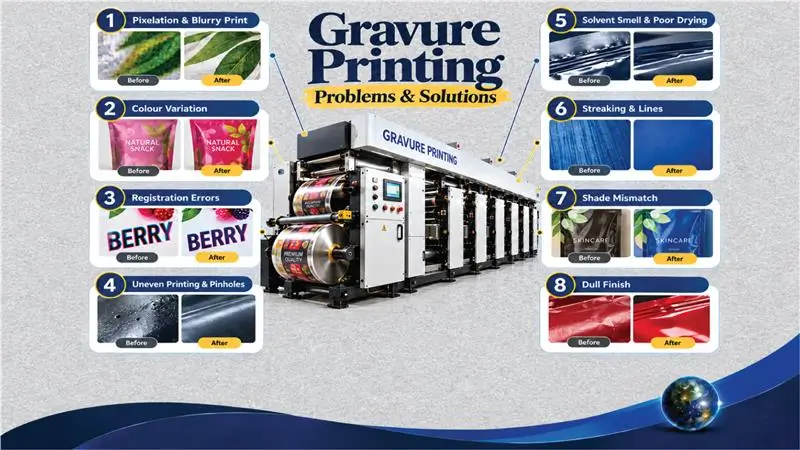
Gravure printing problem-solving was carried out line by line, and two issues were recorded. The gravure printing defects and causes are explained below, and the solution for each one is written separately under its problem.
1. Pixelation in the Print and How It Was Fixed
Problem:
The edges of the logo and images were seen broken and blocky. Artwork had been supplied below 300 dpi, and the logo was in raster format.
Solution:
Artwork was rebuilt at 300 dpi at final size; the logo was converted to vector, and a suitable screen ruling was selected. Dot gain was compensated for in the files. Cylinder engraving was started only after proofing was approved, because correction after a gravure cylinder is made is costly. Prepress discipline is one of the cheapest gravure printing problems and solutions.
2. Colour Variation Between Batches and How It Was Controlled
Problem:
Shades changed from one reorder to the next. During the run, solvent evaporation made the ink thicker, so ink viscosity moved out of range and ink transfer became heavier. Colour had been judged by matching them only.
Solution:
Viscosity was measured every 20 to 30 minutes with a Zahn cup, and solvent was added automatically. A Delta E limit was fixed with a spectrophotometer, so colour matching was recorded in numbers and colour consistency was protected on every reorder. This approach is one of the practical gravure printing problems and solutions for maintaining colour consistency across batches.
OTHER COMMON PROBLEMS CAN BE INCLUDED:
Although these problems were not identified during this particular printing case, several other common issues may occur in gravure printing under different production conditions. These include streaking caused by doctor blade wear, uneven ink coverage, pinholes, solvent retention, registration errors, and colour mismatches. These issues were not observed in the current case but are worth considering as part of gravure printing problems and solutions for future production runs to support consistent print quality and reduce the risk of defects.
3. Registration Errors and How They Were Corrected
Problem:
Colours were seen overlapping slightly at the edges of text and logo. Uneven web tension between stations was found, so print registration moved during the run.
Solution:
Tension was balanced at every station, and automatic register control was installed. The thickness of the film was checked before printing, and the drying temperature was controlled so the plastic film was not stretched by heat. Registration is one more entry among gravure printing problems and solutions that is fixed by measurement.
4. Uneven Printing, Tiny Holes, and Blocked Printing Cells & How They Were Stopped
Problem:
Uneven patches and tiny dots were seen in solid areas. Gravure printing quality problems such as pinholes are formed when surface treatment is low, static is present, or cell plugging occurs in the cylinder.
Solution:
The dyne level was tested (38 to 42 dynes is typical), and corona treatment was raised. Static eliminators were installed, and dust was removed by web cleaners. Ink adhesion was improved, and substrate compatibility was confirmed before every run. Each of these gravure printing problems and solutions was documented for the next job.
5. Solvent Smell and Poor Ink Drying and How They Were Removed
Problem:
A faint smell of solvent was noticed when the pouches were opened, which is a serious matter in skincare packaging. Press speed had been increased by the earlier printer, so ink drying was rushed, and solvent was left behind in the ink and lamination. Smudging, blocking in the roll, and abandonment were also reported. Addressing these issues is an important part of gravure printing problems and solutions, particularly when residual solvent and ink drying affect packaging quality.
Solution:
Dryer airflow was adjusted, and speed was matched to drying. Residual solvent was tested before lamination. Solvent-based inks were kept under strict control, water-based inks were evaluated for suitable layers, and ink migration was checked. The same standards followed in food packaging were applied, and packaging compliance was confirmed according to Canadian requirements. Among all gravure printing problems and solutions, this one protects the trust the most. Discover Stand Up Smell Proof Bags offered for aroma control.
6. Streaking in Gravure Printing and How It Was Fixed
Problem:
Thin lines were seen along the print direction. Streaking is a common issue addressed in gravure printing problems and solutions, often caused by excess ink left on the cylinder due to a worn doctor blade, incorrect doctor blade pressure, or dried particles in the ink. In this case, doctor blade wear had never been tracked.
Solution:
The blade was replaced, and the angle and pressure were set again for every job. The ink was filtered, and a fixed replacement schedule was created. This routine is the first of the gravure printing problems and solutions recorded in this case.
7. Peach and Pistachio Shade Mismatch and How It Was Matched
Problem:
Peach and pistachio green shades were printed darker than the approved shades. Light pastel shades are very sensitive to thick ink, high cell volume, and deep engraving depth.
Solution:
Viscosity was controlled, shallow cells were engraved, and colour density was checked with a spectrophotometer. A laminated press proof was approved because shades may change after lamination, and the approved sample was kept as a golden sample for each batch. These measures are practical gravure printing problems and solutions for maintaining colour accuracy across production runs. For packaging that requires clarity and strength, Custom Clear BOPET Bags are worth exploring. Contact us to discuss clear BOPET bags suited to your product and packaging requirements.
Gravure Printing Problems and Solutions: Before and After Comparison
| Problem | Main Cause | Solution Applied | Before | After |
| Streaking | Worn blade | Blade replaced, ink filtered | Lines in most batches | Clean print |
| Colour variation | Viscosity drift | Viscosity and Delta E control | 4–6% shift | 1–2% shift |
| Registration | Uneven tension | Tension balanced, auto register | Overlapping edges | Sharp edges |
| Mottling and pinholes | Low treatment | Dyne test, static control | Dots and patches | Even solids |
| Solvent smell | Rushed drying | Dryer adjusted, solvent tested | Odour reported | Within safe limits |
| Pixelation | Low-resolution artwork | 300 dpi, vector logo, proof | Broken edges | Sharp edges |
| Shade mismatch | Heavy ink, deep cells | Shallow cells, laminated proof | Darker than approved | Matches approved |
The Moment the Client Understood Gravure Printing Problems and Solutions
The new samples were held by the founder for a minute. “Is this the pack I designed in the beginning?” he asked. It was understood that the method had never been at fault; control of the process was lacking. Measurement, records, and proofing were made part of every job, that is the real lesson of gravure printing problems and solutions.
The advantages of gravure printing include consistent colour reproduction, sharp image details, and reliable results for high-volume packaging orders. With proper process control, these benefits lead to fewer printing defects, less material waste, and consistent colour across repeat orders. Explore the Advantages Of Gravure Printing for flexible packaging.
Results After Applying Gravure Printing: Problems and Solutions
The applied gravure printing problems and solutions addressed colour consistency, registration accuracy, ink drying, and overall print quality. The following results summarise the key improvements observed during production.
Fewer Rejections and Less Waste
Rejected pouches were reduced, and material and ink were saved. Quality control checks were added at the start, middle, and end of every run, lowering the cost per pouch. For larger fill volumes, have a look at Clear Gusset Bags.
Consistent Colour on Every Reorder
The same colour was maintained across batches, so the reputation of the brand was protected and the trust of retailers was rebuilt.
Faster Reorders
Because settings were already recorded, reorders were started without new preparation, and delivery was completed in 15 days. The customer requested square pouches, so the order was produced in a square format. For other shape options, see Custom Shaped Bags to explore designs that improve the visibility of the product on the shelf.
Sample Results:
Lessons From Gravure Printing Problems and Solutions for Your Packaging
Seven practices are recommended after this case, and gravure printing problems and solutions are largely prevented by them:
- The blade and cylinder are checked before every job.
- Viscosity and colour are measured, not judged by eye.
- Dyne level is tested on every roll of packaging film.
- Residual solvent is tested before lamination.
- Artwork is supplied at 300 dpi, with vector logos.
- Foil laminate and metallized film are proofed separately, because their behaviour differs.
For short runs, sticker-style graphics are a practical option when frequent design changes are expected. Settings are recorded for reorders, while screen and UV printing are considered for short runs with frequent changes. Check out Stand Up Sticker Mylar Bags made for short runs and sticker-style graphics.
“Customers will occasionally buy products not because they want them but because of how they are presented to them” James Clear
Final Result and Review of the Customer
Within six months, rejections were reduced, and complaints from retailers stopped. The perception of the brand was improved among buyers, and reorders were placed with confidence. Recyclable packaging is now planned for the next run, and recycling symbols will be placed on the pouches. The review of the founder was short: reviewing the process, not changing the method, was the best decision made for the business. Gravure printing problems and solutions were never treated as a reason to leave the method. For expert guidance on packaging solutions, contact Cheap Custom Packaging Companies to discuss your needs of packaging and requirements of printing.
Conclusion
The initial mistakes in this project turned out to be a blessing in disguise for our team, as they pushed us to improve our printing process, strengthen quality controls, and rebuild the client’s trust. What began as a disappointing experience became a success story for both the client and our team. Streaking, colour variation, registration errors, pinholes, solvent smell, pixelation, and shade mismatch are common gravure printing problems, and each issue was addressed through a specific corrective measure. These gravure printing problems and solutions demonstrate how learning from mistakes can lead to more consistent printing results and stronger client relationships.
Frequently Asked Questions (FAQs)
What are the most common gravure printing problems?
Streaking, colour variation, registration errors, pinholes, solvent smell and pixelation are the most common. Most of them are caused by poor control of the process, which is why gravure printing problems and solutions are mostly about control, not the method.
Why does colour change between batches?
Colour changes mainly because ink viscosity moves during the run and film differs between rolls. When viscosity and colour are measured regularly, the variation is reduced greatly.
How is a darker shade than the approved one corrected?
Viscosity is controlled, shallower cells are engraved, and a laminated proof is approved. Delta E is also checked against a golden sample.
Is this printing safe for food and skincare packaging?
Yes, when drying is controlled, residual solvent is tested, and reverse printing is used. The ink is then sealed between layers, away from the product.v
Are samples offered before the order is placed?
Yes, a free sample is arranged on request. The quality of the product is therefore seen before the decision is made.
Why Choose Universal Packaging for Gravure Printing?
Universal Packaging focuses on print consistency, colour accuracy, and quality control to reduce gravure printing problems and achieve reliable results.
What Did the 2026 B2B Experience Teach Us?
The 2026 B2B experience highlighted the importance of early defect detection, better process control, and consistent print quality.
What Was the Client’s Review?
The client appreciated the improved print quality, fewer rejected pouches, and consistent colours, leading to greater trust in Universal Packaging.