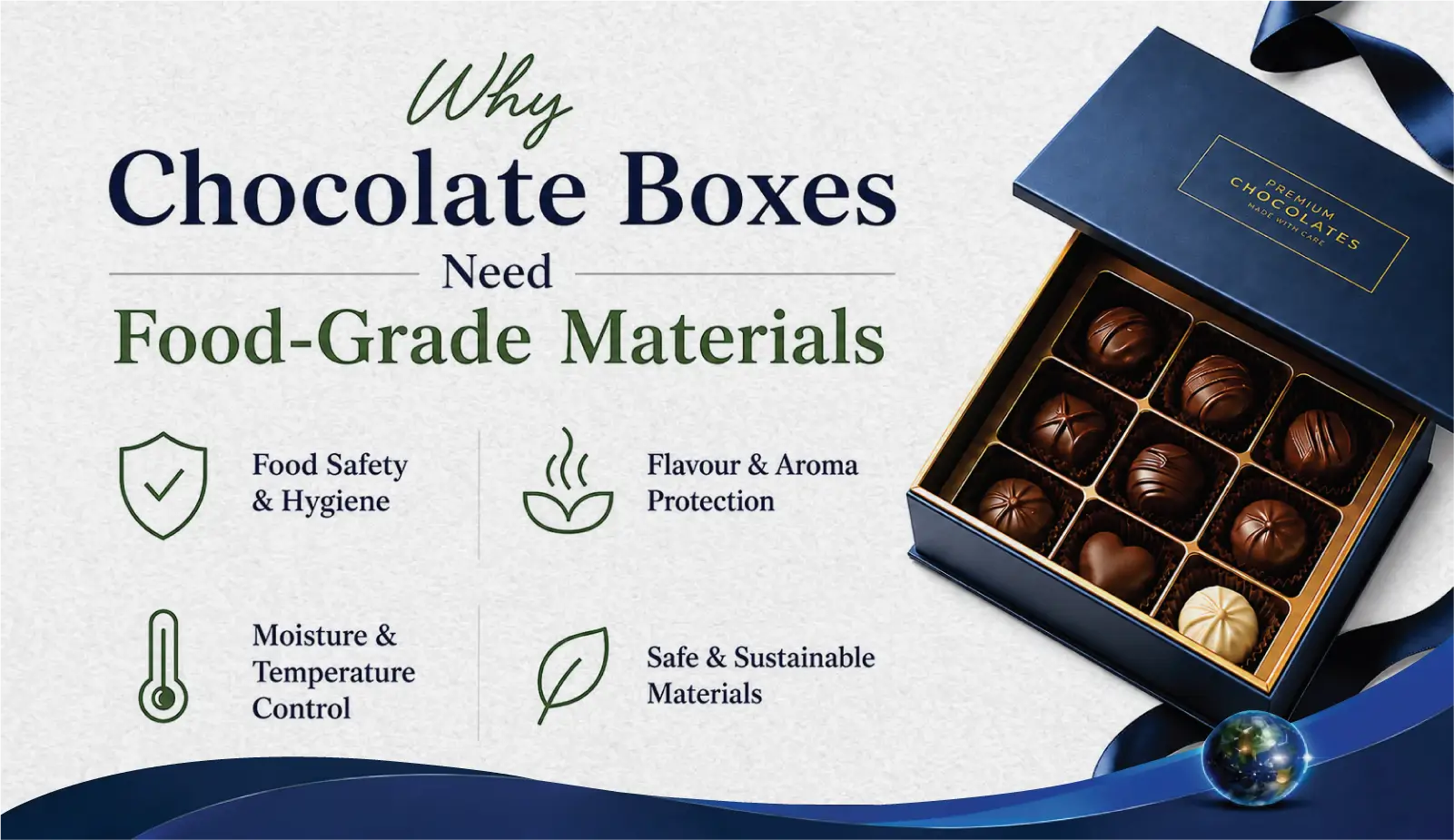
What keeps a delicate chocolate protected from unwanted contact during storage and handling? The right packaging material plays an important role in maintaining flavour, safety, and the reputation of the brand. Behind every smooth, glossy chocolate box, careful material selection is considered to maintain suitable protection and presentation of the product. This is exactly why chocolate boxes need food-grade materials in the first place. Why Chocolate Boxes Need Food-Grade Materials, in short, is the question this entire blog is designed around. Scroll down; the details ahead are worth every second.
Overview: What This Blog Covers
- Health and hygiene info: why food-grade packaging is treated as necessary.
- Flavour preservation: how the taste and aroma of the product are protected.
- Climate control: the role of moisture and temperature in freshness.
- Ink and coating safety: what “non-toxic” really means on a chocolate box.
- Canadian regulations: the exact rules and certifications behind compliant packaging.
- Sustainability: how eco-friendly materials are balanced with food safety.
- Trust and liability: how legal risk is reduced while customer confidence is designed.
Importance Of Food-Grade Materials In Chocolate Box Packaging
Food-grade materials are important for chocolate box packaging because safety, hygiene, and quality of the product are maintained throughout the packaging process. Why chocolate boxes need food-grade materials is mainly connected with contamination prevention, food safety standards, and protection of the product. Approved food contact materials, food-safe adhesives, and controlled production environments are used to reduce the risk of unwanted substance transfer.
“Our pleasures are not material pleasures, but symbols of pleasure – attractively packaged but inferior in content.” — Alan Watts
Materials such as virgin paperboard and SBS paperboard are checked before being converted into chocolate boxes, ensuring freshness and safe presentation. Different rigid structures are also considered according to the requirements of the product and the packaging needs. Wholesale Rigid Boxes are included among these options when a stronger structure and premium presentation are required.
Food-safe inks, low-migration inks, and screen and UV printing methods are preferred to maintain flavour and aroma. Compliance with standards such as HACCP, ISO 22000, and BRCGS Packaging Materials is followed to meet safety requirements. Overall, why chocolate boxes need food-grade materials is also linked with consumer trust, regulatory compliance, and the reputation of the brand.
Food Safety And Hygiene In Chocolate Box Packaging
One of the primary reasons why chocolate boxes need food-grade materials is food safety. Choosing approved packaging materials helps prevent contamination and maintains proper hygiene throughout the packaging process. Food contact materials are carefully selected to ensure that only safe substances come into contact with chocolates, while food-safe adhesives, controlled production areas, and secure sealing methods reduce the risk of unwanted chemical transfer.
Quality checks of materials such as virgin paperboard and SBS paperboard are completed before they are converted into Printed Chocolate Display Boxes. These safety practices protect chocolates from dust, chemicals, and other contaminants while maintaining the quality of the product. Why chocolate boxes need food-grade materials is explained through proper packaging hygiene, where the safety and freshness of chocolates are maintained from production to final delivery.
Maintaining the Natural Flavour and Aroma of Chocolate
The flavour and scent of chocolate, in addition to safety, are delicate, and they are affected by nearly everything the product touches. This is precisely why chocolate boxes need food-grade materials that are chemically neutral rather than reactive. Low-migration inks and food-safe inks are used in preference to standard commercial inks, since ordinary inks are known to transfer odour and chemical residue into cocoa-based products over time.
Similar considerations are relevant across confectionery products such as lollipop, where suitable packaging materials are considered for product contact and presentation. The same food-contact considerations are applied to specialty formats such as Polka Dot Mushroom Chocolate Bar Packaging, where suitable inks, coatings, and inner materials are specified according to the requirements of the product.
Kraft paperboard, valued for its natural fibre composition, is often chosen for rustic-style Chocolate Bar Packaging Boxes, while a matte finish or gloss finish is applied without compromizing the barrier properties underneath. Freshness preservation is achieved through an oxygen barrier layer, which is fitted between the outer print and the inner lining of custom-printed chocolate boxes.
As a result, the natural aroma of the chocolate is kept intact from the moment of packing until the moment it is opened by the consumer. Looking for packaging that reflects the uniqueness of your chocolates? Personalized Chocolate Boxes are designed according to the requirements of the brand, with custom styles, finishes, and printing options
Moisture and Temperature Control Affect
Even the most printed Reverse Tuck Boxes Wholesale or rigid chocolate boxes, on the other hand, are of little use if humidity and heat are left unmanaged. Here, why chocolate boxes need food-grade materials becomes a question of physics as much as chemistry.
- Moisture protection: humidity-sensitive products such as chocolate bomb packaging and Chocolate Lollipop Packaging are given extra lining to prevent softening or blooming.
- Heat sealing: edges are closed through heat sealing rather than adhesive tape, so that airtight protection of the product is achieved without introducing extra chemicals.
- Shelf life: through combined temperature and moisture control, the shelf life of the chocolate is extended well beyond what standard packaging is able to offer.
Food-grade materials are only one part of effective chocolate packaging. The structure and style of the box also influence presentation and protection. In the next section, Chocolate Box Styles Explained will cover popular formats and their suitability for different chocolate products.
Non-Toxic Inks and Coatings Explained
The printing method used on a chocolate box, similarly, is just as important as the paperboard underneath it. Rather than flexographic printing, screen and UV printing are preferred across the industry, since finer detail is achieved and lower chemical transfer is recorded with these methods. Another reason why chocolate boxes need food-grade materials extends beyond the box itself and into the ink.
Food-safe inks and low-migration inks are selected specifically for Custom Candy Boxes, where direct or indirect food-contact considerations are reviewed alongside the packaging requirements. Foil stamping and embossing are commonly applied to luxury chocolate packaging and gift packaging, and UV-cured inks are set under light, leaving minimal off-gassing near the product. For THC Edibles Packaging, suitable inks and coatings are specified according to applicable packaging and product requirements, while careful material selection is maintained.
Canadian Regulations and Certifications for Chocolate Packaging
Canadian law answers why chocolate boxes need food-grade materials most directly, with rules that are neither vague nor optional. Under Division 23, Section B.23.001, of the packages through which a harmful substance could be transferred into food are prohibited outright. Meanwhile, the Safe Food for Canadians Regulations, SOR/2018-108, are enforced by the Canadian Food Inspection Agency, and labelling, packaging, and safety standards have been covered under this regulation since it took effect on January 15, 2019.
A Letter of No Objection, issued voluntarily by Health Canada’s Bureau of Chemical Safety, is often obtained as further confirmation that a material is considered safe for food contact. For special dietary foods, infant formula, and novel foods, Division 24, 25, and 28 require that a mandatory packaging assessment be completed before the product reaches shelves. ISO 22000, and HACCP certifications are also referenced by manufacturers as third-party proof that food safety standards and packaging regulations are being met consistently, not just during a single audit cycle
Sustainable Yet Food-Safe Packaging Material Trends
Eco-friendly packaging solutions are preferred where sustainability and food safety standards are maintained without affecting durability.
- FSC-Certified Paper: Responsibly sourced paper materials are selected to support sustainable packaging practices while meeting food-grade requirements.
- Compostable Packaging: Compostable materials are considered where environmental responsibility and safe packaging performance are required.
- Biodegradable Materials: Testing is performed against oxygen barrier and moisture barrier requirements to maintain protection of the product.
- Recycled Fibre Packaging: Custom Pillow Box and window chocolate boxes are redesigned with recycled fibres to maintain presentation of the product while supporting sustainability goals.
Building Trust While Reducing Legal Risk
Once safety, flavour, climate control, printing, regulation, and sustainability have all been addressed, finally, consumer confidence is what remains to be designed. Reputation of the brand is strengthened every time a compliant, tamper-evident packaging solution is placed in, and presentation of the product is elevated through premium packaging choices such as embossing or a gloss finish.
As retail packaging and gift packaging are increasingly scrutinized by informed consumers, recognition of the brand is earned through consistent, transparent, food-safe choices rather than marketing claims alone. Why chocolate boxes need food-grade materials is, ultimately, a question that touches health, flavour, climate, printing, law, sustainability, and trust all at once, and each of these threads has now been tied together in this blog, one paragraph at a time.
“Customers will occasionally buy products not because they want them but because of how they are presented to them.” — James Clear
Looking for reliable food-grade chocolate packaging designed around your product requirements? universalpackaging offers customized solutions with quality materials, premium finishes, and compliant packaging options. Contact us now to discuss your next chocolate packaging project and bring your packaging vision to life.
Conclusion
A clear connection between material selection, food safety, compliance, and protection of the product is maintained throughout this blog.Food-grade materials are shown to protect health, preserve flavour, and reduce legal risk, all while sustainability is respected. Certifications like ISO 22000 are highlighted as proof of accountability. In short, why chocolate boxes need food-grade materials is answered from every perspective , and the packaging of the product is treated as a promise kept through every food-safe material offered.
Frequently Asked Questions (FAQs)
What exactly does “food-grade” mean for a chocolate box?
It means the packaging of the product is made from materials that are approved for direct or indirect food contact, so no harmful substance is transferred to the chocolate during storage or transport.
Are screen and UV printing safer than other printing methods?
Yes, screen and UV printing are widely preferred because faster curing is achieved and lower chemical residue is left on the surface, which matters greatly for food contact material compliance. It is one more small proof point behind why chocolate boxes need food-grade materials as a standard, not an exception.
Why is virgin paperboard preferred over recycled board for chocolate packaging?
Virgin paperboard is generally purer, so lower contamination risk is recorded compared to recycled stock, which is why it is often specified for direct-contact chocolate packaging.
What is the difference between a moisture barrier and an oxygen barrier?
A moisture barrier is designed to keep humidity away from the product, while an oxygen barrier is designed to slow oxidation, and both are often combined for full freshness preservation.
Can sustainable packaging still be considered food-safe?
Yes, recyclable packaging, FSC-certified paper, and compostable packaging are all being engineered today so that eco-friendly packaging and food safety standards are achieved together, not separately.
What packaging is suitable for chocolate bombs and other specialty chocolate products?
Chocolate Bomb Packaging is prepared with suitable food-contact materials, protective structures, and appropriate printing according to the requirements of the product. For specialty chocolate formats, moisture protection and safe material selection are also considered to maintain the quality and presentation of the product.
How is packaging durability affected when biodegradable materials are used?
In most modern formulations, little to no durability is lost, since biodegradable materials are now designed to match the strength and protective qualities of conventional packaging.
Where is food-grade, fully compliant chocolate packaging offered?
Custom, food-grade chocolate packaging including window chocolate boxes, rigid chocolate boxes, and custom pillow boxes is offered by Universal Packaging, where compliance and design are handled together under one roof. Why chocolate boxes need food-grade materials, put simply, is exactly the question Universal Packaging is design to answer.