Not using the right packaging details: one chocolate package may attract attention while another disappears among dozens of competing products. Sometimes, the difference is not the chocolate itself, but a small packaging decision related to protection, presentation, freshness, or shelf appeal. Common Mistakes In Chocolate Packaging often remain unnoticed until the packaging of the product begins to affect the customer experience. Keep reading to discover the overlooked details that may shape how chocolate is perceived before the first bite.
Common Mistakes In Chocolate Packaging Design And Canada Compliance Requirements
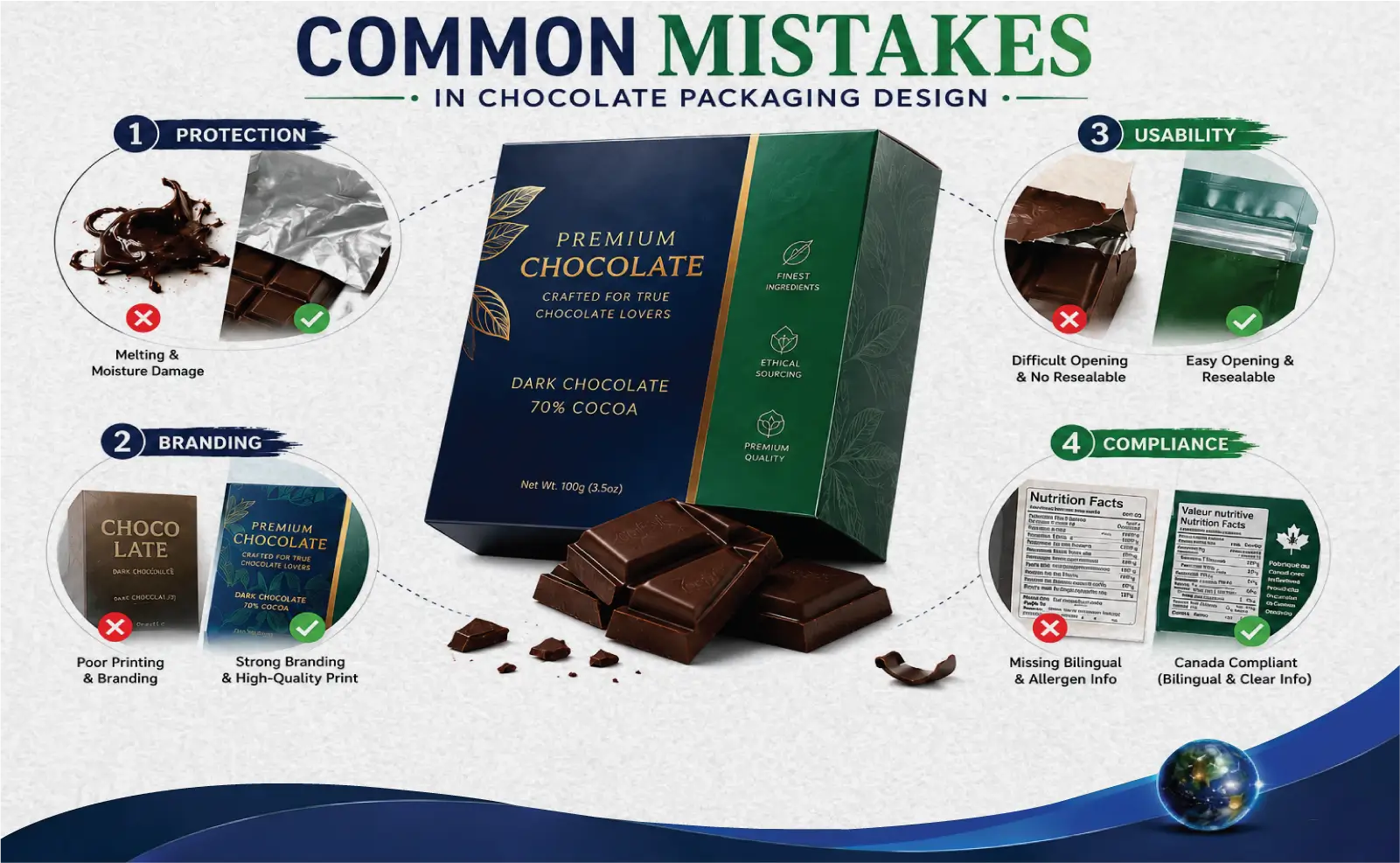
Design mistakes and compliance gaps are usually treated as two separate issues, even though both are connected in most real cases. In this blog, material choices, branding decisions, practical flaws, and Canada-specific regulation numbers are brought together in a single guide, so that a complete picture is formed rather than a partial one. Each section is broken down step by step, starting with the material and protection side of the box.
“Our pleasures are not material pleasures, but symbols of pleasure – attractively packaged but inferior in content.” — Alan Watts
Material And Protection Mistake In Packaging Design
Protection is always the starting point when common mistakes in chocolate packaging are discussed. In many cases, food-grade paperboard is chosen without enough thought given to climate exposure, and as a result, chocolate freshness is affected within days of production. This is one of the common mistakes in chocolate packaging that is repeated across small and large brands alike, and it is seen just as often in Rigid Boxes as it is in simple folding formats.
- Temperature protection: In hot regions, temperature protection is often ignored, and melting is reported by customers soon after delivery.
- Barrier film selection: A weak barrier film is sometimes selected, through which moisture is allowed to pass, and a moisture barrier that should have been standard is skipped entirely.
- Inner wrappers and foil use: Aluminium foil and inner wrappers are, in some cases, replaced with thinner alternatives, and tactile experience is reduced as a consequence.
- Cushioning: Moulded pulp inserts are frequently left out of rigid chocolate boxes, and cracking is reported during transit because of it, an issue that is also noticed in Mushroom Chocolate Bars Packaging where inserts are skipped to save cost.
Protection failures are the Luxury of all common mistakes in chocolate packaging, and visual presentation is where attention is turned next.
Branding And Visual Mistakes That Are Made Often
Presentation of the product is the next factor considered once protection has been addressed. A cluttered dieline is one of the most common mistakes in chocolate packaging, because too much information is placed on too little space. Common mistakes in chocolate packaging at this stage are usually tied to weak decision-making rather than budget limits, and this is where Candy Packaging With Logo often loses consistency across a full product range.
- Colour palette confusion: An inconsistent colour palette is used across variants, and confusion is created at the point of purchase.
- Typography and logo placement: Poor typography is combined with weak logo placement, and recognition of the brand is reduced on a crowded shelf.
- Printing quality issues: Printing quality is compromised in some folding cartons, while screen printing or UV is preferred for Custom Printed Chocolate Bomb Packaging.
- Missing finishing techniques: Embossing, foil stamping, and spot UV are, in budget-driven projects, left out completely, and luxury positioning becomes harder to achieve.
For brands seeking stronger presentation, Chocolate Boxes With Logo are suitable for the presentation of the product and the recognition of the brand. Different box styles, logo placements, printing methods, and finishing options are selected according to the requirements of the product and the needs of the brand. The presentation of the product is personalized according to the intended customer experience, while the reputation of the brand is reinforced through consistent packaging and visual details.
Practical And Usability Mistakes In Packaging Design
Usability is where day-to-day negative experiences are created for the buyer. Ease of opening is rarely tested before packaging is finalized, and as a result, tamper evidence features are sometimes added incorrectly, making the box harder to use rather than safer. Such functional gaps are, quite often, listed among the common mistakes in chocolate packaging that customer service teams hear about the most, and a Customized Reverse Tuck Box is frequently blamed when opening instructions are not made obvious.
- Resealable closure missing: A resealable closure is left out of kraft paper packaging meant for truffles, and freshness is lost after the first use.
- Portion control ignored: Portion control is not built into multi-piece boxes, and breakage is caused when pieces are separated by hand, a problem also reported in Custom Pillow Boxes Wholesale batches meant for gifting.
- Retail versus ecommerce confusion: The same box structure is used for both retail packaging and ecommerce packaging, and damage during shipping is reported far more often than it should be.
- Unboxing experience overlooked: The unboxing experience is treated as an afterthought, even in Edible Customizable Packaging, where presentation and ease of handling remain important for gifting and novelty chocolate products.
Compliance requirements are where attention is redirected next, since regulatory gaps are among the most costly common mistakes in chocolate packaging.
Canada Packaging Regulations And Certification Numbers Missing
Chocolate packaging sold in Canada is required to meet defined legal standards, and these standards are not optional for confectionery packaging, including formats such as Custom Chocolate Bar Box Packaging placed near checkout counters. Ignoring them is, without question, one of the common mistakes in chocolate packaging seen among brands entering the Canadian market for the first time.
- Under the Consumer Packaging and Labelling Regulations, C.R.C., c. 417, net quantity, product identity, and dealer details are required to be shown clearly, in letters no smaller than 1.6 millimetres.
- Under Division 23 of the Food and Drugs Act, packaging materials through which harmful substances could be transferred to food are prohibited, which directly affects food contact compliance for every wrapper and box used.
- Where organic chocolate is packed, CAN or CGSB 32.310 and CAN or CGSB 32.311 certification standards are applied before the Canada Organic Logo is permitted on the label.
Sustainable material choices are looked at next, since compliance and sustainability are increasingly linked, and both are frequently missed in the common mistakes in chocolate packaging conversation.
Eco-Friendly Packaging Gaps Found In Chocolate Packaging
Sustainable packaging is expected by a growing share of buyers, and this expectation is not being met in many current designs. Recyclable packaging is promised on labels, yet mixed materials are used underneath, through which recycling is actually made harder. This gap is, in itself, one of the more overlooked common mistakes in chocolate packaging strategies today, and it is noticed even in Cookie Packaging With Logo where recyclable claims are printed without real material backing. FSC-certified paperboard is offered at a slightly higher cost, but it is skipped by brands trying to cut expenses, even though packaging differentiation is achieved far more easily when sustainability claims are backed by real certification.
Once the sustainability Limitations are understood, the next question is which materials and formats are better suited to a more responsible approach. This is where Eco-Friendly Chocolate Packaging Options become worth exploring, especially for brands looking beyond recyclable claims and focusing on material choices, certification, and end-of-life considerations.
“Customers will occasionally buy products not because they want them but because of how they are presented to them.” — James Clear
Missing Information And Weak Shelf Visibility
Nutritional details, allergen warnings, and expiry dates are, in several cases, printed in fonts too small to be personalized to real customer needs, and readability is lost as a result. Weak logo placement combined with a small footprint on the shelf means seasonal chocolate packaging is often lost among competitors during peak retail periods, and gift chocolate packaging in particular suffers when this happens, a pattern also seen in Custom Lollipop Packaging aimed at younger buyers. These missing details are, without doubt, among the quieter common mistakes in chocolate packaging that rarely get noticed until a complaint is filed.
When professional packaging support is needed, Custom Packaging Solutions Companies are worth considering for different product and industry requirements. From packaging selection to printing and finishing, the right direction is planned around the requirements of the brand. Ready to discuss your packaging needs? Contact us now and get started.
Conclusion
Everything from material failures to has been walked through in this blog in a single, connected view, touching formats ranging from Custom Chocolate Bar Box Packaging on standard shelves to custom printed chocolate bomb packaging built for novelty ranges, and even edible customizable packaging designed for personalised gifting. Common mistakes in chocolate packaging are rarely caused by one factor alone, they are usually a chain of small oversights. Packaging of the product is turned into a genuine advantage rather than a hidden cost once protection, printing quality, and compliance are corrected together, and future common mistakes in chocolate packaging are avoided long before they happen.
Frequently Asked Questions (FAQs)
What is the most common mistake seen in chocolate packaging design?
Weak protection against heat and moisture is reported most often, since chocolate freshness is lost quickly once a moisture barrier is missing or of poor quality, and this remains one of the most repeated common mistakes in chocolate packaging.
Which printing methods are recommended for premium chocolate boxes?
screen printing and UV printing are recommended over cheaper alternatives, since sharper colour output and better durability are achieved through these methods on folding cartons and rigid chocolate boxes.
How is a moisture barrier tested before packaging is approved?
A moisture barrier is usually tested through humidity chamber trials, where sample boxes are exposed to controlled conditions before final approval is given for large scale production.
Why do resealable closures matter for chocolate packaging?
Resealable closures are important because freshness is preserved after the first use, and portion control is made easier for multi piece boxes and truffle assortments.
How is sustainable packaging different from recyclable packaging?
Sustainable packaging refers to the overall lifecycle impact of materials, while recyclable packaging refers specifically to whether the material can be processed again after disposal.
What role does unboxing experience play in chocolate sales?
Unboxing experience is directly linked to consumer perception, and repeat purchases are often influenced by how the box feels, opens, and presents the product inside.
Is FSC certified paperboard required by law in Canada?
FSC certification is not legally required, though it is requested by retailers and buyers as proof that sustainable sourcing practices are being followed.
How is portion control achieved in multi piece chocolate boxes?
Portion control is achieved through internal inserts, individual wrapping, or scored break lines, so that pieces are separated cleanly without damage to the surrounding product.
Where can custom chocolate packaging solutions be ordered from?
Custom packaging solutions across every format discussed in this blog are offered by Universal Packaging, where compliance and design needs are handled together, and common mistakes in chocolate packaging are avoided through expertise.