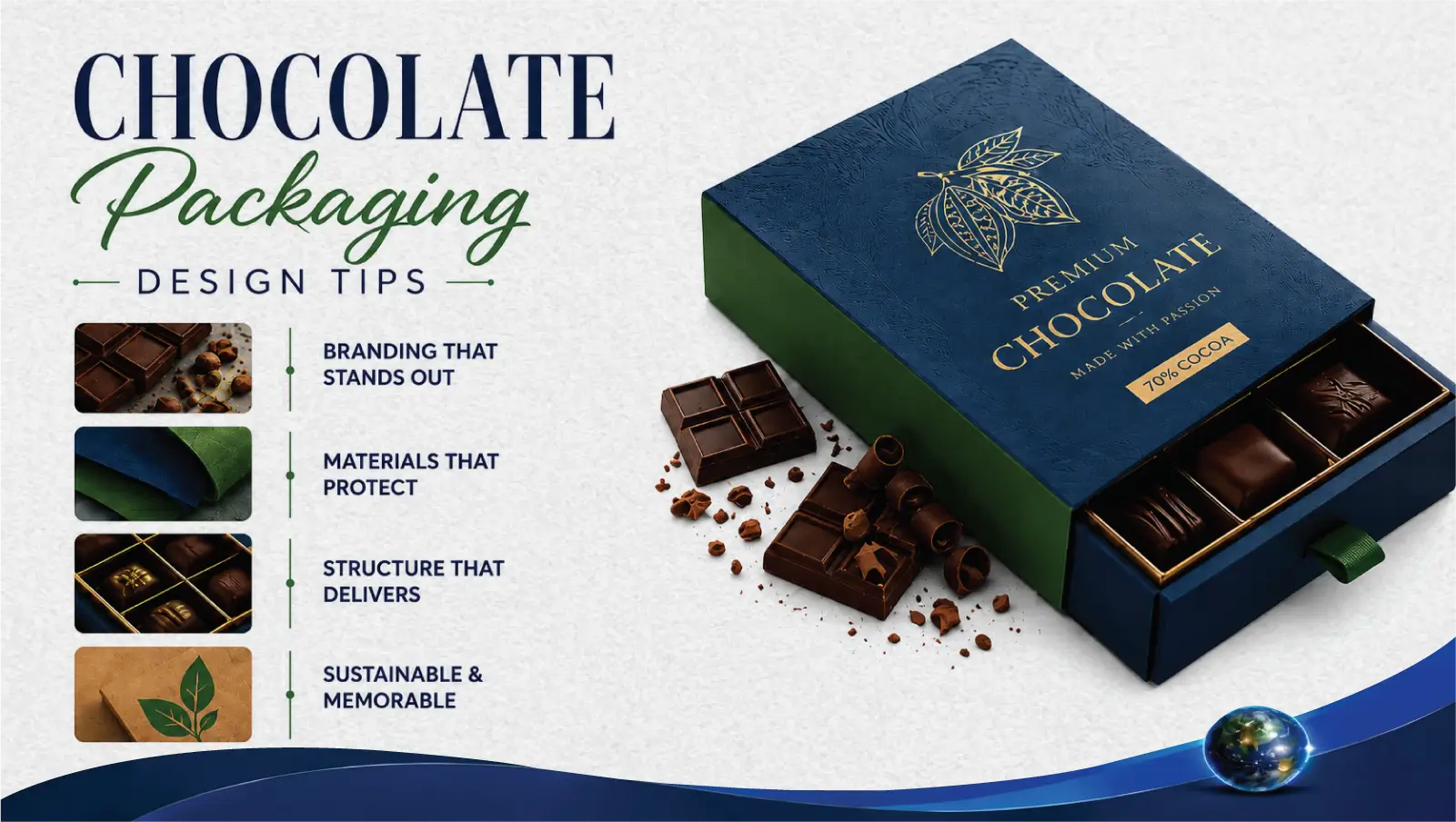
What makes one chocolate package more noticeable than another on a crowded shelf? A carefully planned wrapper, gift box, or rigid design is often used to present the product attractively and maintain a consistent appearance. This is exactly where Chocolate Packaging Design Tips become important. Behind every well-finished package, decisions about colours, materials, structure, finishes, and legal requirements are considered. The key details behind these chocolate packaging design tips are explored below, with practical guidance for creating suitable packaging for different chocolate products.
Key Ideas At A Glance
Different chocolate products are packaged in several formats, with each option suited to different presentation, protection, and gifting requirements:
- Chocolate Wrappers: Lightweight wrapping formats are used for individual chocolate bars and small confectionery pieces.
- Chocolate Bags: Flexible bags are used for chocolate chips, assorted pieces, and larger confectionery portions.
- Chocolate Boxes: Folding cartons, rigid boxes, window boxes, and gift boxes are prepared for retail and premium gifting.
- Chocolate Sleeves: Paperboard sleeves are placed around inner trays or boxes for an additional branded layer.
- Chocolate Pouches: Stand-up, flat, and resealable pouches are prepared for flexible chocolate packaging requirements.
- Chocolate Display Boxes: Retail-focused formats are prepared with visible product areas for shelf and counter presentation.
Complete Guide To Chocolate Packaging Design Tips
Before individual sections are broken down one by one, it is worth noting that packaging is rarely developed through a single decision alone. Instead, branding, material selection, structure, compliance, sustainability, and presentation are combined, and each of these areas is discussed in its own dedicated section below. Protection of the product, presentation of the product, and recognition of the brand are influenced by the way these elements are planned together. Greater consistency across retail displays, online listings, and presentations of gifts is also achieved through careful packaging planning. When each detail is considered properly, practical requirements are addressed while the reputation of the brand is strengthened.
1. Identity of Brand And Logo Placement
This first section of chocolate packaging design tips focuses on how perception of the brand is shaped through visual cues. Chocolate Retail Display Boxes are personalized with consistent branding so the presentation of the product remains recognizable across retail displays. Recognition of the brand is strengthened when the logo is positioned consistently across boxes, wrappers, and labels. The colour palette is matched with the intended character of the chocolate, whether cheerful or luxurious, while visual hierarchy is maintained so the logo, tagline, and product name appear in a clear order.
Once perception of the brand is settled, attention is shifted toward what the packaging is actually made from.
2. Best Materials For Chocolate Packaging
The materials chosen for chocolate packaging are treated as the backbone of every design decision.
- Food-contact safety is prioritized: food-grade packaging is chosen so no harmful substances are transferred to the treat inside.
- Layers add protection: barrier packaging is combined with foil wrappers so moisture protection and heat protection are both achieved at once.
- Texture adds character: kraft paper and glassine paper are often selected for an artisan, rustic presentation of the product, a look also favoured across Custom Kraft Paper Pillow Boxes.
Once the material foundation covered in these chocolate packaging design tips is set, the visual language of the box is explored next.
3. Visual Design Features And Typography
This part of chocolate packaging design tips, similarly, is dedicated to how a box is read and understood at a glance, and a die-cut Chocolate Bar Box With Window is a common example of this principle in action. Packaging typography is kept legible so ingredients and flavour details are read without strain, and illustrations of nuts, fruits, or cacao pods are added so the flavour inside is hinted at before opening. A matte finish or glossy coating is selected to match the overall tone of custom chocolate packaging.
“Customers will occasionally buy products not because they want them but because of how they are presented to them.” — James Clear
Even with suitable materials, colours, and finishes, design errors may still occur. Common issues such as poor readability, weak visual hierarchy, and unsuitable material choices are discussed in Common Mistakes in Chocolate Packaging Design, where practical considerations for avoiding these problems are covered. Reviewing these details before production helps reduce unnecessary design changes and additional costs.
4. Structural Design of Box And Shape
Structural packaging design is where design and creativity are blended.
- Shape is practical: rigid boxes, sleeve-style cases, or hexagonal boxes are selected depending on the treat being protected, with Custom Reverse Tuck End Boxes and Rigid Boxes among the most requested styles.
- Inserts are added for order: dividers are placed inside so individual pieces are kept separate and undamaged.
- Cutting techniques add flair: die-cut design and embossing are applied so a tactile, premium feel is created.
For a broader understanding of box styles and structural choices, Chocolate Box Packaging is also worth exploring. Different formats are compared according to retail, gifting, and storage requirements. Material selection and finishing options are also discussed in greater detail. Better planning decisions are made when these factors are reviewed together.
5. Practical Requirements of Packaging For Protection
Is where premium packaging is truly tested against real-world handling, and this is especially true for delicate formats such as Custom Chocolate Bomb Packaging, where moulded inserts are relied on for cushioning. Freshness preservation is achieved through airtight seals and multi-layer barriers designed, and shelf life is lengthened when moisture and light exposure are minimized through proper sealing. Tamper-evident packaging is used so trust with the end buyer is reinforced at every touchpoint.
6. Canada Packaging Regulations And Certification Standards
This section, above all, is treated with the highest level of care, since regulatory numbers are involved.
- Composition standards are enforced: Food and Drug Regulations (FDR), Division 4, is where cocoa and chocolate composition rules are set out, and this is administered by the CFIA.
- Licensing is mandated: Safe Food for Canadians Regulations (SOR/2018-108) and the Safe Food for Canadians Act, S.C. 2012, c. 24 are the frameworks under which packaging, storage, and labelling compliance is required.
- Bilingual labelling is required: the Consumer Packaging and Labelling Act, R.S.C. 1985, c. C-38 is the act under which English and French text is mandated on every label.
- Material testing is standardized: ASTM D4332-14 is the standard through which packaging containers are conditioned for testing, while ASTM D7387-13 is applied for further component evaluation.
- Specialized Packaging Categories require extra care: with formats such as Custom Magic Mushroom Chocolate Bar Box Packaging, compliant and discreet labelling is treated as a legal necessity rather than a design preference.
Once legal boxes are ticked, attention is turned toward the planet, because eco-conscious choices are now expected by most buyers.
7. Sustainable And Eco-Friendly Packaging Trends
Sustainability is no longer optional in confectionery packaging, and this is reflected in material sourcing decisions across everything from premium gift sets to simple Packaging For Candy. Recyclable packaging and compostable packaging are increasingly requested by environmentally aware buyers, while FSC-certified paper is selected so responsible forestry practices are supported. Eco-friendly inks are used so chemical exposure during production is reduced. Similar considerations are also found in Fruity Pebbles Edibles Packaging, where material selection, presentation of the product, and packaging requirements are considered together. Once these sustainable chocolate packaging design tips are applied, the final touch of the packaging is given full attention.
8. Premium Unboxing Experience For Gifting
This closing part of chocolate packaging design tips, finally, is centred on the unboxing experience, treated as the emotional peak of the entire journey.
- Finishing techniques add luxury: foil stamping and spot UV coating are applied so a tactile, high-end feel is created on gift packaging.
- Storytelling is embedded: brand storytelling is woven into the inner lid or insert card so an emotional connection is formed.
- Seasonal touches are added: seasonal packaging features are introduced during holidays, so shelf appeal is heightened for the target audience, a strategy just as common on Custom Lollipop Packaging as it is on larger gift sets.
Once the emotional experience is covered, related formats such as Personalized Cookie Packaging are also worth exploring. Similar gifting and presentation principles are applied across the wider confectionery industry. Greater consistency is achieved when finishes, colours, and inserts are matched carefully. The presentation of the product is also refined through suitable sizing and arrangement.
“Good things come in small packages.” — Aesop
For custom sizing, materials, printing, and finishing requirements, professional assistance is offered through Custom Packaging Calgary. Each packaging requirement is reviewed according to the product, quantity, and desired presentation. Suitable customization options are then recommended according to the needs of the brand. Ready to discuss your packaging project? Connect with our team today.
Conclusion
From material selection and logo placement to structural details, sustainability, and Canadian packaging requirements, these chocolate packaging design tips have been covered to explain the main considerations behind effective packaging. Screen and UV printing, suitable finishes, practical structures, and food-contact materials have also been discussed according to different chocolate packaging needs. With these factors considered together, a suitable balance between presentation, protection, compliance, and the requirements of the brand is achieved.
Frequently Asked Questions (FAQs)
What is the most important factor covered in chocolate packaging design tips?
Protection of the product is considered the top priority, since freshness and structural integrity are both maintained through the right material choice.
Which materials are best suited for chocolate boxes?
Paperboard, kraft paper, and foil are commonly combined, since barrier protection and a premium look are both achieved together.
What printing methods are recommended, based on these chocolate packaging design tips?
Screen printing and UV printing are widely recommended, since crisp detail and long-lasting colour vibrancy are both delivered through these methods.
Is sustainable packaging becoming a requirement?
It is expected rather than optional, as recyclable and compostable materials are now requested by a large share of buyers.
What makes an unboxing experience feel premium?
Foil stamping, spot UV, and thoughtful insert design are typically included, since a memorable emotional response is triggered through these details.
How is shelf appeal improved for retail chocolate boxes, based on core chocolate packaging design tips?
Shelf appeal is improved through bold typography, a well-planned colour palette, and a clear visual hierarchy on the front panel.
Where Can Custom Chocolate Packaging Be Ordered?
Custom chocolate packaging is ordered directly from packaging manufacturers and suppliers, where box styles, materials, printing, finishes, and quantities are discussed according to the requirements of the brand.
Is tamper-evident packaging necessary for chocolate products?
It is highly recommended, since consumer trust is reinforced and product safety concerns are minimized through visible tamper seals.
What is the difference between rigid boxes and standard folding cartons?
Personalized Rigid Boxes are thicker and sturdier, so a luxury feel is created, while folding cartons are lighter and generally chosen for everyday retail use.