Curiously, what if one measurement error were enough for an entire sleeve order to be rejected? First, Common Mistakes When Designing Custom Packaging Sleeves should be understood before artwork or print quantities are approved. More importantly, losses are reduced when dimensions, labels, and structure are checked. Finally, scroll down to uncover errors noticed too late.
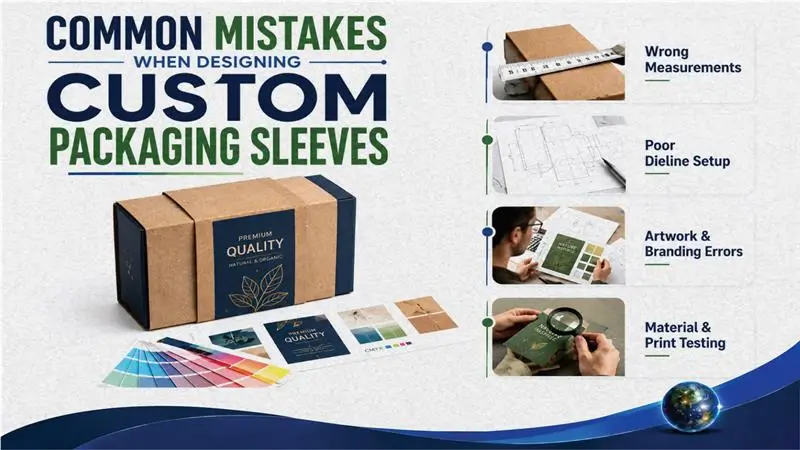
Fast Guide To Sleeve Design Risks
- Measurements: Exact dimensions should be confirmed physically.
- Dielines: Bleed, trim, folds, and glue areas should be marked.
- Artwork: Print-ready files should be checked before approval.
- Branding: Clear visual consistency should be maintained.
- Compliance: Canadian requirements should be verified early.
- Materials: Stock should be matched with actual conditions.
- Finishes: Decoration should be tested before production.
- Testing: Samples should be assessed in retail settings.
“Customers will occasionally buy products not because they want them but because of how they are presented to them.” — James Clear
1. Measure Every Product Before Designing
The 1st common mistakes when designing custom packaging sleeves are often made when old specifications are copied instead of the actual item being measured. With inaccurate product measurements, loose fitting, pressure marks, and tearing are often produced. For Custom Kraft Cup Sleeves, taper, rim width, insulation, overlap, and handling should be checked. Read the next paragraph before a template is approved.
The incorrect sleeve dimensions should be identified through samples made for minimum and maximum product sizes. Curves, closures, seams, and filling variation should be tested. Common mistakes when designing custom packaging sleeves are reduced when compression, removal, and comfort are assessed by users. Continue below to learn why correct measurements are wasted by an inaccurate dieline.
2. Build Accurate Dielines Before Printing
The common mistakes when designing custom packaging sleeves are frequently caused by poor dieline setup. Bleed, trim, folds, glue zones, tabs, and safe areas should be separated, while important wording should be kept away from cutting paths. For Custom Made Gift Card Holders, slot width and removal space should be physically confirmed. Review the next paragraph before structural files are released.
Cutting and folding errors are often introduced when templates are resized. The dieline should remain on a non-printing layer and be verified at 100 per cent. Common mistakes when designing custom packaging sleeves are prevented when grain direction and machine tolerance are discussed. Move forward to see how artwork should be prepared.
3. Prepare Artwork For Professional Printing
The low-resolution artwork should not be enlarged because blurred edges and visible pixels are usually produced. Printer resolution requirements should be met during image preparation, while logos should be supplied as vectors. The wrong color mode should be corrected before proofing through approved CMYK or spot-colour values. Common mistakes when designing custom packaging sleeves are easier to prevent after preflight review. Continue for alignment risks.
The printing alignment issues should be anticipated around seams, folds, and windows. Critical details should be kept away from trim edges because converting tolerance should be expected. Packaging Sleeve With Prints should be judged through a printed proof, not a screen preview. Keep reading to protect clarity and visual consistency.
4. Keep Branding Clear And Consistent
A custom packaging sleeve design should be guided by a clear hierarchy. An overcrowded layout is often produced by excessive claims, icons, patterns, and promotions. Consequently, the presentation of the product and recognition of the brand are weakened. Common mistakes when designing custom packaging sleeves are avoided when essential buying information is prioritized. Read on before typography is finalized.
Unreadable typography should be corrected through suitable size, spacing, and contrast; inconsistent brand colors should be replaced with approved colour values, while incorrect logo placement should be corrected when visibility is obstructed by folds or labels. For Custom Kraft Sleeves with Logo, the image of the brand is strengthened through consistent scale and positioning.
5. Protect Barcodes And Required Information
Barcode placement errors are often caused by insufficient quiet zones, curved surfaces, low contrast, reflective effects, or nearby folds. Scan testing should be completed after assembly, while QR code placement should be checked under normal lighting. Common mistakes when designing custom packaging sleeves are prevented when several devices and retail scanners are used.
The regulatory labeling requirements should be confirmed for the category, province, channel, and buyer. Common name, net quantity, dealer identification, bilingual information, and warnings should be professionally reviewed. Common mistakes when designing custom packaging sleeves are often followed by higher costs when required wording is added after approval. Continue for Canadian regulation numbers.
6. Verify Canadian Labelling Rules Carefully
Packaging compliance for general prepackaged consumer goods should be reviewed against the Consumer Packaging and Labelling Act, R.S.C. 1985, c. C-38, and the Consumer Packaging and Labelling Regulations, C.R.C., c. 417. For food, SOR/2018-108 and the Food and Drugs Act, R.S.C. 1985, c. F-27 should be assessed; checkout bags are addressed under the Single-use Plastics Prohibition Regulations, SOR/2022-138. common mistakes when designing custom packaging sleeves are reduced when applicable laws are checked.
Relevant references may include FSC-STD-40-004 V3-1, ISO 18601:2013, ISO 18602:2013, ISO 18604:2013, ISO 18606:2013, ISO 17088:2021, and ISO 5412:2022. For verified sourcing, FSC-certified paper should be purchased with valid chain-of-custody documentation. No standard should be presented as automatic legal approval. Continue before environmental wording is printed.
7. Select Materials for Actual Conditions
Poor material selection is usually exposed through cracking, moisture damage, scuffing, tearing, ink rub, or weak adhesion. Temperature, grease, humidity, storage, shipping pressure, and retail handling should be shared with the supplier. Accordingly, recyclable materials should be selected only after suitability and recovery access are verified. common mistakes when designing custom packaging sleeves are reduced when the protection of the product and disposal route are reviewed together.
Sustainable packaging claims should be supported with specific evidence. Broad environmental statements should not be printed without qualification because misleading representations may be investigated in Canada. Accordingly, eco-friendly coatings should be assessed for recyclability, repulpability, food-contact suitability, and local processing access. common mistakes when designing custom packaging sleeves are prevented when literal wording and overall impression are reviewed. Continue to finishing.
8. Apply Finishes With Practical Purpose
A matte finish may be selected for a soft appearance, while gloss lamination may be selected for shine and surface resistance. A spot UV coating may be applied to chosen details, and foil stamping may be used for metallic emphasis. Every treatment should be tested for cracking, rub resistance, recyclability, and scanning. common mistakes when designing custom packaging sleeves are made when appearance is approved without handling tests.
The embossing and debossing should be positioned away from tiny text, folds, glue areas, and scanning zones. A window cut-out should be assessed for strength, dust exposure, and visibility. Additionally, tamper-evident features should be considered when opening evidence is needed. Continue to see how customer handling should be evaluated. Explore our Custom Kraft Paper Sleeves for a refined, sustainable, and professionally branded presentation of the product.
9. Test Usability Display
The packaging usability should be tested by new users. Opening, carrying, reading, and disposal should be observed without coaching. The consumer experience is improved when sharp edges, excessive force, and unclear opening points are removed. Common mistakes when designing custom packaging sleeves are discovered earlier through realistic accessibility and grip tests.
“Good things come in small packages.” — Aesop
Retail display testing should be completed on shelves, hooks, counters, trays, and shipping cartons that match the intended channel. The visibility of the product should be checked from several angles, while the unboxing experience should be observed when a premium packaging perception is intended. After these common design errors have been reviewed, the next step is to understand how the right sleeve choices affect visibility, shelf appeal, and customer response. Read How Packaging Sleeves Improve Product Presentation to explore how a more polished and professional appearance is achieved.
10. Approve Mockups Before Full Production
Before final approval is granted, the following four checks should be completed carefully:
- Accurate Mockups: Mockups should be produced with the closest stock, print process, finish, and assembly method.
- Digital Rendering Limits: A digital rendering should not be treated as proof of fit, colour, or durability.
- Sample Review: A structural sample, printed proof, and finished sample should be reviewed before purchase orders are released.
- Final Approval: A checklist should be completed for fit, durability, readability, legal details, and sourcing before the conclusion is reviewed.
For custom sleeves, reliable materials, and professional ready-made options, Universal Packaging is recognized among Custom Packaging Solutions Companies. Connect with the team today to begin your packaging project.
Conclusion
The major common mistakes when designing custom packaging sleeves have been covered through practical guidance on measurements, dielines, artwork, branding, materials, finishes, testing, and Canadian compliance. Better results are achieved when every dimension, colour, code, fold, coating, and claim is reviewed before production. Physical samples and documented approvals should also be completed before a full print order is authorized. Through careful planning, unnecessary costs, printing mistakes, and poor consumer experience are reduced, while the presentation of the product and perception of the brand are strengthened.
Frequently Asked Questions (FAQs)
What is the most common mistake made in custom sleeve measurements?
Old specifications are often copied instead of the actual product being measured, and loose fitting or tearing is produced as a result. Physical confirmation of dimensions is recommended before a template is approved.
Why is a dieline considered important in sleeve design?
Draw, trim, folds, and glue zones are separated through proper dieline setup, and cutting or folding errors are prevented this way. Verification at 100 per cent is required before structural files are released.
What print resolution is recommended for sleeve artwork?
High-resolution artwork is recommended, and vector files are preferred for logos and fine details. Blurred edges and visible pixels are avoided when enlargement of low-resolution artwork is not attempted.
How is the reputation of the brand raised in sleeve design?
Clear and approved colour values are maintained throughout the layout, and the recognition of the brand is strengthened as a result. Consistent scale and positioning are followed for the presentation of the product.
Which Canadian regulations are relevant to sleeve packaging compliance?
The Consumer Packaging and Labelling Act and Consumer Packaging and Labelling Regulations are reviewed for general goods, while SOR/2018-108 and the Food and Drugs Act are assessed for food items. Applicable laws are checked according to the category of the packaging product.
How is the right material selected for a sleeve?
Temperature, grease, humidity, and handling conditions are shared with the supplier in advance, and suitability is confirmed before recyclable materials are chosen. Protection of the product and disposal route are reviewed together.
Are screen and UV printing preferred over other finishing techniques?
Screen and UV printing are tested for cracking, rub resistance, and scanning performance before full production is approved. Practical purpose is considered over appearance alone in every case.
Where are personalized sleeve solutions offered?
Personalized sleeve solutions are offered by Universal Packaging, where dimensions, quantities, materials, and finishes are discussed before approval of the quotation. Exact specifications are shared with the supplier to begin a controlled order.