Ever opened a bag of freeze-dried food after it sat on the shelf for years, only to find it still light and crunchy then opened another bag last week, and by today it’s gone soft and chewy? Strange, right? The food inside is the same. What’s different is the wrap packaging around it. A simple layer of film, a tight seal, and a bit of trapped air pressure are doing more work than most people ever realize. This is the small matter behind Why Freeze-Dried Food Needs Moisture-Barrier Packaging, and once it’s explained in plain words, it’s actually an interesting thing to understand.
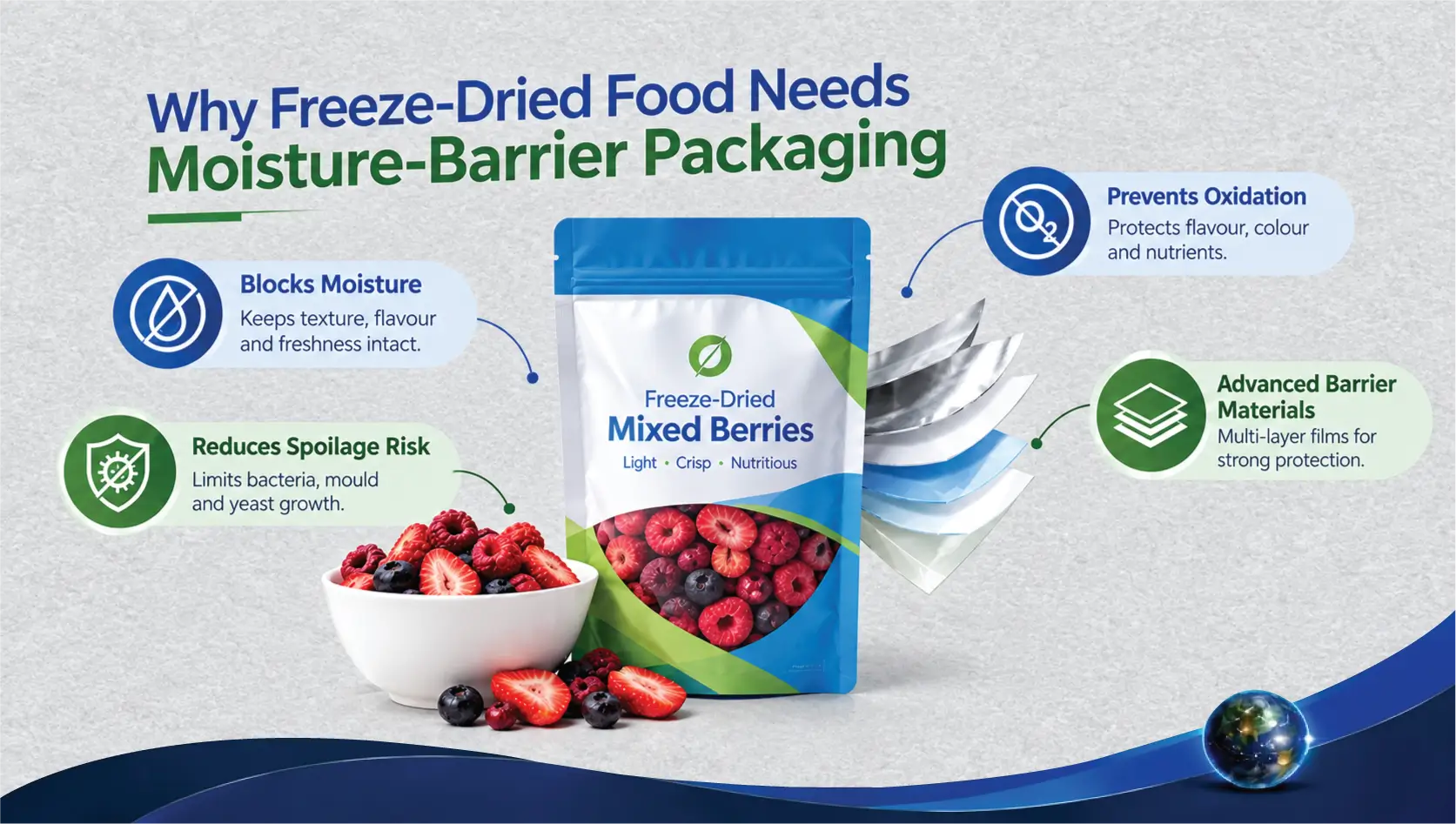
What You’ll Learn
- The Freeze-Drying quick Process: how moisture is removed from food through lyophilization.
- Moisture Risks: why exposure to humidity is created in freeze-dried food.
- Quality Loss: how texture, flavour, and nutrient retention are affected.
- Barrier Materials: which films and laminates are offered for protection.
- Sealing Methods: how heat sealing and hermetic seals are used to maintain freshness.
- Storage Best Practices: conditions under which shelf life is extended further.
- Sustainable Options: how recyclable and compostable packaging of the product fit into the article.
- Regulatory Standards: the Canadian and international numbers behind safe packaging of the product.
Each of these points is offered as a piece of the larger answer to why freeze-dried food needs moisture-barrier packaging, and every section ahead is designed on this foundation.
Reasons To Use Moisture Barrier Packaging
Moisture-barrier packaging is important for freeze-dried food because even small amounts of humidity may affect texture, flavour, and overall quality. This is the main reason why freeze-dried food needs moisture-barrier packaging, as a suitable barrier layer and secure seal are used to limit moisture exposure and maintain the desired condition of the food during storage.
Reduce Moisture Damage: Texture, Taste, Nutrition Loss
Once humidity re-enters a freeze-dried product, quality loss begins, explaining why freeze-dried food needs moisture-barrier packaging. Texture, flavour, and freshness may be affected by moisture exposure.
- Texture Collapse: a light, crisp bite is replaced by a soft or leathery one.
- Flavour Fade: volatile aroma compounds are diminished as moisture is spread unevenly through the product.
- Rehydration Problems: the intended rehydration behaviour is thrown off, and uneven results are left in the final dish.
- Nutrient Loss: vitamins sensitive to moisture and heat are gradually reduced.
This is another reason why freeze-dried food needs moisture-barrier packaging that is held to a tight seal for the entire storage period. Up next, a more serious concern is examined: what is invited in when that same moisture creeps back.
Lessen Microbial Growth Risk From Moisture Exposure
Moisture is not only a texture problem but a food safety problem as well. Once water activity is raised above a safe threshold, the conditions needed for bacteria, mould, and yeast to grow are created. Integrity of the packaging is therefore treated as a safety measure, not just a cosmetic one, in any facility where dehydrated foods or ready-to-eat meals are handled. This safety dimension is a core reason why freeze-dried food needs moisture-barrier packaging that is validated, sealed, and tested before distribution. The following section turns to a related but chemical threat, rather than a biological one.
Decrease Moisture-Driven Oxidation and Rancidity
The reason why freeze-dried food needs moisture-barrier packaging becomes clear when moisture and oxygen pass through a weak pack together. Rising humidity and oxygen exposure accelerate fat oxidation inside the product, while rancid odours and off-flavours may appear when the barrier fails. A strong moisture barrier paired with a strong oxygen barrier is therefore needed for better protection of the product. This dual protection maintains freshness and quality during storage, further explaining why freeze-dried food needs moisture-barrier packaging.
How Moisture-Barrier Packaging Prevents Spoilage
Understanding why freeze-dried food needs moisture-barrier packaging requires attention to several measurable properties, with each one linked to a specific outcome:
- Moisture Resistance: water vapour is kept from migrating into the pack.
- Hermetic Seal: an unbroken, airtight closure is formed along every edge of the bag.
- Airtight Packaging: both oxygen and moisture are excluded from the internal atmosphere.
These properties are what summarize why freeze-dried food needs moisture-barrier packaging designed to a defined performance standard, rather than a generic wrap. For freeze-dried food applications, the right bag structure is equally important for maintaining moisture and oxygen protection. Explore Mylar Freeze Dry Bags for information about barrier protection, sealing, and long-term storage options.
Best Materials For Moisture-Barrier Food Bags
Packaging materials are chosen based on how well a barrier film is performed against both moisture and oxygen, and this choice is central to why freeze-dried food needs moisture-barrier packaging designed from the right structure. A few structures are consistently favoured across the industry.
Foil Laminate Pouches Explained
An aluminum foil laminate is often layered between plastic films, and strength is combined with an almost total barrier against light, oxygen, and moisture in this way. A Custom Printed Foil Pouch is commonly selected for long-term storage projects for this reason, and this is one more example of why freeze-dried food needs moisture-barrier packaging designed from proven materials.
Mylar material For Long-Term Storage
Metallized film, frequently referred to as mylar, is valued for a thin profile and strong resistance to vapour transmission. Gusseted Mylar Bags are widely offered in bulk emergency food storage, where shelf stability over several years is required, and this stability is another reminder of why freeze-dried food needs moisture-barrier packaging designed for the long term.
Multi-Layer Barrier Film Structure
Multi-layer packaging is constructed by combining several materials, such as polyethylene (PE), polypropylene (PP), PET film, and nylon or polyamide film, with an EVOH barrier layer placed in the middle. A Custom Packaging Mylar Bag or a Custom Kraft Stand Up Pouch is frequently designed on this layered principle, and strength, printability, and barrier performance are balanced as a result, which is a further illustration of why freeze-dried food needs moisture-barrier packaging designed in layers.
“Good things come in small packages.” — Aesop
For a deeper comparison of this packaging format, the next step is to explore Mylar Bags For Freeze-Dried Food: Benefits and Considerations, where barrier performance, storage suitability, sealing requirements, and practical considerations are examined in greater detail.
High-Density Polyethylene (HDPE) Films
HDPE films are recognized for strong moisture resistance polyester and are often included in packaging structures where protection from humidity is important. Their use is particularly suitable for dry food products requiring reliable moisture control during storage.
Polypropylene (PP) Films
Polypropylene films are valued for moisture resistance, clarity, and heat-sealing performance. Their role in barrier packaging also helps explain why freeze-dried food needs moisture-barrier packaging, particularly when PP is combined with other protective layers.
Polyethylene (PE) Films
PE films are commonly included as inner sealing layers where reliable heat sealing and moisture resistance are required. When PE is combined with higher-barrier materials, stronger protection of the product is provided, further showing why freeze-dried food needs moisture-barrier packaging.
Vacuum-Sealed Bags Benefits
Trapped air is removed before the final seal is made in vacuum-sealed flexible packaging, and both oxidation and moisture migration are slowed as a result. A Customized Stand Up Pouch, a Retort Bag, or Laminated Flexible Bags are typical formats where vacuum sealing is paired with heat sealing for maximum protection of the product. This material overview underlines, once again, why freeze-dried food needs moisture-barrier packaging designed from proven, tested layers rather than a single film. The next section turns to smaller components that reinforce these barriers from the inside.
Direct Comparison Of Common Packaging Materials
The following comparison highlights why freeze-dried food needs moisture-barrier packaging and how different materials are rated for moisture protection:
| Material | Moisture Barrier Level | Best Used For | Key Advantage |
| Aluminum Foil Laminate | Excellent (Absolute) | Freeze-dried meat, long-term survival food | Complete block against moisture and light |
| Mylar (Metallized) | Excellent | Freeze-dried fruits, vegetables, coffee | Highly puncture-resistant and flexible |
| HDPE | Good | Cereal liners, bulk dry ingredients | Cost-effective and moisture-resistant |
| PET (Standard) | Moderate | Short-term snacks, soda bottles | High clarity and strength |
| LDPE / Ziploc bags | Poor | Daily sandwich storage, short-term use | Easy to seal but allows moisture seepage |
Sustainable And Recyclable Packaging Options
Sustainable packaging of the product is gaining ground as alternatives that do not compromise barrier performance are looked for. Monomaterial packaging and compostable packaging structures are being tested to reduce packaging waste, while recyclable packaging streams are expanded through better recycling infrastructure. A balance between recycling goals and strong barrier numbers is still being refined across the industry, and this trade-off is part of why freeze-dried food needs moisture-barrier packaging that is engineered thoughtfully, not chosen by default. The closing thoughts on presentation of the product and trust are shared next.
Role Of Moisture Absorbers And Oxygen Scavengers
Small internal components are frequently paired with the outer barrier for extra insurance:
- Desiccant Packets: trace humidity that is introduced during filling or sealing is soaked up.
- Oxygen Absorbers: residual oxygen inside the pack is neutralized after closure.
These small additions are a practical answer to why freeze-dried food needs moisture-barrier packaging paired with internal support, not just an external film. Regulatory expectations around all of this are discussed next.
Canada Packaging Regulations And Certification Standards
Understanding why freeze-dried food needs moisture-barrier packaging also involves the Canadian regulations that govern packaging of the product. For freeze-dried food sold in Canada, requirements are set under the Food and Drugs Act, Food and Drug Regulations, Division 23, Section B.23.001, Consumer Packaging and Labelling Act, and Canada Consumer Product Safety Act. Food-contact materials are required to be suitable for their intended use, while bilingual English and French labelling requirements are also addressed. ASTM F1249 and ASTM E96 are used for water vapour transmission testing, further supporting why freeze-dried food needs moisture-barrier packaging.
Proper Storage Conditions Extend Shelf Life
Even the strongest barrier film achieves better performance when external conditions are controlled. A cool, dry, dark environment is recommended for long-term storage, particularly for emergency food storage supplies and dehydrated ready-to-eat meals kept for several years. Extended shelf life is achieved when temperature swings and direct sunlight are avoided, since seal fatigue over time is accelerated by both. This dependency between environment and material is a final, practical reason why freeze-dried food needs moisture-barrier packaging paired with sensible storage habits.
Quality Packaging Designed Consumer Trust Long-Term
The reputation of the brand over time is closely tied to packaging performance. A well-done Custom Logo Food Pouch, printed with screen and UV printing rather than older methods, is what supports the presentation of the product on crowded shelves. A Child Resistant Reclosable Bag or a Custom Clear BOPET Bag is where a layer of practical convenience is added, one that is noticed and remembered by customers. When personalized packaging design is paired with reliable barrier performance, a quiet driver of repeat purchases and recognition of the brand is created. This is the final, business-focused answer to why freeze-dried food needs moisture-barrier packaging that is engineered with care.
“Customers will occasionally buy products not because they want them but because of how they are presented to them.” — James Clear
For customized freeze-dried food packaging solutions tailored to your product requirements, explore Canadian Custom Packaging and discover suitable options for your packaging needs. Ready to get started? Contact Now to discuss your custom packaging requirements with our team.
Conclusion
Moisture, oxygen, and storage conditions were each shown as risks to freeze-dried food in different ways, while barrier materials, certifications, and internal absorbers were presented as a layered solution. In the end, the reputation of the brand, customer safety, and freshness of the product are protected through one simple decision: choosing moisture-barrier packaging that is properly designed. This clearly explains why freeze-dried food needs moisture-barrier packaging, whether the focus is safety, quality, or regulatory compliance.
Frequently Asked Questions (FAQs)
What is the difference between moisture-barrier packaging and regular plastic packaging?
The difference explains why freeze-dried food needs moisture-barrier packaging. Regular plastic allows more moisture and oxygen transmission, while laminated or metallized structures provide stronger barrier protection.
How long is the shelf life of freeze-dried food when proper packaging of the product is used?
With a strong barrier film, hermetic seal, and proper storage, shelf life is often extended for many years. CustomPackaging Mylar Bags are commonly considered for long-term freeze-dried food storage.
Are desiccant packets and oxygen absorbers both necessary in the same pouch?
In many cases, yes. Residual humidity is managed by desiccant packets, while leftover oxygen is targeted by oxygen absorbers. Together, two separate risks are reduced that a single film is not able to fully control on its own.
Is aluminum foil laminate better than plastic film for freeze-dried food?
A superior barrier against light, oxygen, and moisture is generally offered by foil laminate when compared with plain plastic film. This is why it is favoured for long-term or emergency storage applications.
Can sustainable or recyclable packaging still provide effective protection for freeze-dried food?
Yes, though a careful balance is required. Monomaterial and compostable structures are advancing quickly, but barrier performance is still tested rigorously before such packaging is approved for long shelf-life products.
Where are freeze-dried food packaging solutions purchased?
Specialized suppliers of packaging, including stand-up pouches, mylar bags, and Retort Bags, are a reliable source. Custom printing, certification support, and universal packaging formats suited to different production volumes are offered by many of these suppliers.
What printing methods are recommended for custom freeze-dried food pouches?
Screen and UV printing are suitable for personalised packaging applications. Custom Clear BOPET Bags are also considered when product visibility and presentation are important.
Is child-resistant packaging of the product relevant for freeze-dried food products?
For household or specialty items, a Child Resistant Reclosable Bag is sometimes required or preferred. A safety feature is added on top of standard moisture and oxygen protection of the product in this way.