Every drop of sauce benefits from convenient dispensing. However, leakage around the spout, unsuitable opening diameters, and difficult cap fitting are challenges for food brands. Karibbean Flavours, a Caribbean food brand operating under RHS Marketing Limited in Trinidad and Tobago, offers condiments distributed internationally, including Canada. In this blog, Managing Director Ravi Sankar contacts Universal Packaging after reading positive customer reviews and consults Kevin Ziller to find a packaging solution that meets his requirements while addressing the issues experienced with previous formats. The discussion explores the recommendation of Spouted Sauce Pouches: Sizes, Closures and Applications by a packaging expert, with particular attention to dispensing, secure sealing, and suitable dimensions. Scroll down and have a look to find the problem and solution.
Client’s Experience with Previous Sauce Packaging
Ravi wanted a convenient packaging format for selected sauces. His expectations included easy dispensing, secure closure, and consistent presentation. The existing range included 500 ml BBQ sauce products, and the team considered spouted sauce pouches: sizes, closures and applications for additional sauce varieties. Three concerns received particular attention.
1. Sauce Leakage Around the Spout
Kevin Ziller identified the first concern during the packaging review, observing leakage around the fitment attachment area. Even a small amount of sauce around the opening created an unpleasant experience during handling and repeated use. The attachment area included the fitment flange, surrounding film, and heat-sealed connection. Incorrect sealing temperature, pressure, or dwell time could result in weak bonding. Sauce residue between the film and fitment also affected consistent attachment. Therefore, the team wanted additional checks before approving spouted sauce pouches: sizes, closures and applications for production.
2. Incorrect Spout Diameter
After examined the spout and observed that its internal diameter was not appropriate for the required sauce flow. The second concern involved the internal diameter of the spout. Ravi wanted customers to dispense thicker BBQ and jerk sauces without excessive squeezing. A narrow opening restricted the flow, while an excessively wide opening released larger quantities during pouring. The diameter therefore required comparison according to sauce consistency. The length of the spout, pouring angle, and position of the opening also deserved attention. Spouted sauce pouches: sizes, closures and applications are considered according to these practical requirements.
3. Closure Compatibility
Inspected the cap and threaded spout and identified an issue with their fit and alignment. The third concern involved the relationship between the cap and threaded spout. Incorrect thread engagement, unsuitable cap dimensions, or inconsistent tightening affected closure performance. A loose cap increased the risk of leakage, while excessive tightening made repeated opening inconvenient. The team wanted to compare suitable closures before finalizing spouted sauce pouches: sizes, closures and applications.
Key Considerations for Sauce Pouches by Packaging Expert
Packaging expert discussed the filling process, sauce consistency, storage conditions, and dispensing preferences with the production team. He reviewed the complete packaging format instead of focusing on the spout alone. His observations covered the following areas. These considerations form the basis for evaluating spouted sauce pouches: sizes, closures and applications.
Spout Attachment and Heat-Sealing Conditions
He examined the width, spout alignment, sealing surface, and compatibility between the fitment and inner sealing layer. Three factors received attention:
- Sealing temperature: Required to activate the inner sealing layer.
- Sealing pressure: Required for consistent contact between the film and fitment.
- Dwell time: The period during which heat and pressure remained applied.
Clean sealing surfaces were important for consistent bonding in spouted sauce pouches: sizes, closures and applications. Discover how the right spout selection addresses these concerns.
Spout Diameter and Sauce Viscosity
Thicker sauces required different dispensing conditions from thinner varieties. Ingredients, processing conditions, and temperature also influenced how easily the sauce passed through the opening. Kevin reviewed measurements recorded by his technical team, who examined the internal and external diameters, length, and opening position using digital callipers and measuring gauges. Dispensing quantities were compared using graduated cylinders to determine suitable flow conditions.
Cap and Thread Compatibility
Kevin reviewed the cap depth, contact surface, and tightening consistency. The selected cap needed to engage correctly without becoming excessively tight or loose. Tamper-evident closures also received consideration for products requiring an indication of first opening. These observations confirmed that leakage, dispensing, and cap fitting needed to be evaluated together.
Packaging Expert Recommendations for Sauce Pouch Design
After reviewing the requirements, Kevin recommended comparing three important areas.
1. Selecting a Suitable Spout Diameter
Smaller openings received consideration for thinner sauces requiring controlled dispensing. Wider openings were considered for thicker sauces requiring easier flow. The final diameter needed confirmation through practical pouring trials rather than appearance alone. This comparison was important when selecting spouted sauce pouches: sizes, closures and applications. A Custom Taco Bell Sauce Packets that is too small may make filling and sealing difficult.
2. Improving Fitment Attachment
Kevin recommended a fitment with suitable flange dimensions and compatibility with the inner PE sealing layer. The following conditions received attention:
- Consistent heat distribution.
- Correct fitment positioning.
- Clean sealing surfaces.
- Suitable pressure and dwell time.
- Repeated leakage testing.
The team also discussed fitment materials according to the filling process and storage conditions.
3. Choosing a Compatible Cap
Kevin recommended caps with matching threaded spouts. The position is an important factor in spouted sauce pouches: sizes, closures and applications. The selected combination required consistent thread engagement, convenient opening, and secure closure of sauce spout pouch tomato packaging. Tamper-evident features were also discussed for suitable sauce products. For insights into pouch designs and sourcing options, explore examples from Sauce Pouch Packaging Suppliers.
Additional Packaging Suggestions from Kevin
Kevin explained that the dimensions of the stand up spout pouch for tomato sauce packaging, material structure, and presentation of the product also required consideration.
- Stand-up base: Consider a spout pouch for tomato sauce packaging for larger quantities requiring upright storage.
- Transparent window: Discussed for designs requiring visibility of the sauce.
- Matte and gloss finishes: Compared according to the desired presentation of the brand.
PET was reviewed for printing and surface protection, PA for puncture resistance, and PE for heat sealing and suitable food-contact use. The final structure and thickness required confirmation through compatibility and shelf-life testing. Oxygen transmission rate (OTR) and water vapour transmission rate (WVTR) testing were also recommended where necessary. To compare packaging styles for different condiments, take a look at the solutions shown by Condiment Packaging Companies. These suggestions gave Ravi a clearer understanding of spouted sauce pouches: sizes, closures and applications.
Ravi Sankar Approval on the Requirements & Further Updates
Ravi agreed to proceed with sample comparisons after reviewing Kevin’s recommendations. The updated requirements included a suitable spout diameter, secure fitment attachment, and compatible screw caps for repeated opening and closing. For the 500 ml format, the team considered width, height, bottom gusset, filled volume, and headspace. Kevin explained that external measurements alone did not determine actual capacity. Sauce volume, standing sauce pouch packaging shape, filling conditions, and required headspace also influenced the final dimensions. Ravi wanted consistent artwork across the selected sauce varieties. The updated specifications were shared with the designers for spouted sauce pouches: sizes, closures and applications. For a closer look at compact, single-serving formats, browse examples of Sachet Condiment Packets used for portion-controlled servings.
Which Pouch Size Fits Best According to Kevin?
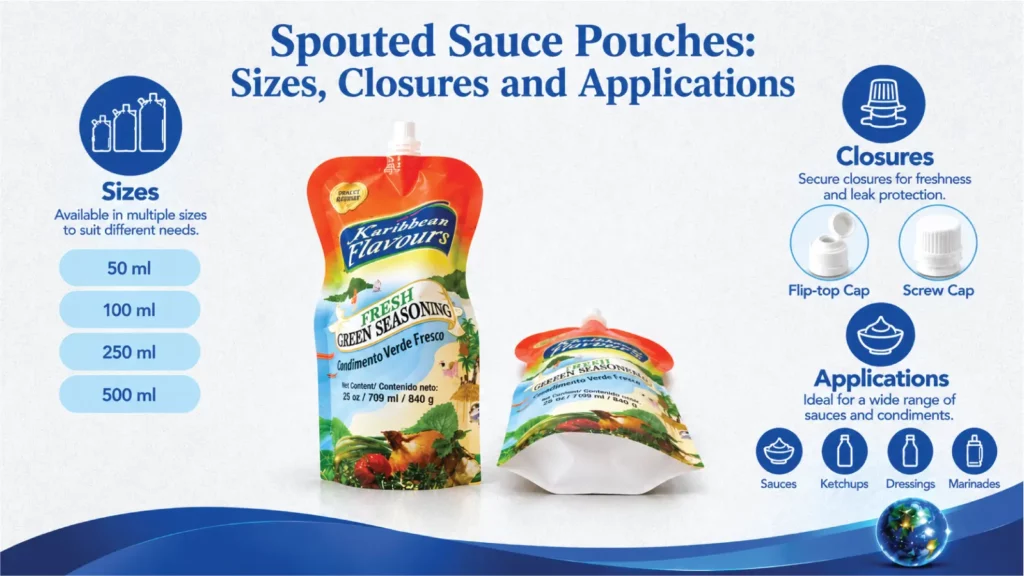
A 100 ml pouch has different requirements from a 250 ml or 500 ml format. Sauce quantity, viscosity, headspace, filling equipment, and storage arrangements influence the final dimensions.
Kevin recommended comparing these planning capacities:
|
Sauce quantity |
Potential use |
|
50–100 ml |
Samples and small portions |
|
100–150 ml |
Individual servings |
|
200–250 ml |
Smaller household quantities |
|
350–500 ml |
Regular household quantities |
|
750–1000 ml |
Larger household or food-service quantities |
The actual dimensions should be calculated according to the density of the sauce, the required fill quantity, headspace, pouch construction, and spout position. To explore packaging ideas for organic applesauce products, check out samples of Apple Sauce Pouches Organic in different sizes and styles. Actual width and height depend on material, gusset, filling volume, and required headspace. Smaller formats receive consideration for individual portions, while larger formats are considered for repeated household use and food-service requirements. Selecting spouted sauce pouches: sizes, closures and applications therefore requires attention to the intended quantity and dispensing experience.
Universal Packaging Announces Custom Packaging Standard Quantity Options
Director manager expanded custom packaging options, with order quantities of up to 100,000 units for Canadian businesses. Customers receive flexibility in selecting dimensions, materials, printing, and finishes according to their requirements. All packaging information and environmental claims must follow applicable Canadian legislation, including the Consumer Packaging and Labelling Act, R.S.C. 1985, c. C-38, and its regulations. Food packaging must also comply with applicable Safe Food for Canadians Regulations, SOR/2018-108.
Explore Suitable Closure Options for Sauce Packaging
Kevin would present the following options for consideration:
- Screw cap: A familiar option for repeated opening and closing.
- Flip-top cap: May be convenient when frequent dispensing is expected.
- Tamper-evident closure: Can provide visible evidence of initial opening when an appropriate design is selected.
- Specialized dispensing fitment: May be considered for thicker sauces or controlled dispensing applications.
Connecting With Universal Packaging Designers
Kevin discussed with designer that are Justin Daniel, packaging designers at Universal Packaging. Justin prepared the initial mock-ups, while William reviewed the artwork, spacing, and placement of the required information.
Their discussion covered:
- Branding logo: Positioned prominently on the front panel.
- Name of Product: Arranged clearly to distinguish sauce varieties.
- Spout Position: Considered near the top corner with sufficient fitment clearance.
- Nutritional Information: Arranged according to applicable Canadian labelling requirements.
- Printing Colours: Reviewed for consistency across sauce varieties.
Important information remained away from areas where attachment and sealing operations took place. Minor adjustments were made to the logo position, spacing, and artwork alignment. The updated mock-up reflected the requirements for spouted sauce pouches: sizes, closures and applications.
“I like the whole package to be good. It’s a rarity that that happens, so I end up not working a lot.” — Robin Wright Penn
Preparing and Testing the Pouch Mock-Ups Of Ravi
The approved artwork moved into sampling of spouted sauce pouches: sizes, closures and applications. Kevin coordinated the technical requirements with production, while the designers supplied the finalized artwork.
1. Digital or Gravure Printing
The printing method was considered according to production quantity and artwork requirements. Gravure printing involved engraved cylinders transferring ink onto the outer film. Digital printing was also considered for shorter sampling runs. Colour, registration, and artwork appearance received attention.
2. Film Lamination
The printed outer film was bonded with the selected layers. A PET/PE structure included an outer PET layer for printing and surface protection and an inner PE layer for heat sealing. PET/PA/PE was also considered where additional puncture resistance was required. As you can see in Custom Printed Foil Pouches that contain multiple barrier layers. Material compatibility is central to choosing spouted sauce pouches: sizes, closures and applications.
3. Pouch Formation
A pouch-making machine formed the laminated film into the selected shape. The production team checked width, height, bottom gusset, and side sealing areas according to the intended filling quantity.
4. Spout Insertion
The fitment was positioned between designated film sections. A spout insertion and sealing system applied controlled heat and pressure around the flange.
5. Cap Fitting
The screw cap was fitted onto the threaded spout. The team checked thread engagement, tightening consistency, and opening convenience.
6. Filling and Leakage Testing
Sample pouches were filled with representative sauce or a suitable test liquid. The team examined the fitment attachment, pouch seals, and cap connection. The checks included:
- Sealing strength testing.
- Burst testing.
- Visual inspection.
- Cap fitting checks.
- Repeated opening and closing trials.
- Filled-pouch handling tests.
The samples were also reviewed for convenient dispensing and comfortable handling. These procedures helped the team compare different combinations of spouted sauce pouches: sizes, closures and applications.
Applications of Spouted Sauce Pouches Across Different Industries for different Clients
Standing up pouch with spout for sauce packaging are suitable for different sauce categories, depending on their consistency, serving quantity, and dispensing requirements. Kevin also recommended considering the following applications:
-
BBQ Sauces: Suitable for thicker sauces that require controlled pouring during cooking, grilling, and serving.
-
Jerk Sauces: Convenient for dispensing marinades and sauces during food preparation and seasoning.
-
Hot Sauces: Suitable for smaller quantities where controlled dispensing and repeated closure are important.
-
Food-Service Sauces: Larger pouch capacities are considered for restaurants, catering businesses, and commercial places.
If you want to see how different sauces are packed for convenient pouring and storage, explore these options of Packaging For Sauces. The final pouch size, spout diameter, and closure are selected according to the consistency and intended use of each sauce. The use of spouted sauce pouches: sizes, closures and applications therefore includes the existing production setup. Moving forward, let’s explore how the right tomato sauce packaging stand up pouch dimensions complete the packaging decision!
Technical Complexities in Spouted Sauce Pouch Applications By Packaging Expert
In spouted sauce pouches: sizes, closures and applications, different sauces create different packaging challenges because of variations in viscosity, ingredients, and dispensing requirements. Thick BBQ and jerk sauces require wider spout openings to prevent restricted flow, while thinner hot sauces need controlled dispensing to avoid excessive pouring. Fitment attachment, heat-sealing conditions, cap compatibility, and leakage prevention also require technical attention. Kevin Ziller recommended evaluating these factors according to the characteristics and intended use of each sauce.
Final Sample Approval and Feedback from Client
The revised samples received another round of technical and visual evaluation. The spout opening was compared according to dispensing behaviour. The cap was checked for secure look, while the fitment attachment received additional attention during leakage testing.
Ravi reviewed three requirements: convenient dispensing without excessive squeezing, secure closure after repeated opening, and consistent product presentation. The revised direction received positive approval within this illustrative project, subject to final specifications and applicable food-contact requirements. The demonstrated why spouted sauce pouches: sizes, closures and applications require combined consideration of pouch dimensions, spout diameter, and closure compatibility. This approach guides decisions about spouted sauce pouches: sizes, closures and applications. Contact experts now!
Six-Month Customer Feedback on Packaging Performance
After six months of use, the customer shared positive feedback on the packaging performance, giving us a closer look at the results of the final solution. Choosing the right sauce pouch becomes easier when you understand which size, closure, and their applications suit best for our bags, but here to add the specific selected feature option you must have to add on the specific type of the bags, but which types are considered the most popular options for different sizes & closures, let’s get involved and read Different Types Of Sauce Pouches For Food Packaging, to know the types in a few minutes.
Conclusion
Selecting suitable spouted sauce pouches: sizes, closures and applications involves more than choosing an attractive format. The internal diameter of the spout, compatibility of the cap, strength of the fitment attachment, and dimensions of the pouch all deserve careful consideration. Through Kevin Ziller’s recommendations, this illustrative Karibbean Flavours demonstrates how these requirements receive attention during packaging development. At Universal Packaging, food brands receive guidance on flexible packaging formats, printing, materials, and closures. Whether you need small sauce pouches or larger stand-up formats, our team offers free design support, flexible specifications, and competitive pricing. Explore Universal Packaging and discuss your next sauce packaging project with our team.