The material of the package is usually chosen first because it plays an important role in food protection, sustainability, and the reputation of the brand. Today, Eco-Friendly Popcorn Packaging Options are no longer treated as a minor topic within the snack industry. Instead, greater attention is being given to compostable bags, recyclable boxes, and responsibly sourced materials. Behind every solution, a thoughtful decision is made about the packaging of the product. Scroll down to discover how eco-friendly popcorn packaging options are evaluated for sustainability, performance, and long-term value.
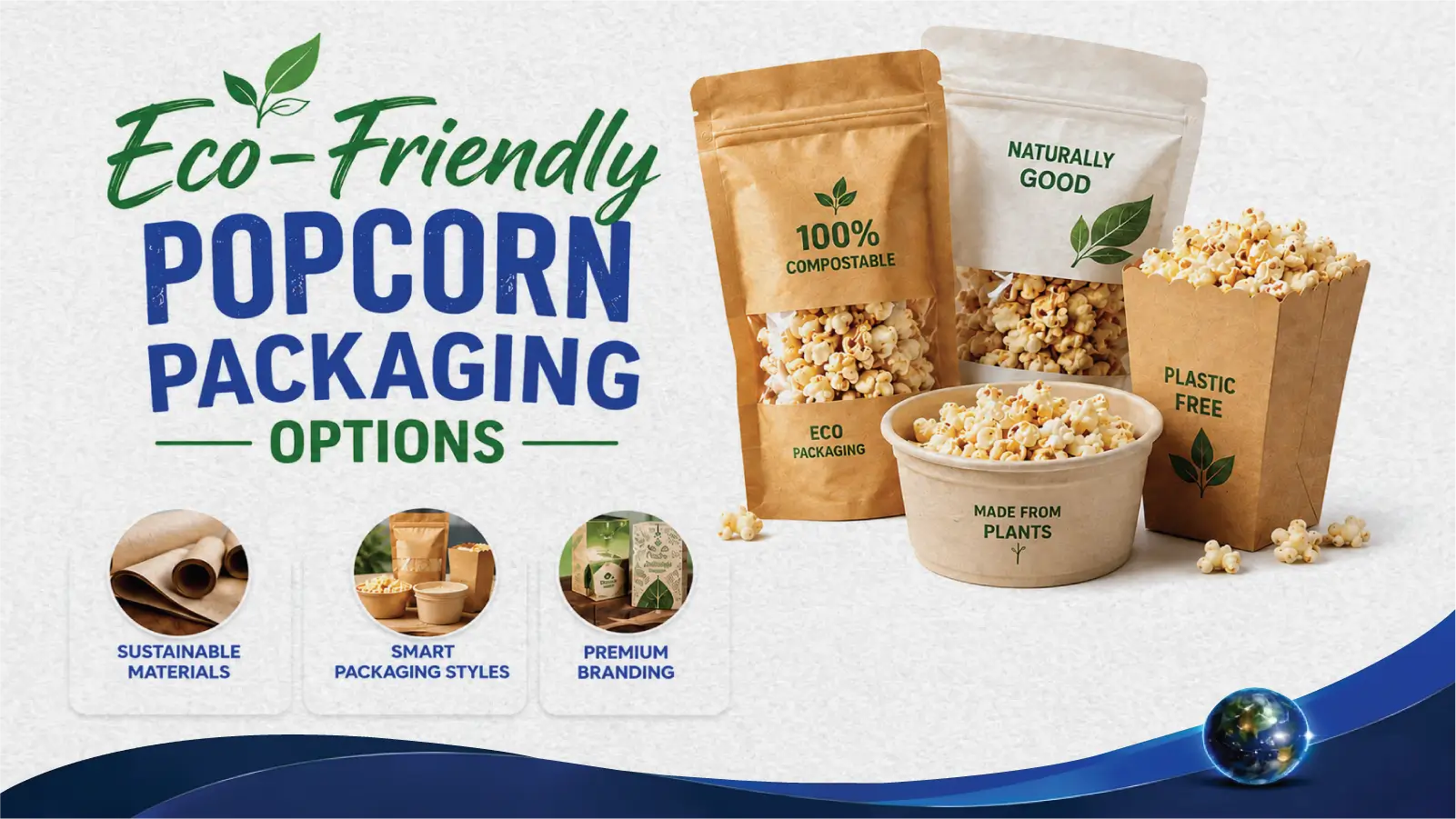
Material Options For Eco-Friendly Popcorn Packaging
Before a snack is picked from a retail shelf, attention is often drawn to the material used for the packaging of the product. Therefore, when eco-friendly popcorn packaging options are compared, the raw material is treated as the starting point of every evaluation.
Kraft Paper Bags
Wide recognition is given to Custom Printed Kraft Boxes kraft paper bags because recyclability and a natural appearance are associated with paper. However, the strength of plain paper is reduced quickly when butter or oil is absorbed. For this reason, a grease-resistant paper lining, often produced with PLA, is added so that greater durability is achieved. A Custom Kraft Stand Up Pouch is offered for retail shelves and multi-serve counters.
Among all eco-friendly popcorn packaging options, strong preference is often given to kraft paper because a balance between sustainability, durability, and print quality is achieved. In addition, greater trust is often associated with this material by environmentally conscious consumers.
Compostable Popcorn Bags and Films
For a clear window and a heat-sealed finish, compostable popcorn bags produced from PLA or PBAT blends are frequently selected. A strong moisture barrier is incorporated into these films, while either a matte finish or a gloss finish is chosen according to the presentation of the product intended for the retail shelf. In most cases, proper decomposition is achieved only within industrial composting facilities.
Through these materials, a wider selection of eco-friendly popcorn packaging options is offered to snack brands seeking environmentally responsible alternatives. At the same time, food protection and shelf presentation are maintained when the appropriate barrier properties are selected.
Molded Fiber and Bagasse Containers
Sugarcane fibre, widely known as bagasse, together with bamboo fibre and recycled cardboard, is pressed into tubs and paper popcorn tubs for the traditional theatre-style bucket. A Child Resistant Reclosable Bag finish is applied so that the quality of the product is maintained throughout use. Compliance with food-grade packaging requirements is also achieved without difficulty.
Recycled Paperboard Boxes
A gable-top or gusseted structure is formed from recycled paperboard, and a die-cut design or window cutout is added to custom popcorn boxes so that the presentation of the product is improved without a full plastic film being wrapped around the package. Through this approach, the amount of packaging material is reduced while clear visibility of the product is still maintained.
Consequently, once a suitable material has been shortlisted, attention is shifted toward the performance requirements that must be met before eco-friendly popcorn packaging options are introduced to the retail market. Food protection, durability, and regulatory compliance are all evaluated before a final packaging format is chosen.
After selecting the right material, attention is often shifted toward the visual appeal of gourmet popcorn packaging. Premium finishes, creative structures, and attractive presentation ideas are discussed in more detail in Best Popcorn Packaging Ideas for Gourmet Brands. So, get the deep dive now!
Practical Performance Requirements
Careful evaluation is carried out before eco-friendly popcorn packaging options are selected for food-contact use. A barrier is now preferred over older grease-resistant coatings because the use of chemicals is being reduced across many markets. Through this approach, protection of the product is maintained while greater confidence is placed in food safety.
- Shelf Life Requirements: A lighter barrier is generally chosen for freshly prepared popcorn because early consumption is expected. By comparison, a stronger moisture barrier is required for pre-popped popcorn intended for retail distribution and longer storage. In this way, eco-friendly popcorn packaging options are matched with the storage requirements of the product.
- Portion Formats: A single-serve pouch is commonly chosen for convenience stores, while a family pack is preferred for supermarkets and takeaway sales. Bulk packaging is generally selected for wholesale distribution and food service operations so that different requirements of the brand are met efficiently.
- Stack-Friendly Design: Greater efficiency during storage and transportation is achieved when stack-friendly packaging structures are selected. Damage during handling is reduced, warehouse organization is improved, and smoother logistics are achieved throughout the supply chain. As a result, eco-friendly popcorn packaging options are evaluated for durability as carefully as appearance.
“Good things come in small packages.”— Aesop
Sustainable Design And Branding Choices
Printing Method
Preference is now given to soy-based inks and water-based coatings because a lower environmental impact is associated with these alternatives. Screen and UV printing are selected for Gusseted Mylar Bags so that sharper graphics, consistent colour reproduction, and a premium finish are achieved.
Mono-Material Structure
A mono-material structure is preferred whenever possible because easier recycling is achieved after disposal. Fewer material layers are incorporated into a Custom Logo Food Pouch or Custom Printed Foil Pouches format so that sustainability goals are supported.
Window and Cutout Details
A small window cutout is often incorporated instead of a full plastic panel. Within Laminated Flexible Bags, this approach is adopted so that the presentation of the product is improved while unnecessary packaging material is reduced.
Accurate Labelling
Compostable and recyclable claims are expected to match recognized certification standards. Particular attention is given to bilingual labelling within Canadian markets, so that regulatory compliance is maintained and the reputation of the brand is strengthened.
Looking for packaging that supports sustainable goals while maintaining protection of the product? Explore Biodegradable Popcorn Packaging solutions designed for modern snack brands.
“Customers will occasionally buy products not because they want them but because of how they are presented to them.” — James Clear
Environmental Impact And Economy Considerations
Lower transportation emissions are generally associated with locally sourced materials because shorter shipping distances are involved. Consequently, eco-friendly popcorn packaging options sourced locally are often preferred over imported alternatives whenever suitable materials are offered.
- Water Consumption: Greater water usage is commonly associated with conventional paper production, whereas a lower environmental footprint is often achieved through bagasse and moulded fibre alternatives. As a result, environmental performance is improved throughout the life cycle of the package.
- End-of-Life Disposal: A clear distinction is maintained between compostable, biodegradable, and recyclable packaging. Compostable material is broken down under controlled conditions, recyclable material is processed into new products, and misleading environmental claims are treated as greenwashing.
- Reuse Before Disposal: Reusable jars are often selected for premium collections and seasonal promotions.
For large retail operations, a stronger preference is generally given to plastic-free packaging and zero-waste packaging whenever practical. Through this approach, eco-friendly popcorn packaging options are aligned with circular economy principles while the reputation of the brand is strengthened through responsible packaging choices.
Cost And Supply Chain Factors
Choosing eco-friendly popcorn packaging options often involves balancing cost with long-term value. A higher upfront investment is generally associated with compostable and fibre-based materials than with conventional plastic packaging. However, greater confidence from consumers, compliance with packaging regulations, and an improved reputation of the brand are often achieved over time. Careful supplier selection and production planning are also considered important before a packaging format is finalized.
Supplier Access
- Shorter lead times are often offered by local suppliers.
- A wider range of materials, including custom packaging mylar bags, Retort Bags, and Custom Clear BOPET Bags, is commonly offered by international manufacturers.
- Higher shipping costs are generally associated with imported packaging.
Minimum Order Quantities
- A minimum order quantity between 5,000 and 10,000 units is commonly applied to moulded fibre and compostable film packaging.
- This requirement is often treated as a challenge for small businesses during the early stages of growth.
Room for Growth
- A flexible supplier relationship is recommended from the beginning.
- A smooth transition between packaging formats, such as a Child Resistant Reclosable Bag or a Customized Stand Up Pouch, is achieved more easily as production volume increases.
- Through proper planning, eco-friendly popcorn packaging options are introduced without unnecessary disruption.
This format makes the content more engaging and prevents every section from looking identical.
Canada Packaging Regulations And Certifications
Whenever eco-friendly popcorn packaging options are intended for the Canadian market, compliance with food safety and compostability standards is expected rather than treated as an option. Standards such as CAN/BNQ 0017-088, ISO 17088:2021, ISO 18606:2013, ASTM D6400, ASTM D6868, and EN 13432 are widely recognized for compostable packaging. In addition, compliance with the Safe Food for Canadians Regulations (SFCR) and Food and Drug Regulations, Section B.23.001 is required to ensure food-contact safety. Although compostability certification remains voluntary in Canada, a genuine certification mark is widely regarded as an important indicator of credibility and consumer trust.
Market Trends And Regional Regulations
- Regional Regulations: Restrictions on certain single-use plastic bags have already been introduced in parts of Pakistan, including Punjab and Islamabad. However, compostable packaging regulations have not yet been developed to the same level as those applied in Canada and the European Union.
- Consumer Behaviour: Greater preference is increasingly being shown toward environmentally responsible packaging, particularly among younger urban consumers. As a result, the reputation of the brand is often strengthened when certified eco-friendly popcorn packaging options are selected.
- Competitive Positioning: Careful evaluation of competitor packaging is commonly carried out before packaging decisions are finalized.
Through this process, opportunities for differentiation are identified, particularly where certified eco-claims, QR code packaging, and sustainable materials are incorporated. Consequently, eco-friendly popcorn packaging options are being adopted by a growing number of brands seeking stronger market recognition.
Choose sustainable packaging with confidence. Partner with universalpackaging for personalized biodegradable popcorn packaging solutions. Contact Us Today.
Conclusion
Everything from material choice to Canadian certification numbers has been covered in a single, connected walkthrough, each piece explained in its own style rather than repeated the same way twice. Eco-friendly popcorn packaging options were shown to sit at the intersection of function, compliance, and cost. A grease-resistant lining, a certified compostable film, or a simple recycled box- the choice is offered, not fixed, and the right one depends entirely on the brand behind it.
Frequently Asked Questions (FAQs)
What is meant by eco-friendly popcorn packaging options?
Eco-friendly popcorn packaging options refer to bags, boxes, or tubs made from compostable, recyclable, or plant-based material instead of conventional plastic. Kraft paper, bagasse, and PLA-lined film are commonly included in this category.
Is a compostable popcorn bag suitable for hot, buttered popcorn?
Yes, in most cases, as long as a grease-resistant lining is added to the bag. Without a proper barrier, oil is absorbed quickly, and the strength of the bag is reduced.
Is a difference maintained between biodegradable and compostable packaging?
Yes, a clear difference is maintained. Compostable material is broken down fully under specific, tested conditions, while a biodegradable timeline is often left undefined and could take much longer.
Are custom popcorn boxes offered with a window cutout?
Yes, a window cutout or die-cut design is commonly offered on custom popcorn boxes so that the product inside is shown without a full plastic film being used.
Is screen and UV printing a better choice than older printing methods for eco packaging?
Generally, yes, more precise results are achieved with screen and UV printing, and soy-based inks or water-based coatings are more easily paired with these methods for a non-toxic finish.
What is the typical minimum order quantity for compostable packaging?
A minimum order quantity between five thousand and ten thousand units is usually required for molded fiber and compostable film formats, though this figure is sometimes lower for standard kraft paper.
Is customization offered for eco-friendly popcorn packaging?
Yes, full customization is offered a custom logo food pouch, a Customized stand up pouch, Custom Printed Foil Pouches a specific matte or gloss finish, and a personalized print design are all made possible depending on the format and quantity chosen.
Where are eco-friendly options of popcorn packaging bought from?
A wide range of eco-friendly packaging formats, including a custom kraft stand up pouch, Custom Packaging Mylar Bags, and Custom Printed Kraft Boxes, is offered through specialized packaging manufacturers and wholesale suppliers like Universal Packaging that deliver orders depending on order volume and required certification.
Is plastic-free packaging always more expensive?
In most cases, a higher upfront cost is involved, though this cost is usually offset over time through improved customer trust, regulatory compliance, and reduced environmental impact.