Have you ever wondered why some beef jerky stays fresh, flavourful, and crisp on the shelf for months, while other bags lose their appeal within weeks? The answer often comes down to one overlooked decision, and that decision is exactly what Custom Beef Jerky Bags Vs Standard Food Packaging is all about. In this guide, materials, certifications, pricing, and Canadian regulations are broken down in detail, so that an informed decision is made with confidence. Keep scrolling; the full details are laid out just below.
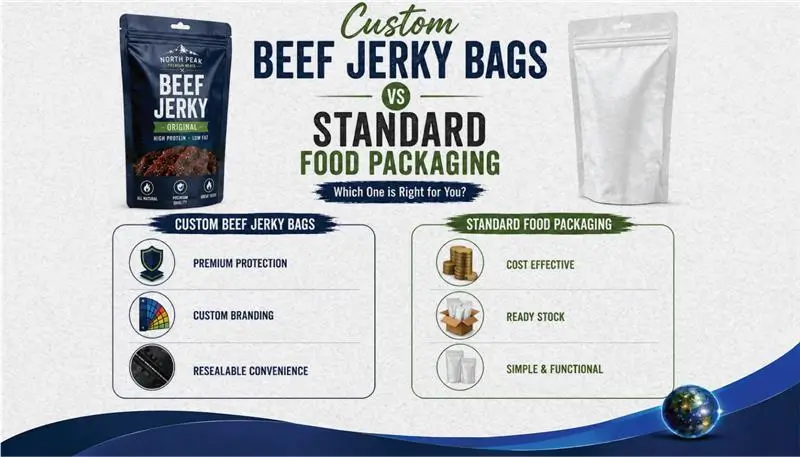
The Importance Of Packaging Quality
To begin with, the quality of the product is directly tied to how it is packaged. Beef jerky is a high-fat, semi-moist snack, so freshness protection and an effective oxygen barrier are considered essential to prevent rancidity. Meanwhile, food-grade packaging is treated as a baseline requirement across the entire beef jerky packaging category, regardless of whether a custom or standard option is chosen.
As a result, shelf life is often extended by several months when the right barrier structure is selected. While choosing between custom and standard packaging is important, understanding How Packaging Protects Beef Jerky Freshness is just as important. The barrier materials, sealing methods, and protective layers inside a package all play a direct role in preserving flavour, texture, and shelf life topics explored in greater detail in our dedicated guide. With that foundation established, the debate around custom beef jerky bags vs standard food packaging begins with the features of custom bags, which are explored next.
“Customers will occasionally buy products not because they want them but because of how they are presented to them.” — James Clear
Custom Beef Jerky Bags: Features That Stand Out
Custom Beef Jerky Bags are flexible packaging pouches designed specifically for beef jerky and other dried meat products.
They are manufactured in custom sizes, materials, thicknesses, and printing designs to match the packaging requirements of food manufacturers and the presentation of the brand. Several elements are found within the custom category, an important starting point for anyone comparing custom beef jerky bags vs standard food packaging, and each one is outlined below:
- Flexible packaging design: stand-up pouches and mylar bags are commonly offered in this category, along with gusset styles similar to Wholesale Gusset Bags.
- Closure and access features: a resealable zipper, tear notch, and hang hole are typically included for consumer convenience.
- Sealing method: heat seal technology is applied along the edges for a secure, tamper-evident closure.
- Order flexibility: smaller brands are increasingly accommodated through low-quantity custom runs offered by several Canadian suppliers.
Once the features of custom bags are understood, the standard packaging alternative deserves a closer look.
Standard Food Packaging: A Practical Overview
Standard Food Packaging refers to packaging manufactured according to commonly accepted industry demands for protecting and displaying food products.
Standard food packaging is typically limited to generic sizes and finishes, one of the clearest distinctions in the custom beef jerky bags vs standard food packaging conversation. Snack packaging and meat packaging bags are usually stocked in bulk by distributors, including Flexible Retort Pouch Packaging Distributors, without much room for personalized branding. Furthermore, retail-ready packaging can still get through the addition of stickers or printed labels. For small businesses testing a new flavour lineup, this route is often chosen because of its lower cost and faster turnaround. From here, the technical side of protection barrier performance is examined in detail.
Barrier Protection: Oxygen, Moisture And Light
Barrier performance is what separates a package that results in jerky fresh from one that does not, and this is where custom beef jerky bags vs standard food packaging is most noticeably decided. High-barrier packaging is typically built with multiple layers, so that an oxygen barrier, a moisture barrier, and an aroma barrier are all achieved within a single structure. Additionally, an odor barrier is maintained through the same laminate, which keeps outside smells from affecting the flavour of the product.
In vacuum packaging, air is removed entirely, a method preferred for longer storage, such as Mylar Pouches Food Storage applications. Freshness is preserved for a longer period when these layers are correctly specified. Next, the materials behind these barrier properties are compared side by side.
Material Composition: Comparing Jerky Bags And Standard Options
Meanwhile, the material selected for a jerky bag plays a defining role in performance, and it remains a central factor whenever custom beef jerky bags vs standard food packaging is being weighed. Several options are commonly compared:
- PET/PE films: clarity and strength are key; Custom Foil Pouch Bags are often selected to help preserve freshness while delivering a premium shelf appearance.
- Kraft paper material: a natural, rustic look is achieved, though barrier films are still added inside for freshness.
- Metallized poly and BOPET Packaging Bags: a lightweight, cost-effective barrier is provided against light and moisture.
A custom foil pouch bag and a Custom Mylar Bag Design are both considered leak-resistant packaging options once sealed correctly. With materials compared, attention now turns to how branding is affected by each choice.
Branding Impact: Custom Bags Vs Stock Packaging
The perception of the brand is often shaped by the very first glance at a package on the shelf, which is why branding sits at the heart of custom beef jerky bags vs standard food packaging discussions. Recommended thickness by the brand, range of 3 to 4 mil, is generally specified for jerky, and Kraft Stand Up Barrier Pouches are usually built within this range for durability.
Custom printing methods including digital printing, screen printing, and CMYK printing are used so that a wide range of colours and finishes is produced accurately. A matte finish, gloss finish, and soft-touch finish are each offered for a different tactile impression, while spot UV coating is added for highlighted logo details. A window pouch is also selected in many cases, since the visibility of the product is improved when the contents are seen before purchase. Through these details, the recognition of the brand is strengthened over time. Upgrade your products with custom Beef Jerky Packaging Bags with Zipper closures for maximum freshness and standout shelf appeal.
Cost And MOQ: Jerky Bag Vs Standard Pricing
Budget plays a central role in this decision, and pricing is often the deciding factor once custom beef jerky bags vs standard food packaging options are placed side by side. Standard bags are usually priced lower per unit, and no design fees are involved. Custom orders, on the other hand, often involve minimum order quantities, though wholesale gusset bags and Custom Stand Up Pouches No Minimum are offered by Canadian suppliers for smaller brands. Portion control formats are also factored into pricing, since additional die-cutting is sometimes required. As a general guideline, custom pricing becomes more competitive once volume increases substantially. After pricing is understood, sustainability considerations are worth exploring.
“Good things come in small packages.”
Aesop
Sustainability And Eco-Friendliness: Key Differences
Environmentally conscious consumers request sustainable packaging, and this factor is now shaping how growing brands evaluate custom beef jerky bags vs standard food packaging. Recyclable packaging and compostable packaging are both offered as alternatives to traditional plastic films, and eco-friendly materials are being adopted at a faster pace across Canada. In line with national single-use plastics restrictions, several provinces are moving toward reduced plastic waste, and mono-material structures are being tested by many suppliers as a recyclable alternative. As sustainability becomes a bigger priority, so does regulatory compliance, that is covered in the next section.
Regulations And Certifications: Canada Packaging Standards
Several formal regulations apply to food packaging bags sold in Canada, and compliance is a factor that separates custom beef jerky bags vs standard food packaging suppliers in a meaningful way. The key regulations are summarized below:
- Safe Food for Canadians Regulations (SOR/2018-108), Section 187: requirements are applied to any food conveyed inter-provincially or imported.
- Letter of No Objection (LONO): a voluntary confirmation is issued by Health Canada that a food-contact material is considered safe.
- BPA-free packaging and FDA-compliant packaging: these standards are often referenced by suppliers who also export to the United States, alongside USDA guidelines for meat products.
The Child Resistant Mylar Pouches are also accepted in some additional standards are expected to be met where age-restricted or specialty products are involved. Explore high-quality Custom Packaging solutions for your products. Get a Free Quote Today.
Conclusion
The topic has now been covered, from barrier performance and material selection to Canadian regulations and printing finishes, each explained in an easy way. In the end, custom beef jerky bags vs standard food packaging comes down to branding, protection of the product, and long-term value for growing brands, while standard food packaging remains a practical, budget-friendly starting point for smaller ones. Whether a stand-up pouch, a kraft paper pouch, or an emerging trend such as QR code packaging is chosen, the packaging of the product should always be matched to business goals, shelf-life needs, and Canadian compliance requirements before a final decision is made.
Frequently Asked Questions (FAQs)
What is the main difference between custom beef jerky bags and standard food packaging?
Custom beef jerky bags are built around personalized branding and specific barrier needs, while standard bags are offered as ready-made, generic options.
How long is freshness maintained in a properly sealed jerky bag?
Freshness is typically maintained for several months when a high-barrier structure and a proper heat seal are used together, a benchmark often used to judge custom beef jerky bags vs standard food packaging side by side.
Is a resealable zipper necessary for beef jerky packaging?
A resealable zipper is not mandatory, though it is generally recommended; it is a small detail that still matters in the custom beef jerky bags vs standard food packaging decision.
What thickness is recommended for beef jerky bags?
A thickness of 3 to 4 mil is generally recommended, depending on the barrier layers included in the structure.
Are beef jerky and standard bags both offered in recyclable or compostable materials?
Yes, recyclable and compostable options are offered as sustainable alternatives to traditional plastic laminates.
What printing options are offered mostly for custom packaging designs?
Digital printing, screen printing, and CMYK printing are all commonly offered, along with matte, gloss, and soft-touch finishes, a feature list that stands out clearly in any custom beef jerky bags vs standard food packaging comparison.
Are jerky bags fully customizable in size, colour, and finish?
Yes, size, colour, finish, closure type, and printing style are all fully customizable when a custom packaging route is chosen, suitable to show every detail and to be matched to the requirements of the brand.
Where are custom beef jerky bags purchased in Canada?
Custom and standard options like Flexible Pouches Canada are typically sourced through specialized platforms such as Universal Packaging, where the entire custom beef jerky bags vs standard food packaging decision, design, materials, and compliance is handled with free design support and fast turnaround.