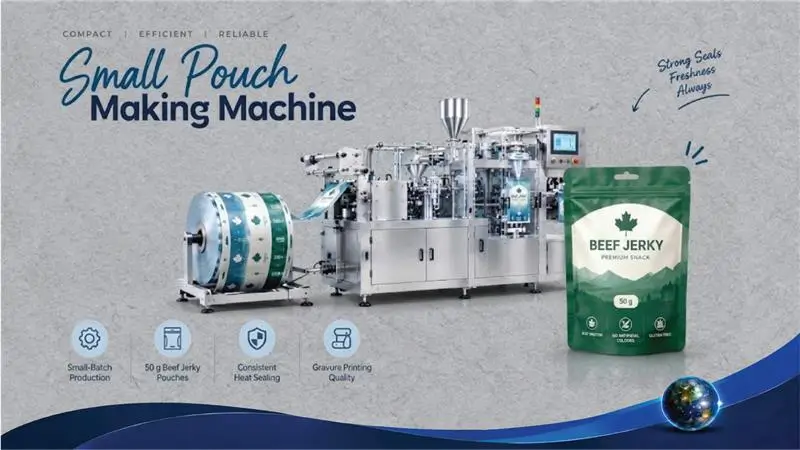
A snack pack was ready to be sold, but the pouch was weak, the seals were uneven, and no machine was matched with such a small batch. A Canada-based food business planned a 50 g beef jerky snack for retail shelves, and strong, resealable pouches were needed for short production runs. During discussions, the client explained the concerns about pouch strength, seal consistency, production volume, and budget. The team reviewed these priorities and recommended testing a small pouch making machine with a suitable pouch structure before proceeding with a bulk order. A first sample was prepared for the client to assess the sealing, resealability, and overall presentation, and adjustments were discussed before approval. In this Small Pouch Making Machine case study, the client’s needs, production process, printing options, applicable regulations, and results are explained step by step.
Client Background: Small Batch Beef Jerky Packaging Needs
The client is a food business based in Canada. A 50 g beef jerky snack was planned for retail shelves, and small-batch and short-run production was needed first, so that demand was tested before a larger order was placed. The earlier pouches were plain, the seals were uneven, and large minimum quantities were asked for, so the job was brought to Universal Packaging, and the complete work was handed over, from film to final sample. In food and snack packaging, the first sample is judged on strength and shelf look, so both points were set as targets. Explore Stand Up Pouches Canada, a style that was suggested when the pouch of a client was flat, and an upright pack was required on the shelf. The promise made to the client became the centre of this small pouch making machine project.
Demands of Client and Our Suggestions
Five demands were shared by the client: protection from moisture and oxygen, a resealable closure, a bright shelf look, a clean label space, and the same quality in every batch. In response, stand-up pouches with zipper and resealable closures were suggested, and a laminated packaging film was planned for the barrier layers, so the protection of the product was provided by the film. Learn more about Gusseted Bags Wholesale, which were planned for the larger family packs of another client. For the short runs, a small pouch making machine was proposed, and the reputation of the brand was kept as the main goal.
Reasons to Select a Small Pouch Making Machine for Short Runs
A small pouch making machine was selected because large lines are costly for small batches. The pouch size and dimensions were fixed first, and a pouch making machine of this size was compared with a pouch converting machine built for long runs, so operating cost and production efficiency were checked for both. The setup and changeover time was found to be short on compact pouch manufacturing equipment, so a new size or a new design was started quickly. A mini pouch making machine was also kept for sample runs, and the needs of the brand were met without large stock.
Step-by-Step Process of a Small Pouch Making Machine
The mini pouch production process was explained to the client in simple steps, because a pouch is formed from a flat film roll.
Step 1: The film roll was loaded on the film unwinding system, and web tension control was set so that the film was kept flat and free of wrinkles.
Step 2: The laminate was guided to the forming section, where pouch forming, filling, and sealing were completed in one flow.
Step 3: The pouch gussets and bottom seals were formed, so an upright pouch was created for the shelf. Learn more about Flat Bottom Pouch Making Machine, where a box shaped base was formed for a client who needed a wider print panel and a firmer shelf display than a standard stand up pouch could offer.
Step 4: At a set temperature and pressure, heat sealing was done, and the side seals were closed by the pouch sealing machine.
Step 5: The film was cut to the set size by the cutting and slitting unit, and the pouches were counted.
Each step was explained with its reason, so the way a small pouch making machine is controlled was shown, as with other flexible packaging machinery.
Gravure Printing on Film for a Sharp Logo and Green Colour
A choice between digital printing compatibility and gravure was explained, because digital printing is suited to very small test lots, while gravure is suited to the main run. A screen and UV printing comparison was also shown, but fine logo edges were not held as sharply. Gravure was therefore selected, and the logo, the maple leaf, and the green panel were printed evenly with strong printing and registration accuracy. Discover High Quality Gravure Printing Packaging Bag, which was shown to the client when sharp logo edges were demanded.
A comparison of matte and gloss finishes was made on a sample, and a matte finish was selected for a soft look. The material compatibility was checked, so the inks and film layers were matched, with a PET (polyester) film outer layer for print and a PE (polyethylene) film inner layer for sealing. A PP (polypropylene) film and a BOPP film were also tested for stiffness and clarity, and a paper-based packaging material was dropped because protection against moisture was weak. View Printed BOPET Packaging, a film structure that was tested for the clear outer layer of another client. After printing, the film was run smoothly through the small pouch making machine.
“Customers will occasionally buy products not because they want them but because of how they are presented to them.” —James Clear
Film Layer Selection for the Pouch
| Film Layer | Material | Purpose | Decision |
| Outer layer | PET (polyester) | Holds the gravure print and adds strength | Selected |
| Inner layer | PE (polyethylene) | Forms the heat seal and keeps moisture out | Selected |
| Test film | PP and BOPP | Checked for stiffness and clarity | Tested only |
| Paper-based material | Paper | Natural look, but weak moisture protection | Dropped |
| Surface finish | Matte | Gives a soft look to the pouch | Selected |
Further Changes by the Client: Zipper, Tear Notch, and Label Panel Design
After the first sample, a few changes were requested by the client. A zipper was added, and a tear notch and easy-open feature were placed near the top, so the snack was opened without scissors. The blank white panel was kept for the label, and a transparent window was discussed but dropped because light protection was needed for the jerky. The custom pouch dimensions were adjusted slightly for the 50 g fill. Explore Custom Shaped Pouches, which were shown when another client asked for custom shapes and die-cut features such as a round corner and a hang hole. Next, child-resistant closure compatibility and spout pouch formats were reviewed and found not needed for this snack. The small pouch making machine was then set again for the zipper and the notch, so the same flow was kept.
Canadian Packaging Regulations, Certifications, and Specifications
Food packaging in Canada falls under the Food and Drugs Act and the Food and Drug Regulations, where section B.23.001 prohibits packaging that may pass a harmful substance to the food. The Safe Food for Canadians Regulations also apply to the jerky, and the Consumer Packaging and Labelling Regulations require the net quantity in metric units, so 50 g was shown.
Sample Approval and Quality Checks
A first sample was prepared and tested before approval. In the sample checks, seal strength and leak prevention were verified by peel tests and bubble tests, and the zipper was opened and closed many times. Next, machine capacity and output were recorded for a full batch, and machine maintenance was planned, with cleaning of the sealing bars at the end of every shift. The small pouch making machine was approved after the third sample, and a personalized sample set was signed and kept as the reference.
Results of the Small Pouch Making Machine
The delivered pouches were strong, clean, and even, and the logo was sharp on every batch. Three batches were measured, and the readings were within the agreed tolerance. The setup for each new batch was short, and the running cost was kept low, so a repeat order was placed for a second flavour. Explore Custom Printed Flexible Pouches, which were ordered by the client for that second flavour. This was the main result of the small pouch making machine project.
Benefits of a Small Pouch Making Machine for Growing Brands
- Suited to Growing Brands: A small pouch making machine is suited to growing brands because short runs are produced without large stock.
- Flat and 3-Side-Seal Pouches: On the same platform, flat pouches and 3-side-seal pouches are made, so sachet and sample pouches are produced for trials.
- Wider Applications: Sachet packaging machine applications are extended to cosmetics and personal care packaging and to pharmaceutical and healthcare packaging.
- Less Waste and Energy: Through short runs, material waste reduction and energy-efficient machine operation are achieved.
- Recyclable Structures: Recyclable mono-material PE structures and recyclable mono-material PP structures are used where recycling goals are set.
- Odour Control: Learn more about Smell Proof Packaging Bags, which were suggested for another client whose strongly scented herbs needed odour control.
- Brand Value: The quality of the product is protected, the visibility of the product is improved, and the reputation of the brand is strengthened.
When a stable shelf presence, a wide print panel, and long-lasting freshness are all wanted from one pouch, the right machine and the right partner make the difference. A flat bottom pouch is made with care at Universal Packaging, where samples and a clear quotation are offered before any order is started. Contact us now to get your first flat bottom pouch sample prepared.
“Big things come in small packages” —Stacey King
Conclusion
In this blog, we covered how a weak, plain snack pouch was turned into a strong, resealable pack through a small pouch making machine. The needs of the client, the step-by-step process, the printing choice, the Canadian rules, and the sample checks were explained. Once the film, the seals, and the printing were matched, every batch was delivered with the same quality. The perception of the brand is improved when the machine is selected for the batch size before the first order is placed, and trust is built.
Frequently Asked Questions (FAQs)
1. What is a small pouch making machine?
It is a compact machine used to form, seal, and cut pouches from film rolls. It is suited to small batches and sample orders.
2. Why was a small pouch making machine selected for the jerky pouches?
Short runs were needed, and large lines are costly for small batches. The setup was short, so each new size was started quickly.
3. Which films are used for snack pouches?
Laminates of polyester, polyethylene, and polypropylene layers are used for strength and sealing. Barrier layers are added for protection against moisture and oxygen.
4. How is the quality of a seal checked?
Peel tests and bubble tests are carried out on sample pouches. The results are recorded before the full batch is approved.
5. Is a small pouch making machine suited to zipper pouches?
Yes, a zipper is added in the forming stage. An easy opening cut is also placed near the top, so the pouch is opened without scissors.
6. Which printing is selected for the pouch film?
Gravure is selected for the main run, because the logo stays sharp across every batch. Digital samples are used only for very small test lots.
7. Where are small orders placed?
Samples and quotes for short orders are offered by Universal Packaging. The size, the film, and the artwork are shared, and a first sample is prepared before the order.
8. What labelling is required on food pouches in Canada?
Bilingual English and French labelling and a metric net quantity are required. The nutrition facts table is also shown where it applies.
9. How is a small pouch making machine different from a large line?
A small pouch making machine is built for short runs, while a large line is built for long runs. The setup is shorter, and the cost is lower for small batches.
10. When is the pouch size selected?
The size is selected before the artwork and the film is fixed. After the first run, a change is costly.