Stand-up pouch packaging is rarely considered at the start of a company, yet shelf visibility is often influenced by how the pouches are displayed. An Ontario-based granola product client needed upright collection pouches for a drop-off centre, but the flat pouches in use kept falling over. During discussions with the team at Universal Packaging, the client explained the need for stable positioning, convenient collection, and clear product presentation. Based on these priorities, a flat bottom pouch making machine was recommended, along with a suitable pouch structure to maintain an upright shape. After the recommendations were discussed, the team outlined the proposed solution and explained the production process. Scroll down to learn about the client’s challenges, the printing and material options that were compared, the Canadian regulations that were followed, and the final results.
Client Story: Packaging Needs for a Granola Collection Drive
The client was an Ontario-based granola brand that organized a yearly fundraising campaign involving young volunteers. The client’s granola products were packed in pouches for collection and delivery to a central office. Bright lime green was chosen for the packaging to improve visibility of the brand, while a stand-up shape was requested to keep the pouches upright and neatly displayed at collection points. The client also wanted clear product information and consistent packaging quality to maintain the reputation of the brand. The colours and brand used for this blog were chosen so that the pouch is recognized easily. A stand-up shape was also requested so that the pouches are neatly displayed on counters. The reputation of the brand was to be protected, and a clean presentation of the product was expected at every drop-off point.
Packaging Challenges Faced by the Client
Five main problems were noted during the discussion.
-
Packaging Protection: Single-Use Problems, Moisture, and Tearing
The earlier pouches were treated as single-use. Moisture entered during outdoor events, and edges were torn when thick envelopes were pushed inside. Protection of the contents was weak, and the trust of donors was affected.
-
High Production Costs and Material Waste
Several small runs had been ordered by the client, and material was wasted during every setup. It was explained by our team that a flat bottom pouch making machine is run with larger, planned batches, so cost per piece is lowered and waste is reduced.
-
Poor Printing Quality on Packaging
Colours were printed unevenly, and fine text such as the web address and drop-off address was found to be blurry. Because a QR code is scanned by donors, sharp printing was required.
-
Inconsistent Pouch Sealing and Dimensions
Seals were uneven, and sizes were changed from one batch to the next. Zippers were closed with difficulty. Consistent flat bottom pouch sealing was therefore set as a target, and a better method of production was reviewed.
-
Large-Scale Production Efficiency
Thousands of pouches were needed within a few weeks. Hand-finished work was too slow, so a flat bottom pouch making machine was considered for speed and repeatability.
Recommended Packaging Solution for the Client
During discussions, Universal Packaging’s team reviewed the client’s concerns about pouch stability, moisture protection, printing quality, sealing, and production costs. A flat bottom pouch making machine was recommended, along with suitable barrier materials, reliable seals, and sharp printing in bright lime green. The client’s preferences for upright display, clear product information, and larger production batches were discussed before the pouch design and production specifications were finalized.
What Is a Flat Bottom Pouch Making Machine?
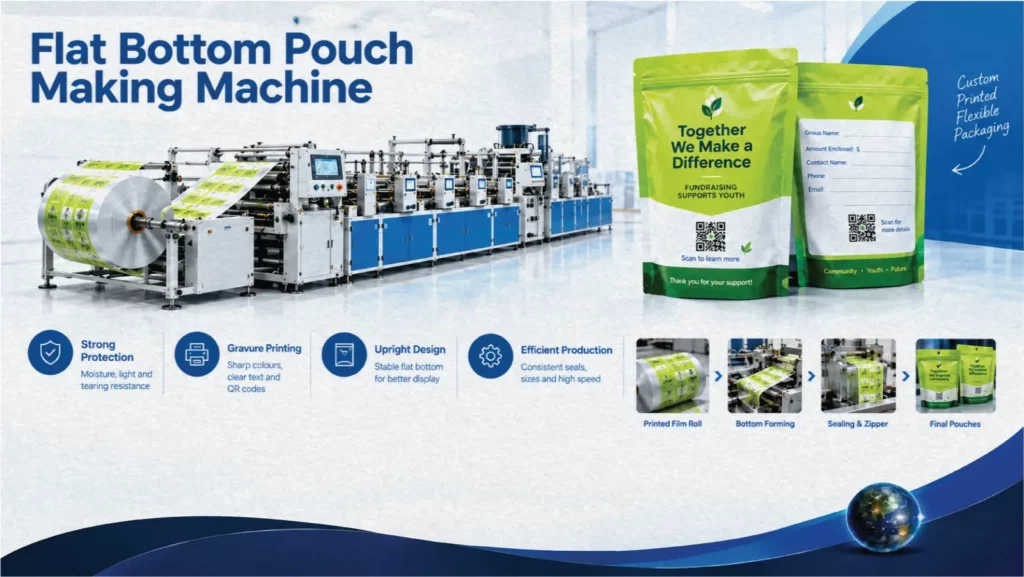
A flat bottom pouch making machine is used to convert rolls of printed film into pouches with a stable base. Film is unwound, folded, and sealed in stages. A bottom panel is formed so that the filled pouch is held upright. Flat bottom pouch forming is followed by side sealing, zipper application, and cutting.
Flat bottom pouch making equipment is fitted with servo-driven controls, so sizes are repeated accurately. This type of flat bottom pouch making machine is commonly used for coffee, snacks, supplements, and fundraising kits. Compared with side-gusseted bags and custom shape mylar bags, a wider base and a larger print panel are obtained.
Printing Options Offered: Screen and UV Printing vs Gravure Printing
Two printing methods were presented to the client for comparison.
| Comparison Factor | Screen and UV Printing | Gravure Printing |
| Production Volume | Suitable for short runs | Preferred for long production runs |
| Printing Effects | Special effects and spot colours | Uniform colour and fine detail |
| Colour Consistency | Suitable for specific colour applications | Consistent colour across thousands of pouches |
| QR Code Printing | Depends on print quality and setup | Favoured for clear, detailed printing |
| Best Application | Short runs and special finishes | Large-volume pouch production |
| Compatibility | Printed film rolls are processed through a compatible flat bottom pouch making machine | Printed film rolls are processed through a compatible flat bottom pouch making machine |
Because the client needed a large volume of pouches and clear QR codes, gravure printing was favoured. The final choice was based on production volume and colour matching.
Material Options Shown to the Client
Several structures were offered to the client:
- Custom BOPET packaging is used where clarity, stiffness, and a glossy finish are required.
- Metalized laminates are selected where a strong barrier against moisture and light is needed.
- Custom printed smell proof bags are made with multi-layer laminates where odour is to be contained.
- Matte and gloss finishes are chosen according to the presentation of the product.
Laminates such as BOPET/PE and PET/AL/PE were compared. A strong sealing layer is needed for a flat bottom pouch making machine, so that stable seals are obtained at line speed.
Step-by-Step Process of a Flat Bottom Pouch Making Machine
The flat bottom pouch making machine process was explained to the client, from film loading to final quality checks.
Step 1: Film Roll Loading
Printed film is loaded onto the machine. Tension controls and automatic web guiding help maintain smooth, aligned film movement.
Step 2: Print Registration
Sensors detect printed marks to maintain the correct placement of the bright lime green artwork, brand logo, and QR code.
Step 3: Flat Bottom Formation
The film is folded to form the front, back, side panels, and flat base, allowing the filled pouches to stand upright.
Step 4: Heat Sealing
The film layers are bonded through controlled heat sealing to form secure bottom and side seams.
Step 5: Zipper Application
A zipper is added when a resealable design is selected. Its alignment and closing performance are checked.
Step 6: Cutting and Finishing
The continuous film is cut into individual pouches. Tear notches and other opening features are added according to the approved design.
Step 7: Quality Inspection
Pouch dimensions, print clarity, bottom formation, and seal strength are checked. Sample pouches are also tested for leakage.
Step 8: Counting and Packing
Approved pouches are counted, grouped, and packed for dispatch. Production consistency and material waste are reviewed before delivery.
Canadian Regulations and Packaging Standards
Packaging bags sold or used in Canada must meet applicable legal and technical requirements. The following Canadian regulations and relevant testing standards were reviewed for this project:
- Consumer Packaging and Labelling Act and Regulations: Govern mandatory labelling requirements, including product identity, net quantity, and dealer information.
- Safe Food for Canadians Regulations (SFCR): Apply to food businesses and packaging activities within their scope.
- Food and Drugs Act and Food and Drug Regulations: Cover food safety and applicable requirements for food-contact packaging materials.
- Canada Consumer Product Safety Act: Applies to consumer products within its scope.
- Canadian environmental and recycling requirements: Applicable provincial extended producer responsibility (EPR) rules and environmental-claim requirements are reviewed according to the product and province of sale.
- Packaging quality testing: Seal strength, moisture transmission, oxygen transmission, and film tensile properties are assessed using suitable testing methods agreed upon with the supplier or customer.
Samples produced using the flat bottom pouch making machine were checked for pouch dimensions, print quality, and seal integrity before approval. ASTM and ISO testing methods may also be used where specified by the customer; however, these are technical standards rather than Canadian regulations.
Solution Implemented: Flat Bottom Pouch with Flexible Materials and Gravure Printing
A flat bottom pouch, a BOPET and polyethylene laminate, and gravure printing were selected together. A zipper was added so that the pouch is reclosed, and the bottom gusset was shaped so that the pouch is kept upright even when lightly filled. The artwork was personalized with the logo, a QR code, and the form on the back.
Tight tolerances are held in every batch by using a flat bottom pouch making machine. Custom flexible pouch packaging of this kind is also adapted for other campaigns and products.
First Sample Prepared for Flat Bottom Pouch Packaging
A first sample was prepared within days. It was filled with weights and placed on a table, and it was observed that the pouch is upright and stable. Seal strength, zipper closure, and print clarity were checked.
Small changes to the size of the form panel were requested by the client, and the sample from the flat bottom pouch making machine was adjusted accordingly. Approval was given after the second sample.
Role of Gravure Printing on Flat Bottom Pouches
Gravure printing and packaging are closely linked in long runs. Cylinders are engraved once, and thousands of pouches are printed in the same colour. The lime green was matched closely, and the fine address text was printed sharply. Reverse printing on the inside of the film is used so that ink is protected from scuffing.
Printed rolls were then fed into the flat bottom pouch making machine without any change of registration.
Final Result: One Complete Packaging Solution
Upright pouches with secure closures and sharp printing were delivered. A smooth drop-off process was experienced at the centre, and the reputation of the brand was strengthened because the presentation of the product was made consistent.
Thousands of pouches were produced within a few weeks on one production line. Cost per piece was lowered, and material waste was reduced.
Benefits of Using a Flat Bottom Pouch Making Machine
- Stability: pouches are made upright on tables and shelves.
- Protection: protection of the product is provided by barrier layers.
- Cost savings: material waste is reduced through planned batches.
- Consistency: uniform seals and sizes are obtained with a flat bottom pouch making machine.
- Printing: large panels are offered for artwork, QR codes, and forms.
- Speed: large volumes are completed in a short time.
- Flexibility: zippers, tear notches, and hang holes are added as required.
Conclusion
A flat pouch was replaced by an upright one, and the needs of the brand were met through careful planning. A flat bottom pouch making machine was selected, gravure printing was chosen, and every pouch was tested against recognized specifications. Stand Up Pouch Packaging, custom flexible pouch packaging, and custom printed smell proof bags are also offered to other clients who are looking for a similar upgrade. If a flat bottom pouch making machine is being considered for a campaign or a product line, a personalized sample is prepared by our team on request.
Frequently Asked Questions (FAQs)
1. What is a flat bottom pouch making machine used for?
A flat bottom pouch making machine converts printed film rolls into pouches with a stable base. These pouches are used for coffee, snacks, supplements, granola, and fundraising packs.
2. Which materials are used for flat bottom pouch manufacturing?
Common material structures include BOPET/PE and PET/AL/PE laminates. Material selection depends on the required moisture barrier, light protection, sealing performance, and presentation of the product.
3. Is gravure printing suitable for large flat bottom pouch orders?
Gravure printing is commonly used for large production runs because consistent colours and fine details are maintained across thousands of pouches. Screen and UV printing are more suitable for short runs and special printing effects.
4. How fast does a flat bottom pouch making machine operate?
Production speed depends on pouch dimensions, film structure, zipper application, and machine specifications. A suitable production setup helps maintain consistent seals and dimensions across larger batches.
5. How does a flat bottom pouch making machine help reduce production costs?
Production costs per pouch may be reduced through planned, larger production batches. Material waste during setup may also be lowered when production specifications and printing requirements are confirmed in advance.
6. How are seals checked during flat bottom pouch production?
Seal quality is checked through inspections of the bottom and side seams. Depending on the agreed specifications, testing may include seal strength, leakage, pouch dimensions, and zipper closure performance.
7. What printing details are suitable for flat bottom pouches?
Logos, product information, QR codes, addresses, and promotional artwork are commonly printed on flat bottom pouches. Print registration and colour consistency are checked to maintain clear information and recognition of the brand.
8. Which features are available for custom flat bottom pouches?
Custom flat bottom pouches may include resealable zippers, tear notches, different barrier laminates, matte or gloss finishes, and customized artwork. The final specifications depend on the packaging requirements of the brand and the intended use of the pouch.
9. Are flat bottom pouches suitable for food packaging in Canada?
Flat bottom pouches intended for food must meet the applicable Canadian food safety and food-contact requirements. Material suitability, labelling obligations, and relevant testing should be reviewed according to the product and its intended use.
10. How is a flat bottom pouch sample approved before bulk production?
A sample is inspected for dimensions, print clarity, pouch stability, seal strength, and zipper performance where applicable. Requested adjustments are made before approval and the start of bulk production.