A heavy and costly pouch was placed on the shelf, but the branding of the product was hardly noticed by the customer. This plastic pouch making machine is based on Sunstone, a Canadian bath and body brand that approached Universal Packaging with a high budget concern and branding that was not attractive. A lightweight and user-friendly pouch was demanded for the Botanical Bath Soak. Our approach was different: a flat pouch was suggested, plastic film was selected for the outer layer, and the pouches were made on a plastic pouch making machine with high-quality and low-cost gravure printing. In this plastic pouch making machine, the problems faced, the pouch structure, the machine process, the printing, the results and a checklist are explained step by step.
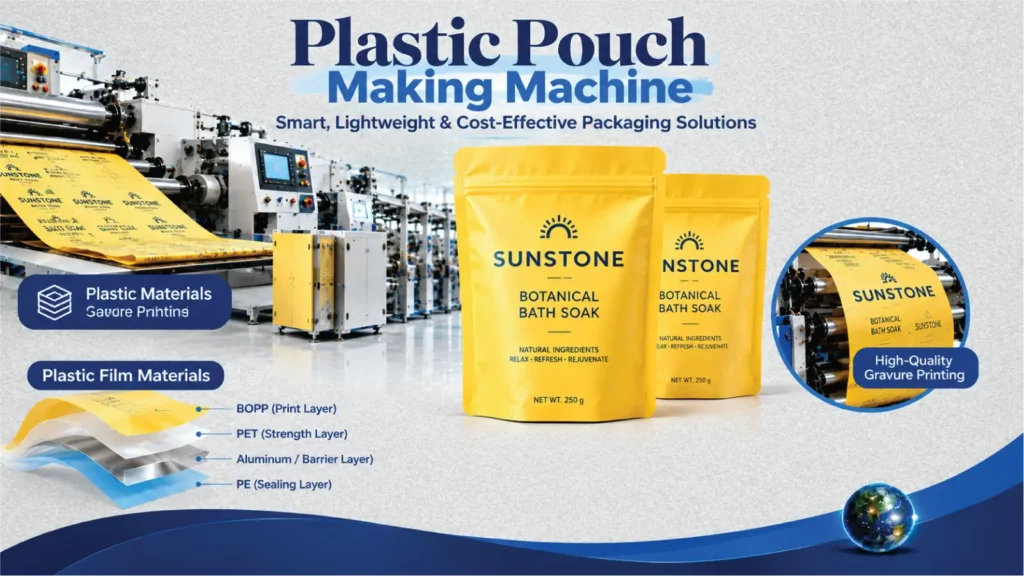
Client Background and Plastic Pouch Requirements of Packaging
The client’s packaging goals, visibility of brand concerns, and budget limits are outlined below.
Requirements of Packaging
The client behind Sunstone was planning to launch a new range of bath soaks for retail shelves and needed packaging that met the product requirements without increasing costs. The client requested a lightweight flat pouch with custom dimensions, a resealable zipper, and an easy-tear notch for convenient use. Full-print artwork was preferred for clear brand visibility, while reduced film consumption and a simple pouch structure were prioritised to keep production costs under control. Explore Flexible Pouches to compare flexible packaging structures suitable for bath and personal care products.
Branding That Did Not Stand Out
The recognition of the brand was weak on the shelf because the colours were dull and the logo was small. A fresh look was needed, but the budget was not increased.
Client Demand for Lightweight Pouches
The demand of the client was discussed:
- Weight: a lightweight pouch, so that freight cost is reduced
- Use: a user friendly pouch that is opened and closed easily
- Look: a matte yellow finish with clear blue branding
- Cost: a low cost per pouch, with high quality print
The reputation of the brand was to be protected, so a balance between cost and quality was required. How the pouches are made was also asked by the client, so the plastic pouch making machine was explained.
Recommended Plastic Pouch Packaging Solutions
The following recommendations were made after reviewing the client’s packaging concerns.
| Identified problem | Recommended solution | Expected benefit |
| High packaging costs | Lightweight flat pouch with reduced film consumption | Lower material costs |
| Poor shelf visibility | Matte yellow finish with clear blue branding | Improved visibility of the product |
| Difficult opening and closing | Resealable zipper and easy-tear notch | Convenient product use |
| High printing costs at production volume | Gravure printing for the main production run | Consistent print quality at volume |
| Limited packaging flexibility | Custom pouch dimensions | Better alignment with product requirements |
Why a Flat Pouch Was Suggested
A flat pouch was recommended for Botanical Bath Soak because of its lightweight structure, easy storage, and lower production cost. A three-side-seal design was selected to reduce film use and keep the packaging simple on the plastic pouch making machine. Custom pouch dimensions, a resealable zipper closure, and an easy-tear notch were added for convenient handling. Stand-up and spout pouch styles were also compared, but the higher cost made the flat option more suitable. A full-print design was preferred over transparent pouch windows for better visibility of brand. Explore Side Gusset Bags for packaging that needs extra space and a stable shelf presentation.
The pouch shape was also considered during packaging development, with a simple flat structure preferred for the current product. Lower material use and fewer production steps helped reduce costs on the plastic pouch making machine. Explore Shape Bags for distinctive packaging shapes considered for a future launch.
“Good things come in small packages.” — Aesop
Plastic Film Structure for the Pouch Suggested
The film layers and their roles in print quality, product protection, and sealing are described below.
Outer Plastic Film Layer
A multilayer plastic film was used; the outer layer was chosen for print quality, and the film was matched to the plastic pouch making machine. Polyethylene (PE) film and polypropylene (PP) film were compared, and BOPP packaging film was selected for a clean matte surface. A PET/PE laminated film was approved for the final structure. Matte and gloss finishes were compared, and the matte finish was selected.
Barrier and Sealing Layers
A barrier layer is added for the protection of the product, and a sealing layer is added so that strong seals are formed on the plastic pouch making machine. The pouch thickness range was matched to the weight of the product, so that cost was not increased unnecessarily. Get these BOPET Bags Wholesale for the film that was tested as a barrier layer.
Canadian Plastic Pouch Regulations and Standards
Plastic pouch materials and printed packaging in Canada should comply with applicable federal and provincial regulations. For non-food consumer products, the Consumer Packaging and Labelling Act (R.S.C. 1985, c. C-38) and the Consumer Packaging and Labelling Regulations (C.R.C., c. 417) establish requirements for product identity, net quantity, dealer information, and accurate labelling, where applicable. The Competition Act (R.S.C. 1985, c. C-34) addresses false or misleading environmental claims, including representations about recyclability and recycled content. Provincial extended producer responsibility (EPR) regulations, such as Ontario’s O. Reg. 391/21 (Blue Box), should also be reviewed for applicable packaging reporting and producer obligations. Plastic films, laminates, inks, and adhesives should be assessed for their intended application, with environmental claims supported by appropriate evidence.
Plastic Pouch Making Machine Process
The main production stages, from film conveyance to sealing and quality checks, are explained below:
STEP 1: Film Unwinding and Registration Control
The film is loaded onto the unwinding system of the plastic pouch making machine, and the appropriate FFS machine setup is selected. A pre-made flat pouch line was preferred for this project.
STEP 2: Film Production and Tension Control
The film is moved forward with controlled tension to prevent stretching. PLC controls and servo motors maintain accurate film positioning on the plastic pouch making machine.
STEP 3: Heat Sealing and Zipper Attachment
Sealing temperature is controlled to prevent weak seals, while zippers are attached at the appropriate production stage.
STEP 4: Pouch Cutting and Trimming
Pouches are cut to the required dimensions and trimmed for clean edges. Automatic machinery is used for the main run, while a semi-automatic machine is used for initial samples.
STEP 5: Production Capacity Planning
Machine capacity of the plastic pouch making machine is matched to the client’s monthly order volume to maintain the production schedule.
STEP 6: Quality Checks During Production
Seal integrity and leak testing are performed at regular intervals on the plastic pouch making machine. Nitrogen flushing is considered for products that need additional protection.
STEP 7: Machine Maintenance and Waste Reduction
Regular maintenance helps reduce production stops on the plastic pouch making machine, while suitable setup film is reused to minimise material waste.
Plastic Pouch Making Machine Process Table Overview
The production stages and key choices are compared for a quick overview.
| Stage | What is done | Result |
| Printing | Artwork is printed by gravure | Sharp, steady colour |
| Lamination | Layers are bonded | The print is protected |
| Unwinding | Film is fed with tension control | No stretching |
| Sealing | Heat is controlled | Strong seals |
| Cutting | Pouches are trimmed | Clean edges |
| Testing | Seals are checked | Safe pouches |
High Quality Low Cost Gravure Printing
The printing method, cylinder setup, and cost considerations are covered in this section.
Why Gravure Printing Was Chosen
Rotogravure printing was selected because sharp details and consistent colour were required at a low cost per pouch for high-volume production. Digital printing was considered for small trial runs, while screen and UV printing were reserved for special effects. The final packaging specifications were also reviewed alongside the plastic pouch making machine requirements to maintain production consistency. Explore Packaging Gravure Printing to learn how the same method is applied to other pouch ranges.
Process of Gravure Printing
Gravure printing involves engraving the artwork onto a cylinder, with tiny cells created to hold the ink. During printing, a doctor blade removes excess ink, and the remaining ink transfers onto the packaging film. Cylinder engraving, ink viscosity, and print registration are checked to maintain sharp details, consistent colour, and uniform results across large production runs. After printing, the film may proceed to pouch conversion, where the plastic pouch making machine is configured according to the required pouch dimensions and sealing specifications.
Cylinder Setup for Sharp Branding
The gravure printing cylinder was engraved from the approved artwork, and a proof was signed before the run. The printed rolls were then sent to the plastic pouch making machine. The blue branding and the yellow background were matched to the proof, so the perception of the brand was strengthened. Learn more about the Gravure Printing Cylinder to see how the engraved cells decide the sharpness of small text and dots. The cylinder was also checked for consistent ink transfer, so the small text and brand colours remained clear across the print run.
Cost per Pouch at Volume
The cost of the cylinders is spread across the whole order, so the cost per pouch is lowered at volume. This balance was the main reason for the choice.
Results After the Pouch Solution
The main outcomes are summarized, including branding, cost, and repeat orders.
- Stronger branding on the shelf through clearer pouch presentation and improved visibility of the product.
- Lower cost per pouch through a more cost-effective packaging solution and production process on the plastic pouch making machine.
- Repeat order from Sunstone following approval of the pouch design and satisfaction with the results.
“Big things come in small packages!” — Stacey King
Other Uses and Greener Choices
Other packaging applications and recycling-related considerations are outlined below.
The same plastic pouch making machine is used for food packaging applications, pharmaceutical packaging, detergent packaging and industrial packaging, with settings changed for each product. Recyclable mono-material films and post-consumer recycled (PCR) plastic were also discussed, and plastic film recycling is supported by recycling labels and disposal instructions. Extended producer responsibility (EPR) rules in Canada are followed for the packaging of the product. Learn more about Smell Proof Bags With Lock for products that need extra protection.
Plastic Pouch Production Checklist for Brands
These checks help keep cost, film selection, machine settings, and seal testing in view.
- Cost: the cost per pouch is calculated with the print.
- Film: the outer layer is matched to the print method.
- Machine: settings of the plastic pouch making machine are recorded for heat, tension, and cutting.
- Testing: seals are tested before packing.
For custom packaging support, expert guidance, and competitive pricing, connect with Custom Packaging Solutions Companies. Contact now to discuss the packaging needs of your brand and explore suitable packaging options. Reach out today to discuss your project and request a quote for your requirements of packaging.
Conclusion
The key lessons from the packaging decision and production process are brought together here. The problem for the client was not only the pouch. It was the cost, the print, and the machine process that were not planned together. Once a flat pouch was selected and the pouches were made on a plastic pouch making machine, a light and bright pouch was achieved at a low cost. This is the main look and experience that starts and ends with the article plastic pouch making machine.
Frequently Asked Questions (FAQs)
What is offset gravure printing in packaging?
It is a combined approach in which offset is applied on boxes and gravure on pouches. The flower design is then matched between the two.
Are eco-friendly inks suitable for offset gravure printing?
Yes, water-based and low-migration inks are suitable when they are tested on the real material. Adhesion is also checked on the board and on the film.
Why is a proof required on the real material?
Flowers are seen differently on different surfaces, so the result is confirmed by a proof before the full run. This avoids a costly reprint.
Why is offset not used for pouches?
Offset is made for paper and board, so it is used for boxes. Pouches are made from film, so gravure is selected.
Are the cylinders reused for repeat orders?
Cylinders are reused when the artwork is not changed. The offset plates are made again from the same approved files.
Why is a white layer printed under the flowers?
Kraft board is brown, so the base shows through a thin ink layer. A white layer covers the fibres under the fine details, so petals and leaf lines are seen clearly.
Is a water-based aqueous coating suitable for recycling?
A thin water-based coating is suited to most paper recycling streams, because it does not form a plastic layer on the board. The local recycling rules should still be checked before the structure is finalized.
What does 15% recycled content mean in kraft board?
It means that 15% of the fibres in the board come from recycled paper, and the rest is fresh fibre. The natural brown look is kept, and the use of new material is reduced.
Why is artwork prepared before printing and not sent as it is?
Screens show light, while print is made from ink, so an automatic conversion gives dull mixed values. The artwork is prepared in advance, so the same look is kept on the board and on the film.