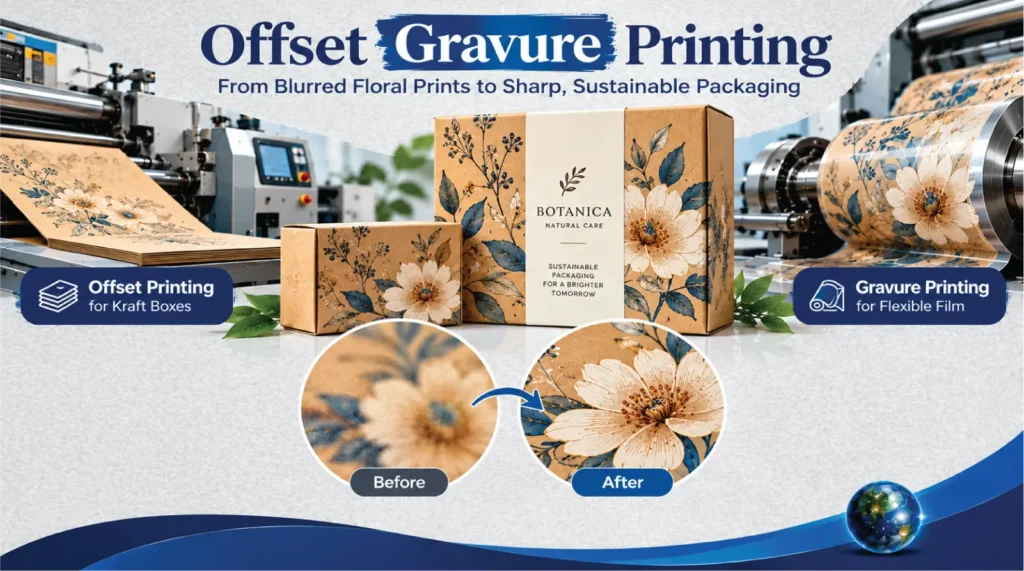
A fine flower design was expected on every box, but a blurred print was delivered. This offset gravure printing case study is based on a client from Canada, whose eco-friendly inks could not be matched with a recycled kraft board elsewhere. The whole task was therefore handed over to our team for complete creation, and a separate process was selected for each surface. The client background, the process, the comparison, the applications, the advantages, and a printer checklist are explained step by step. Scroll down to see how the flower print was rebuilt, from the first blurred sample to the final approved batch.
Client Background: Kraft Paperboard Gift Boxes
The client is a retail business based in Canada. A range of custom printed gift packaging was planned for a large event, and recycled kraft board with 15% recycled content was selected so that a warm, handmade, and eco-conscious look was achieved. A detailed floral design, a wrap-around label, and small text were required on every box, and a matching set of was needed. Eco-friendly water-based inks were required for the full range.
The first sample was found to be unsatisfactory: the petals were blurred, the leaf lines were broken, and the label text was hard to read. As these points were not achieved with eco-friendly inks on the recycled board, the job was brought to Universal Packaging, and the complete work was handed over, from artwork to final approval. Explore Custom Stand Up Pouches No Minimum, a style that was suggested when a client’s pouch was flat and the product needed to stand on the shelf. The promise made to the client became the centre of this offset gravure printing project.
“Customers will occasionally buy products not because they want them but because of how they are presented to them.” — James Clear
Why Dot Gain Blurred Flower Details on Recycled Kraft Packaging?
Recycled kraft is brown, uncoated, and slightly fibrous. Because 15% recycled fibre is mixed into the board, ink is absorbed at different rates across the sheet, so fine petals and thin leaf lines are broken. Ink is also spread slightly on this surface, and small dots are enlarged. This enlargement was not corrected in the artwork, so thin lines were thickened, and small letters were hard to read. These were treated as surface and ink challenges, so the board, the ink, and the process were considered together.
How the Offset Gravure Printing Process Was Selected for Boxes
The two processes were first explained to the client because packaging printing depends on the surface that is printed. In offset printing, ink is transferred from a flat plate to a rubber blanket and then to the board, and the plates are prepared only after the artwork is checked. Pouches are made from film, so gravure was selected for them. The image is engraved as tiny cells in engraved cylinders, which are mounted on a gravure press, and the ink held in these cells is transferred to the film.
Pouches are a type of flexible packaging, and pouch printing is carried out on film supplied as rollstock. Discover Gravure Printing Packaging, where film is printed in long rolls for a matching range. In this offset gravure printing process, offset was applied on the boxes and gravure on the pouches, so one family of flowers is seen on the shelf.
Choosing Between Offset Gravure Printing vs Gravure Printing by Surface
| Point | Offset on boxes | Gravure on pouches |
| Surface | Uncoated recycled kraft board | Laminated flexible film |
| Image carrier | Flat plate and rubber blanket | Engraved cylinder |
| Main strength | Sharp flower detail on paper | Thick, even ink on film |
| Main risk | Soft edges on fibres | Streaks and uneven cells |
A comparison of offset gravure printing vs gravure printing was also explained, because each process suits a different surface. A digital printing comparison and a screen and UV printing comparison were prepared too, since short runs suit small test orders, while long runs are better matched with gravure.
Eco-Friendly Inks for Food Contact Packaging and Printing
Eco-friendly inks were the main requirement of the client, so a separate selection was made. Solvent-based and water-based inks were compared, and the water-based type was selected for the boxes because VOC emissions are low and clean-up is simpler. Ink viscosity was controlled at regular intervals so that fine flower lines were held evenly. Through this selection, offset gravure printing was kept eco-friendly without any loss of floral detail.
Artwork Checks: CMYK Printing and Spot Colours Before Plate Making
Before any plate was made, the artwork was checked by our prepress team. Thin flower outlines and small label text were thickened slightly to allow for ink spread on the fibres. The petal shading was prepared in process inks, while the outlines were defined as controlled solid inks, so no automatic conversion was applied. A flower-shaped cut was not planned for these boxes, because the boxes were made in a standard straight-edge shape, and the client had no special demand for a cut shape. But for a flower-shaped or logo-shaped pack, a bag solution is also offered, so discover Custom Shape Bag designs, where the artwork is checked even more closely on a cut shape. Accurate black ink depends on the CMYK values, artwork preparation, and colour checks completed before printing. For more insight into black ink preparation and colour consistency, explore Black CMYK For Print before finalizing the artwork and print settings.
Ink Printing Procedure for Sharp Petals and Leaf Lines on Kraft
A white layer was applied under the flower areas, so the fibres of the kraft were covered where fine detail was needed, and the natural look was kept around the artwork. Test prints were made on the real recycled board. At this stage, the strength of offset gravure printing was seen on the boxes, because fine petals and thin leaf lines were held sharply.
Keeping Every Layer in Place on the Label Film
In rotogravure printing, a separate set of printing cylinders is engraved for each layer of the wrap-around label film, and the run was monitored on a gravure printing machine, where print registration was checked so that every layer landed in the same place as on the box. Kraft board does not need a film layer for printing, so BOPET film was not used on the boxes, but a clear and strong film is often needed for labels and wraps. For such needs, learn more about BOPET Packaging Bags, which were tested for the label film of another client. Through this step, offset gravure printing was completed on both surfaces.
Film Layers and Matching Colours Between Box and Label
The label film was built from bopp film, pet film and pe film layers, and recyclable mono-material films were also discussed for packaging film printing. Swatch tests were made on kraft and on matte film, and colour matching was done so that the box and the label were seen as one family. Smell protection was not requested for these boxes, because kraft board is not a smell proof material, and the client had no special demand about it. But for tea or herb gifts that need aroma protection, a bag solution is also offered, so get Smell Proof Bag options made from the same film, where the layers are laminated and the pouches are formed during pouch manufacturing.
Offset Gravure Printing Applications in Gift and Food Packaging
The offset gravure printing applications of this project were the event gift boxes and the matching label film. Gusset folds are not formed on these boxes, so bulky items are not well suited to them, but the client had no such demand. For bulkier gifts, a bag solution is also offered, so learn more about Gusseted Plastic Bags, which were formed on a plastic pouch making machine for another client. The same approach is applied in plastic pouch printing for retail gifts and in food pouch printing for dry foods, once compliance is confirmed for the inks and films. No barrier is provided by kraft board, so in barrier packaging, an oxygen barrier is required for coffee and tea, and foil laminates are used for protection. The client had no such demand for these boxes, but if a moisture barrier is needed, explore Bag Custom Foil Pouch. In laminated packaging, reverse printing is applied on the inner side of the film, so the ink is protected between layers.
Canadian Packaging Regulations
Food packaging in Canada must comply with the Food and Drugs Act (R.S.C. 1985, c. F-27), the Food and Drug Regulations (C.R.C., c. 870), and the Safe Food for Canadians Regulations (SOR/2018-108). Bilingual English and French labelling is required under section B.01.012, while nutrition facts are governed by section B.01.401. Made in Canada claims are guided by the Competition Bureau of Canada, and packaging compliance, including closures, was confirmed with the supplier.
Offset Gravure Printing Advantages for Flexible Packaging Printing
The offset gravure printing advantages begin with high-resolution flower graphics, which are reproduced on both surfaces, so shelf appeal is improved, and packaging differentiation is created on the display table. Eco-friendly inks and recycled board are used together, so the sustainability goal of the brand is supported without a loss of quality. Because film printing is run in long lengths, repeat orders are matched easily.
“Our pleasures are not material pleasures, but symbols of pleasure – attractively packaged but inferior in content.” — Alan Watts
Colour Proofing and Final Approval
Two stages were followed: a digital proof for layout, and a press proof on the real board and film. The flower detail was measured by instrument, and packaging quality control was carried out between batches. A personalized sample set of one box was prepared, and the signed samples were kept as the reference.
How the Offset Gravure Printing Process Was Selected for Boxes
The two processes were first explained to the client step by step, because packaging printing depends on the surface that is printed.
Offset on the boxes
Step 1: A plate was prepared from the approved artwork, so only the flower areas were set to hold ink.
Step 2: The plate was wetted and inked, and the ink stayed on the flower areas only, so the background was kept clean.
Step 3: The image was moved from the plate to a rubber blanket. The soft blanket presses the ink gently into the uneven fibres of recycled board, so fine petals are printed evenly.
Step 4: The image was then transferred from the blanket to the kraft board, and thin leaf lines were held sharply.
Step 5: The sheets were dried before coating, cutting, and folding, so the ink was not marked.
In this offset gravure printing process, offset was applied on the boxes and gravure on the film, so one family of flowers is seen on the shelf.
Offset Gravure Printing Checklist for Printers
Before any offset gravure printing job is started, the following points are confirmed:
-
Process: confirm offset for boxes and gravure for pouches.
-
Detail: define pantone colours for controlled elements, and adjust thin lines for ink spread.
-
Inks: confirm the eco-friendly ink type and the food-contact status for each surface.
-
Records: confirm the obligations under extended producer responsibility (EPR) for the market, and record every value in the job sheet
Results of the Offset Gravure Printing Project
The delivered boxes were clean and even, and the fine flowers and label text were easy to read. Three batches were measured, and the readings were within the agreed tolerance. This was the main result of the offset gravure printing project, and a repeat order was placed for a second event.
Lessons from the Offset Gravure Printing Project
The lessons from this offset gravure printing project are listed below.
- Process: the process is selected for the surface, offset for boxes and gravure for pouches.
- Testing: a test print is made on the real material, and thin lines are adjusted before plates are made.
- Inks: eco-friendly inks are tested on recycled board, and a white layer is planned where fine detail is needed.
- Recycling: post-consumer recycled (PCR) content and local recycling infrastructure are reviewed before the structure is finalized.
Need a packaging solution built around your product, material, and production requirements? Explore Custom Packaging Calgary solutions for custom packaging designed around your application. To discuss your next packaging project with the team.
Conclusion
In this blog, we covered how a blurred flower print on recycled kraft was corrected. The problem was not caused by the artwork alone. Once a white layer was added, the eco-friendly inks were tuned for the recycled board, and the label film was matched with gravure, the flowers on every box were sharp and consistent. This is the lesson of the offset gravure printing case study: the process is selected for each surface before the first plate or cylinder is made, so the reputation of the brand is protected.
Frequently Asked Questions (FAQs)
What is offset gravure printing in packaging?
It is a combined approach in which offset is applied on boxes and gravure on pouches. The flower design is then matched between the two.
Are eco-friendly inks suitable for offset gravure printing?
Yes, water-based and low-migration inks are suitable when they are tested on the real material. Adhesion is also checked on the board and on the film.
Why is a proof required on the real material?
Flowers are seen differently on different surfaces, so the result is confirmed by a proof before the full run. This avoids a costly reprint.
Why is offset not used for pouches?
Offset is made for paper and board, so it is used for boxes. Pouches are made from film, so gravure is selected.
Are the cylinders reused for repeat orders?
Cylinders are reused when the artwork is not changed. The offset plates are made again from the same approved files.
Why is a white layer printed under the flowers?
Kraft board is brown, so the base shows through a thin ink layer. A white layer covers the fibres under the fine details, so petals and leaf lines are seen clearly.
Is a water-based aqueous coating suitable for recycling?
A thin water-based coating is suited to most paper recycling streams, because it does not form a plastic layer on the board. The local recycling rules should still be checked before the structure is finalized.
What does 15% recycled content mean in kraft board?
It means that 15% of the fibres in the board come from recycled paper, and the rest is fresh fibre. The natural brown look is kept, and the use of new material is reduced.
Why is artwork prepared before printing and not sent as it is?
Screens show light, while print is made from ink, so an automatic conversion gives dull mixed values. The artwork is prepared in advance, so the same look is kept on the board and on the film.