Why is freshness retained in some beef jerky packs for months, while it is lost in others within weeks? The difference is rarely found in the meat alone. Instead, it is found in what surrounds it. Behind every crisp bite, a science of barriers, seals, and materials is hidden from most shoppers. How Packaging Protects Beef Jerky Freshness is explained step by step in the sections below.
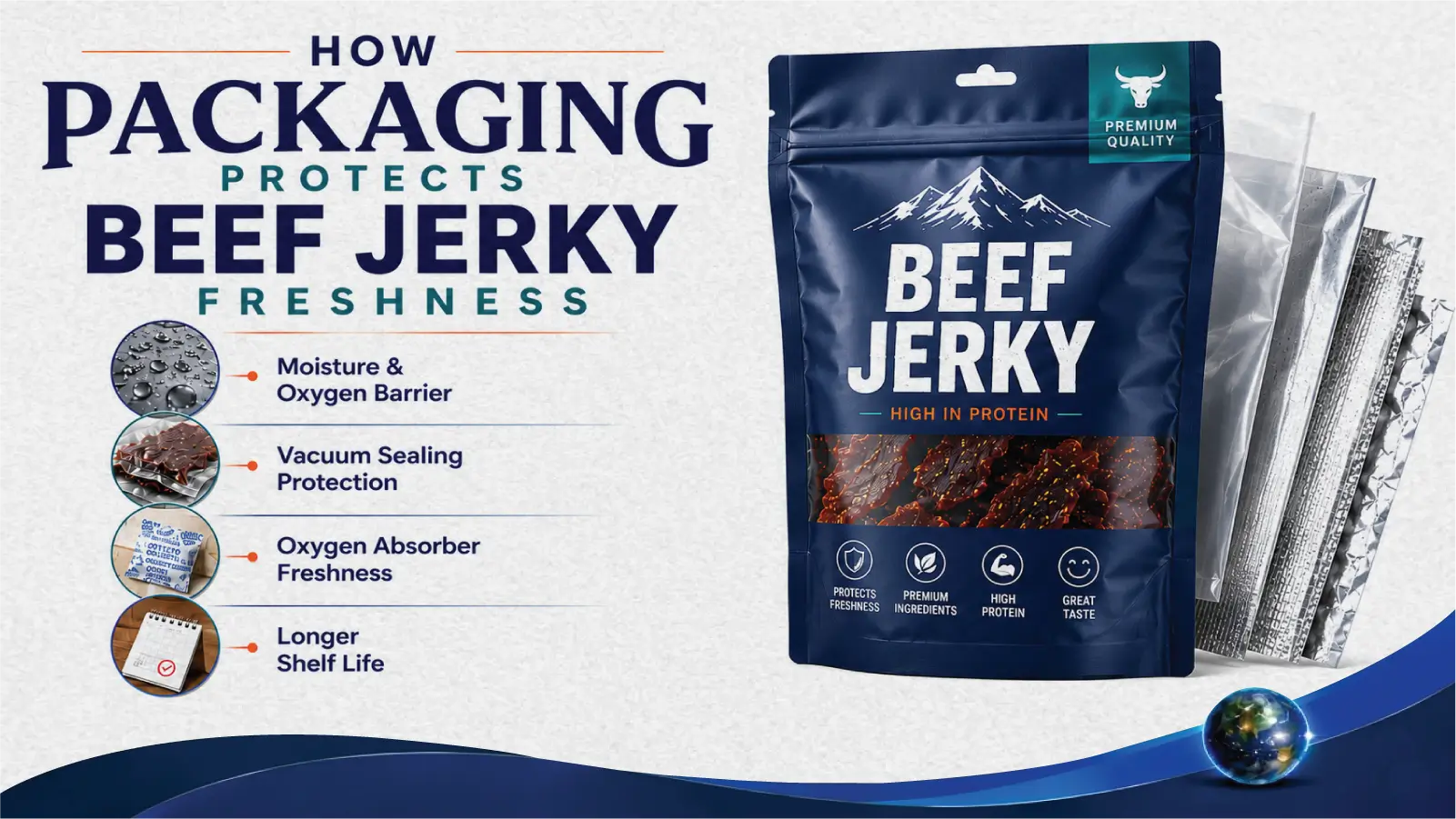
Moisture Barrier And Oxygen Barrier Films
Beef jerky is recognized as a low-moisture and high-protein food category, and spoilage is increased whenever oxidation, mould, or rancidity develops. A first line of defence is formed by a moisture barrier because dried meat is turned into a site for bacterial growth once excess moisture is reintroduced. In addition, an oxygen barrier is incorporated into most bags because fat oxidation, discolouration, and rancid odours are triggered whenever oxygen remains in contact with the surface.
For this reason, food-grade packaging is manufactured from a multi-layer film in which polyethylene, polypropylene, and a metallized or foil layer are combined to maintain low transmission rates. A clearer understanding of how packaging protects beef jerky freshness is gained by examining the methods through which air protection.
“Customers will occasionally buy products not because they want them but because of how they are presented to them.” — James Clear
Vacuum Sealing And Airtight Protection
Once air and moisture entry are controlled at the material level, attention is directed toward the method through which the package is closed. Several techniques are combined to keep the contents secure.
- Vacuum sealing: Air is removed completely before the pouch is closed, and oxidation and mould growth are slowed significantly.
- Airtight seal: A continuous, unbroken seam is formed around the package, and the re-entry of outside air is prevented after the initial closure.
- Heat sealing: High temperature is applied along the seam, through which a strong leak-proof bond is created between film layers.
Stronger protection of the product is achieved when these methods are combined instead of being applied individually.
Sustainable And Wholesale Packaging Choices
Environmental impact is increasingly considered during purchasing decisions in both retail and markets. For this reason, preference is given to eco-friendly packaging, and recyclable materials are incorporated wherever barrier performance is not compromised. BOPET Bags Wholesale is selected where high barrier performance is required. In addition, sustainable packaging is recognized as a point of differentiation, particularly among younger consumer groups. On the material science side, UV protection is incorporated into printed or opaque films so that light-driven degradation is minimized during extended retail display.
For businesses expanding production, wholesale packaging is ordered in bulk, through which lower per-unit costs are achieved across larger volumes. Custom Food Stand Up Pouches are selected for both retail and wholesale food packaging. The importance of how packaging protects beef jerky freshness is further reflected through the regulatory requirements discussed below.
Freshness Retention Through Oxygen Absorbers
Even after a strong seal has been formed, small amounts of trapped air are sometimes left behind. Therefore, small internal packets are added to complete the process.
- Oxygen absorber: These absorbers are placed inside the bag, and any remaining oxygen is absorbed after sealing has been completed.
RESULT:
- Moisture control: Silica gel packets are included, through which residual internal moisture is absorbed before conditions for spoilage are created.
As a result, food freshness is extended well beyond the level that is achieved through a barrier film alone. A broader understanding of how packaging protects beef jerky freshness is gained in the next section, where shelf stability and food safety standards are discussed.
Shelf Stability And Food Safety Standards
Beyond internal freshness protection, compliance and structural reliability are equally required for retail-ready pouches. Furthermore, shelf-stable packaging is engineered so that ambient storage is made possible without refrigeration, provided that a high-barrier packaging structure is maintained throughout distribution. At the same time, food safety is treated as non-negotiable, and a tamper-evident seal is added so that any prior opening is made visible before purchase. Additionally, FDA-compliant packaging materials are specified for cross-border products so that recognized safety thresholds are met on both sides of a shared market.
Batch codes, best-before dates, and net weight are also printed clearly because traceability is expected at every stage of distribution. Altogether, trust in the pack is reinforced long before the first bite is taken. A deeper understanding of how packaging protects beef jerky freshness is continued through the packaging formats discussed below.
Packaging Formats For Beef Jerky
The choice of format is considered just as important as material option. Several formats are preferred across the category.
- Flat packaging: Small formats are selected for grab-and-go convenience at checkout counters.
- Side gusset bags: Thicker, higher-barrier constructions are selected for products intended for longer storage periods. Side Gusset Bags are preferred for products requiring additional storage capacity.
- Mylar bags: Excellent barrier performance against light and oxygen is achieved through a metallized polyester layer.
- Foil barrier: Near-total blockage of light and gas transmission is achieved through an aluminum layer embedded within the film. Longer shelf life is supported through the use of Foil Pouches.
- Resealable zipper: Repeated opening and closing are made possible through a plastic track closure positioned at the top of the bag without loss of integrity.
- Stand-up pouch: Upright shelf display is made possible through a wide base and gusseted sides. Stronger shelf presentation is achieved through a Stand Up Pouch Custom design.
Once the most common packaging formats have been understood, the next consideration often involves selecting between custom and standard options. A detailed explanation is provided in Custom Beef Jerky Bags Vs Standard Food Packaging, where the differences in customization, branding, cost, and practical applications are examined.
Custom Printing And Other Options (Addition INFO)
Visual presentation is treated as a major purchase trigger at the retail level, beyond barrier performance alone. A matte finish is generally selected for a premium and understated appearance, while a gloss finish is preferred whenever vibrant colour reproduction is desired. Meanwhile, Custom Mylar Bag Printing is applied across most production runs so that artwork of the brand, nutrition panels, and batch codes are incorporated onto a single film surface.
The role of how packaging protects beef jerky freshness is further reflected through the way these bags are positioned in retail environments. Better visibility of the product is provided through a Kraft Stand Up Pouch With Window. For businesses requiring different portion sizes, custom sizes are offered so that portion weight and format are matched precisely. Lower shipping weight is achieved through the use of a Flexible Pouch.
The contribution of how packaging protects beef jerky freshness is further demonstrated through sustainable packaging choices discussed in the next section. Explore Custom Beef Jerky Packaging Bags offered in a variety of sizes, materials, and premium finishes to match your branding and freshness requirements.
Canada Packaging Regulations And Certifications
Several federal regulatory instruments govern the sale of beef jerky packaging bags in Canada, and compliance is required before any package is placed on a retail shelf. Many options also include Retortable Pouches Food Packaging that is used for food products are produced to comply with these regulation & standards.
- Safe Food for Canadians Regulations (SOR/2018-108): Manufacturing, packaging, and labelling requirements for meat products are established under this regulation, and enforcement is carried out by the Canadian Food Inspection Agency (CFIA).
- Consumer Packaging and Labelling Act (R.S.C., 1985, c. C-38): Packaging, labelling, sale, importation, and advertising requirements for prepackaged consumer products throughout Canada are governed under this statute, which was first enacted in 1970.
- Consumer Packaging and Labelling Regulations (C.R.C., c. 417): Mandatory label information is required in both English and French, and deceptive packaging practices are prohibited.
- Health Canada Packaging Materials Policy: Pre-registration in the Reference Listing of Accepted Construction Materials has not been required since July 2, 2014, although a voluntary Letter of No Objection continues to be made available through Health Canada.
- Recognized Private Certification Schemes: ISO 22000, SQF, and BRC are recognized by the CFIA as internationally accepted food safety certification systems for supplier programs.
A better understanding of how packaging protects beef jerky freshness is gained by examining these standards that are commonly requested across the industry.
“Good things come in small packages.” — Aesop
Find the right Custom Packaging Calgary solution for your products with premium materials and personalized designs. Get Started Today.
Conculsion
A complete understanding of how packaging protects beef jerky freshness has been presented through discussions of barrier films, vacuum sealing, oxygen absorbers, printing finishes, sustainability, and Canadian regulations. Whether a small home-based business or a large wholesale business is being managed, beef jerky is kept safe, flavourful, and shelf-ready for months through the appropriate combination of materials, sealing methods, and packaging formats. As a result, greater confidence is achieved when the right bag is selected, regardless of the scale of production.
Frequently Asked Questions (FAQs)
What is the biggest threat to beef jerky freshness after packaging?
Residual oxygen and re-entering moisture are considered the two leading causes of rancidity and mould growth after a package has been sealed.
Why is vacuum sealing preferred over standard sealing?
Almost all air is removed before the pouch is sealed, so oxidation and the risk of spoilage are reduced significantly compared with standard sealing methods. This process demonstrates how packaging protects beef jerky freshness by limiting oxygen exposure.
Are resealable bags less effective after opening?
Barrier performance is reduced to some extent after a zipper has been opened repeatedly. For this reason, refrigeration is recommended after the first use.
What is the role of an oxygen absorber packet?
Any oxygen remaining after sealing is chemically absorbed by an iron-based sachet, and shelf life is extended as a result.
Is mylar the best material for jerky bags?
Excellent barrier performance against light and oxygen is achieved with mylar, and it is widely recognized as a strong option for shelf-stable products. As a result, how packaging protects beef jerky freshness is clearly demonstrated through the use of high-barrier materials.
Are custom sizes available for small-batch jerky brands?
Custom sizes and portion weights are made available for most orders, including small-batch and seasonal production runs.
What certifications are relevant for packaging sold in Canada?
Compliance with the Safe Food for Canadians Regulations (SOR/2018-108), the Consumer Packaging and Labelling Regulations (C.R.C., c. 417), and recognized certification systems such as ISO 22000 or BRC is generally expected.
Is custom printing available on beef jerky bags?
Full custom printing, including matte and gloss finish options, digital printing for short production runs, and private label branding, is made available across most order volumes.
What makes a bag tamper-evident?
A visible indicator, such as a broken seal or altered closure, is incorporated into the package so that previous opening is made noticeable before purchase. Childproof Bags are used where additional safety requirements are specified.
Is eco-friendly packaging a realistic option for jerky brands?
Recyclable and lower-impact materials are increasingly incorporated, although a balance between barrier performance and long-term storage requirements is still required.
Where are beef jerky packaging bags bought in bulk or wholesale quantities?
Bulk and custom orders are commonly placed through Universal Packaging, where flexible packaging, stand-up pouches, and printed finishes are made available for both small and large production runs.
How long does beef jerky typically stay fresh once packaged correctly?
A properly sealed package, together with barrier film and internal oxygen absorbers, is generally associated with a shelf life ranging from several months to more than one year, depending on formulation and storage conditions. This explains how packaging protects beef jerky freshness throughout long-term storage.