Have you ever paused at the checkout counter and wondered how thick is the plastic on a beef jerky bag is? Behind that simple crinkly wrapper, a surprising amount of science is hidden within every layer. Decisions about barrier protection, sealing methods, and plastic film thickness are made long before a single strip of jerky is packed inside. Anyone searching for How Thick Is The Plastic On A Beef Jerky Bag is often surprised to discover that thickness is only one part of the overall packaging structure. Scroll down to uncover the micron ranges, materials, and industry standards behind every jerky pouch found on the shelf.
What Is the Standard Thickness Of Beef Jerky Bags?
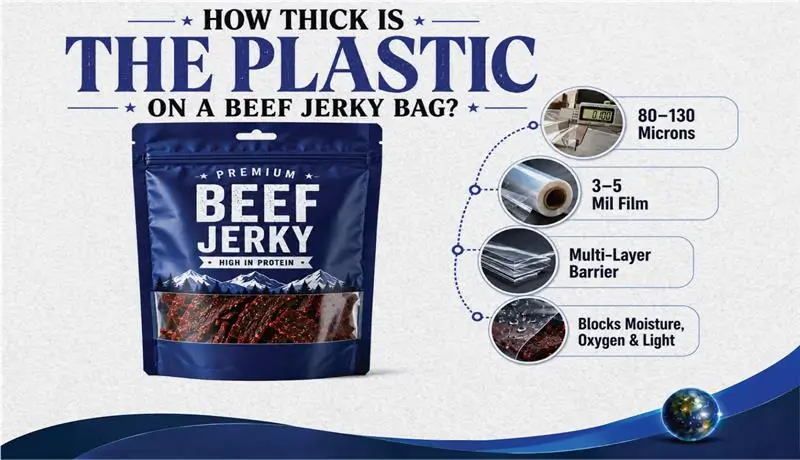
When asked how thick is the plastic on a beef jerky bag, plastic film thickness is generally measured in two ways: film thickness (mil) and micron thickness. A typical range is noted between 80 and 130 microns, or roughly 3 to 5 mil, depending on the pouch size and intended use. These measurements are established according to detailed packaging specifications prepared for food packaging that must withstand shipping, shelf storage, and repeated handling.
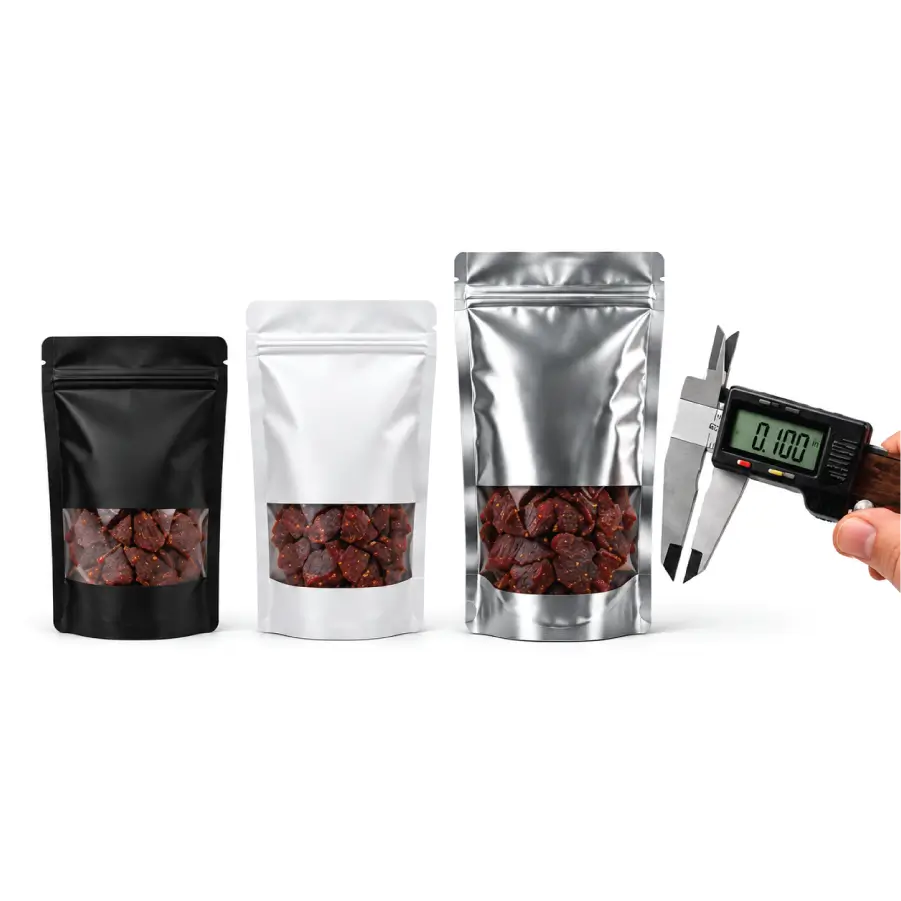
A thinner film is generally reserved for smaller portions, while heavier cuts of meat are matched with a thicker structure. Anyone researching how thick is the plastic on a beef jerky bag is often introduced to these standard measurements first. Interested about what actually goes into that film? The next section breaks down the exact materials layer by layer.
Understanding Beef Jerky Bag Materials & Thickness
When how thick is the plastic on a beef jerky bag is examined, attention is usually directed towards the layered construction of the pouch. A beef jerky pouch is rarely manufactured from a single sheet of plastic. Instead, several films are bonded through laminated packaging techniques so that sealing performance, puncture resistance, strength, and protection against oxygen and moisture are achieved.
For readers asking how thick is the plastic on a beef jerky bag, a total pouch thickness ranging from approximately 70 to 130 microns, or 2.8 to 5.1 mils, is commonly specified. The final thickness is determined according to the required shelf life, weight of the jerky, pouch size, storage conditions, and required barrier performance.
1. Multi-Layer Plastic Film
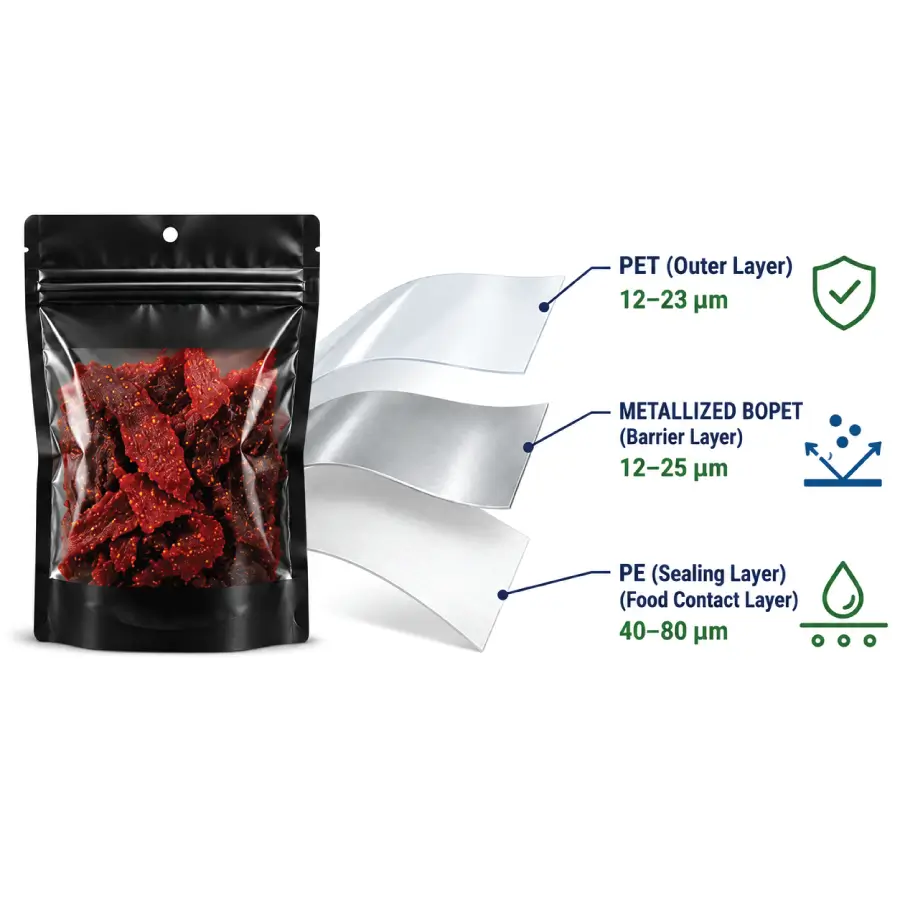
When how thick is the plastic on a beef jerky bag is considered, the complete laminate structure must be examined rather than only one plastic layer. Several individual materials are bonded through lamination, and combined protection against oxygen, moisture, grease, light, punctures, and external handling is achieved through the layered structure.
Thickness of Multi-Layer Plastic Film
In response to how thick is the plastic on a beef jerky bag, a total multi-layer film thickness of approximately 70 to 130 microns is commonly specified. A thicker laminate is generally specified where heavy jerky pieces, sharp edges, extended storage, or higher barrier performance are involved.
2. PET Film
For a complete understanding of how thick is the plastic on a beef jerky bag, the outer PET layer must also be considered. PET, or polyethylene terephthalate, is commonly positioned as the outer layer, and high-quality printing, dimensional stability, surface durability, and resistance against external wear are achieved through this material.
Thickness of PET Film
When how thick is the plastic on a beef jerky bag, a PET film thickness ranging from 12 to 23 microns is commonly included. A thickness of 12 microns is frequently specified for standard laminated beef jerky pouches, while thicker PET films are specified where additional rigidity and resistance against handling are required.
3. BoPET Film
When researching how thick is the plastic on a beef jerky bag, BoPET is often identified as an important outer laminate material. BoPET, or biaxially oriented polyethylene terephthalate, is manufactured through the stretching of PET film in two directions, and greater tensile strength, clarity, printability, and tear resistance are achieved through the orientation process.
Thickness of BoPET Film
For the question how thick is the plastic on a beef jerky bag, a BoPET film thickness ranging from 12 to 25 microns is commonly specified. A 12-micron BoPET film is frequently positioned as the printed outer layer in personalized beef jerky packaging.
4. Metallized BoPET Film
When how thick is the plastic on a beef jerky bag is reviewed for high-barrier packaging, metallised BoPET is commonly included in the laminate structure. Metallised BoPET film is produced through the application of a very thin aluminium coating to BoPET film, and improved protection against oxygen, moisture, light, and aroma loss is achieved through the metallised barrier.
For readers examining how thick is the plastic on a beef jerky bag, metallised BoPET is frequently found in three-layer pouch structures. Strong barrier protection is achieved without the additional stiffness commonly associated with aluminium foil.
Thickness of Metallised BoPET Film
When determining how thick is the plastic on a beef jerky bag, a base BoPET film thickness of approximately 12 microns is commonly specified. Depending on the required strength and barrier performance, base film thicknesses ranging from 12 to 25 microns may also be specified.
5. PE Film
When how thick is the plastic on a beef jerky bag is examined, the inner PE layer usually forms the thickest part of the laminate. PE, or polyethylene, is commonly positioned as the innermost food-contact layer, and a reliable heat seal is formed through this material.
For readers asking how thick is the plastic on a beef jerky bag, resistance against moisture, grease, and leakage is also achieved through the PE layer. Safe separation between the jerky and the remaining laminate layers is maintained through the inner food-contact film.
Thickness of PE Film
When calculating how thick is the plastic on a beef jerky bag, a PE sealing-layer thickness ranging from 40 to 80 microns is commonly specified. A thickness ranging from 50 to 70 microns is frequently included so that reliable sealing and resistance against punctures are achieved.
For a more precise answer to how thick is the plastic on a beef jerky bag, a thicker PE layer is generally specified for heavier jerky portions, sharp product edges, or larger pouch sizes.
6. BOPP Film
When how thick is the plastic on a beef jerky bag for clear or moisture-resistant structures, BOPP may be included within the laminate. BOPP, or biaxially oriented polypropylene, is used in selected structures where clarity, stiffness, moisture resistance, and surface protection are required.
Thickness of BOPP Film
When answering how thick is the plastic on a beef jerky bag, a BOPP film thickness ranging from 15 to 30 microns is commonly included. Thicknesses ranging from 18 to 20 microns are frequently specified in flexible food packaging structures.
For readers wanna know how thick is the plastic on a beef jerky bag, a thicker BOPP film may be specified where greater stiffness or surface resistance is required.
7. PP Film
When how thick is the plastic on a beef jerky bag is examined, PP, or polypropylene, may also be identified within the laminated structure. PP is commonly positioned as an inner or intermediate layer where heat resistance, moisture resistance, stiffness, and sealing performance are required.
For a complete understanding of how thick is the plastic on a beef jerky bag, PP and BOPP should not be treated as identical materials. Standard PP is commonly used as a sealing or structural layer, while BOPP is produced through biaxial orientation and is generally included where greater clarity, tensile strength, and dimensional stability are required.
Thickness of PP Film
When how thick is the plastic on a beef jerky bag, a PP film thickness ranging from approximately 25 to 80 microns is commonly specified. A thickness ranging from 40 to 60 microns is frequently included where PP is positioned as the inner sealing layer.
For heavier portions or sharper jerky pieces, a greater PP thickness may be specified when how thick is the plastic on a beef jerky bag. Additional sealing strength and puncture resistance are achieved through the increased layer thickness.
Beef Jerky Bag Material and Thickness Table
When how thick is the plastic on a beef jerky bag, the total thickness is determined through the combined measurement of all laminated layers.
| Material | Common Position in the Pouch | Typical Thickness | Main Purpose |
| PET Film | Used as an outer layer | 12–23 microns | Print quality, surface durability, and dimensional stability are achieved. |
| BoPET Film | Used as a printed outer layer | 12–25 microns | Greater tensile strength, clarity, and tear resistance are achieved. |
| Metallised BoPET Film | Used as a middle barrier layer | 12–25 microns | Protection against oxygen, moisture, light, and aroma loss is improved. |
| PE Film | Used as an inner food-contact and sealing layer | 40–80 microns | Reliable sealing and resistance against moisture, grease, and leakage are achieved. |
| PP Film | Used as an inner or intermediate layer | 25–80 microns | Heat resistance, sealing performance, stiffness, and moisture resistance are achieved. |
| BOPP Film | Used as an outer or intermediate layer | 15–30 microns | Clarity, surface protection, stiffness, and moisture resistance are achieved. |
| Complete Multi-Layer Laminate | Formed through the bonding of several layers | 70–130 microns | Combined sealing, barrier, puncture, and storage protection are achieved. |
For readers asking how thick is the plastic on a beef jerky bag, an overall thickness of approximately 70 to 130 microns, or 2.8 to 5.1 mils, is commonly specified. The exact measurement is determined according to the weight of the jerky, pouch size, storage period, required shelf life, and required protection of the product.
Ways To Measure Plastic Thickness On A Jerky Bag
When how thick is the plastic on a beef jerky bag is determined, a digital micrometer or film thickness gauge is commonly used. Measurements are taken from several flat areas, while seals, folds, zippers, and gussets are avoided.
Digital Micrometer
A flat section of the pouch is placed between the measuring surfaces, and light pressure is applied. At least five readings are recorded, and the average thickness is calculated.
Film Thickness Gauge
Greater accuracy is usually achieved through a film thickness gauge. This method is commonly used during packaging quality inspections.
Cross-Section Testing
When the thickness of PET, BoPET, PE, PP, foil, or nylon must be checked separately, laboratory cross-section analysis is performed.
The total thickness of a beef jerky bag commonly ranges from 70 to 130 microns, or approximately 2.8 to 5.1 mils.
Standard-Size Pouch Thickness (60g–100g Jerky Bags)
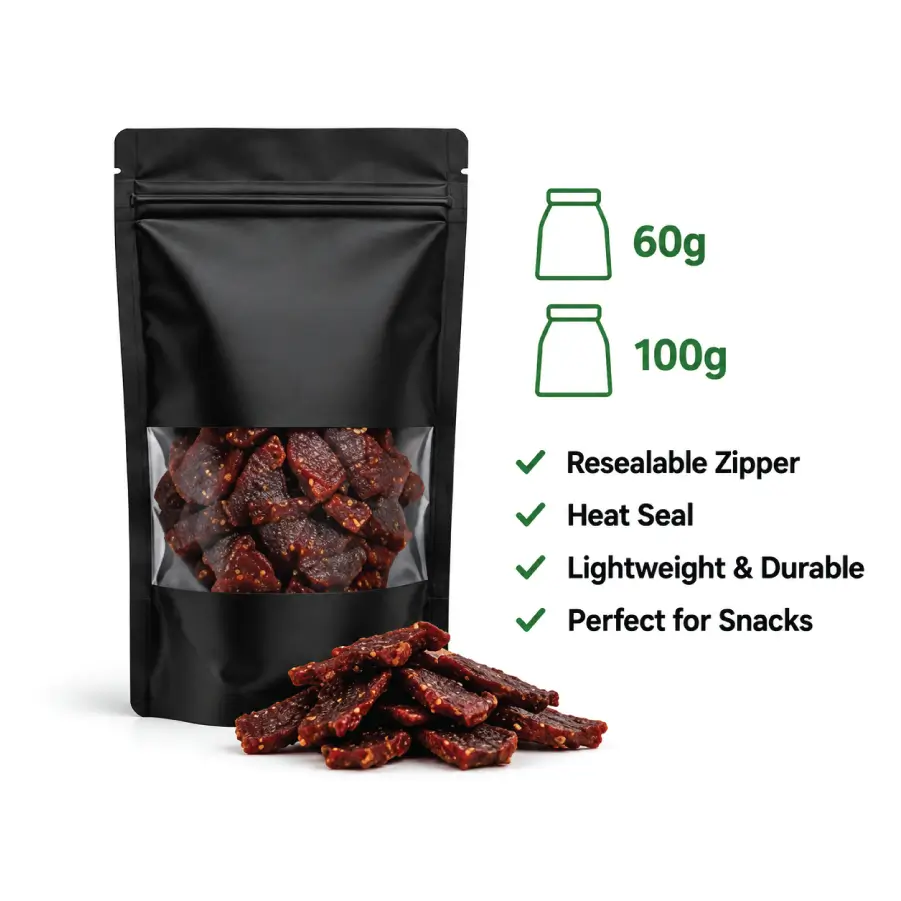
When how thick is the plastic on a beef jerky bag is discussed for smaller snack packs, thickness is generally found between 100 and 120 microns. Smaller portions of jerky, typically in the 60g to 100g range, are most often packed in a stand-up pouch. A heat-seal layer is incorporated into the inner lining so that the pouch is closed securely after filling. A resealable zipper or a zip-lock closure is frequently included so that convenience is maintained after the pouch has been opened. For products requiring additional safety features, Childproof Ziplock Bags are also considered, particularly where controlled access is preferred.
For everyday snack packaging, a balanced thickness is selected so that tearing is resisted while handling remains comfortable. Anyone comparing how thick is the plastic on a beef jerky bag across different pouch sizes is likely to notice that larger packages are produced with thicker films. Those larger formats are discussed below.
Businesses searching for Custom Foil Pouch Packaging Wholesale often prefer these high-barrier structures because additional protection against moisture, oxygen, and light is achieved.
“Good things come in small packages.” — Aesop
Large-Size Pouch Thickness (200g–500g Packaging)
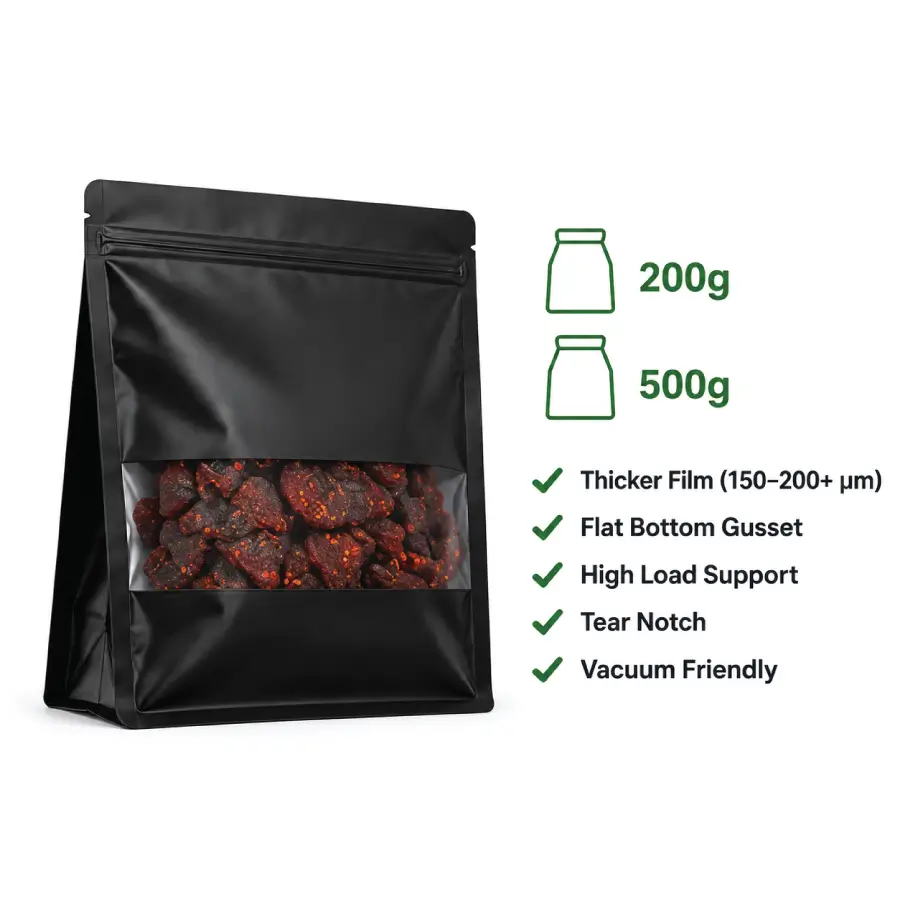
For larger package sizes, how thick is the plastic on a beef jerky bag is answered with higher thickness values. When package sizes increase to 200g or 500g, thickness is commonly increased to 150–200+ microns. A gusset pouch and Flat Bottom Gusset Bags are frequently selected because greater stability is achieved for heavier loads. Greater attention is also given to packaging durability, and a tear notch is commonly included so that the pouch is opened neatly without damage to the main seal.
For extended freshness, vacuum-sealed packaging is sometimes preferred over a standard air-filled pouch. Flexible Customized Pouches in this category are produced with support as a primary consideration. Readers interested in how thick the plastic is on a beef jerky bag often find that larger pouch sizes are matched with thicker plastic structures rather than a single standard thickness. Custom printing standards are explained next.
Custom Printed Jerky Packaging: Industry Thickness Standards
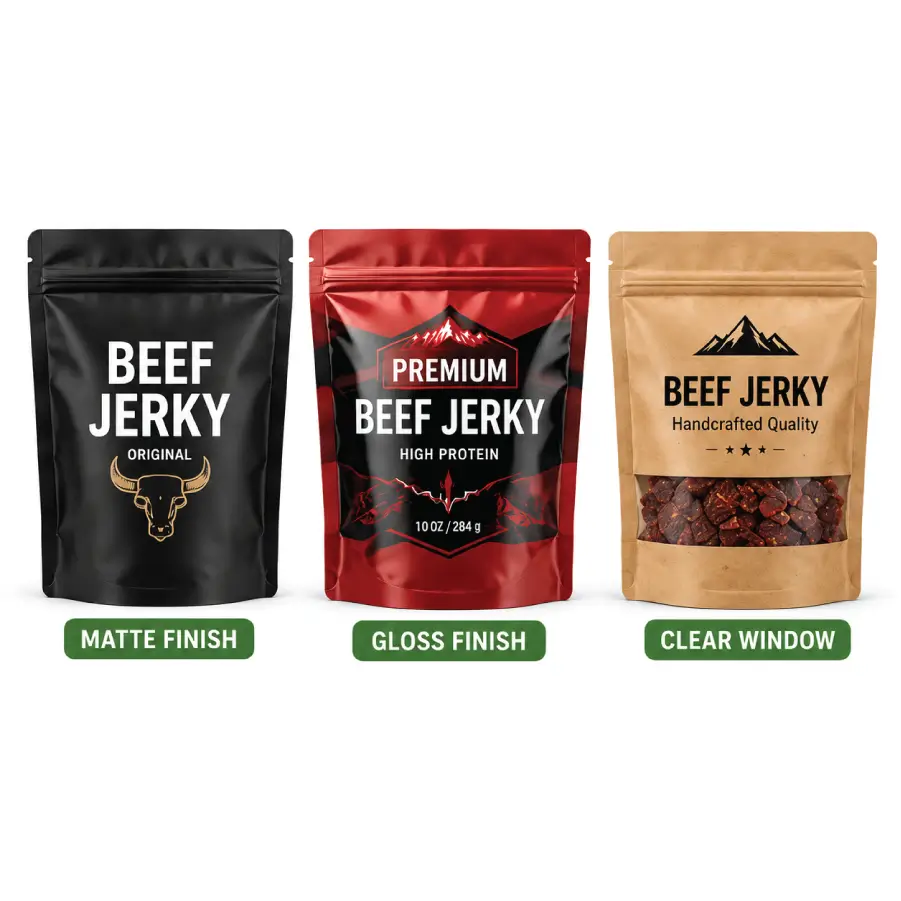
Beyond protection of the product, shelf presentation is also considered an important factor. When considering how thick is the plastic is on a beef jerky bag for custom-printed packaging, stock measuring approximately 5 mil per side is commonly referenced. This thickness is generally selected so that detailed printing quality is achieved while structural strength is maintained. A matte finish or a gloss finish is selected according to the perception of the brand, while a clear window pouch is sometimes preferred so that the product remains visible to shoppers. Digital printing, flexographic printing, or rotogravure printing is selected according to order volume and artwork requirements. Once printing specifications have been finalized, attention is generally shifted toward selecting a suitable supplier.
Looking for premium Beef Jerky Bags with customizable sizes, finishes, and barrier protection? Explore our collection to discover packaging that matches the requirements of your brand.
“Customers will occasionally buy products not because they want them but because of how they are presented to them.”
James Clear
Regulations, Specifications, And Certifications Of Plastic Material According To Canada
Across Canada, several established suppliers (hum dosre k bare mei baat nhi kr skte) are relied upon for retail packaging. But platform like Universal Packaging supplied the custom packaging solutions, Kraft Stand Up Pouches Wholesale for beef jerky bags that is produced in compliance with Food and Drug Regulations B.23.001 and Safe Food for Canadians Regulations SOR/2018-108, Section 186 is required. Food-safe materials, sanitary construction, and protection against moisture, contamination, damage, and deterioration must be confirmed.
Certification may be obtained under ISO 22000:2018, BRCGS Packaging Materials Issue 7, or SQF Food Sector Packaging Edition 10 Stand Up Pouches Food Packaging solutions. Thickness testing may be performed according to ASTM F2251-13(2023). No fixed thickness is prescribed, as suitability is determined according to sealing, barrier, strength, and shelf-life requirements.
Businesses searching for Custom Mylar Bags Toronto are often directed toward suppliers like this that offer both small-batch and bulk production.
How To Choose The Right Jerky Bag Thickness For Your Brand
When how thick is the plastic on a beef jerky bag is considered for a specific product, a single answer is rarely found. Thickness selection is guided by the needs of the brand, the requirements of the brand, and the characteristics of the product being packed. Compliance with food safety regulations is treated as a non-negotiable requirement, and a tamper-evident seal is frequently incorporated as an additional safety feature.
For brands seeking a personalized appearance, Custom Food Pouches With Logo are commonly requested alongside flexible customized pouches produced for unique product shapes. Childproof ziplock bags and Retort Pouches are also considered for specialty or premium beef jerky packaging. Readers interested in how thick is the plastic on a beef jerky bag generally discover that the right thickness is determined according to the intended application rather than a universal standard. Once the appropriate packaging thickness has been selected, attention is often shifted toward storage life.
Explore our range of Custom Packaging For Small Companies, where personalized printing, premium materials, and flexible packaging options are offered for brands of every size. Request Your Custom Quote Today.
Conclusion
In this blog, how thick is the plastic on a beef jerky bag has been explained from several different perspectives, including micron measurements, material selection, barrier protection, printing standards, and Canadian sourcing. Anyone searching for how thick is the plastic on a beef jerky bag is often surprised to discover that thickness alone is not responsible for long-term performance.
Instead, freshness, durability, and shelf presentation are achieved through the right combination of materials, barrier properties, and film thickness. After this, you want to know the time limit for lasting them, as they also depend on the thickness of the plastic bags, so know How Long Does Beef Jerky Last In A Ziplock Bag next! Whether a small resealable pouch or a large gusset bag is selected, the appropriate structure is determined according to the product, storage requirements, and handling conditions.
Frequently Asked Questions (FAQs)
How thick is the plastic on a beef jerky bag, on average?
Most bags have between 80 and 130 microns, or roughly 3 to 5 mil, depending on size and material.
Why are multiple layers used instead of one plastic sheet?
Multiple layers are combined so barrier protection, strength, and printability are all achieved together.
Is PET or LLDPE better for jerky packaging?
Both are widely used; the choice generally depends on recyclability goals, cost, and required seal strength.
Are jerky bags recyclable?
Some are, particularly those built with mono-material structures; multi-material laminates are harder to recycle.
Can jerky packaging be customized with a logo or design?
Yes, custom food pouches with a logo are commonly offered, along with matte, gloss, UV finishes, or clear window features.
Is customization offered for small or startup jerky brands?
Yes, flexible customized pouches and smaller print runs with custom design, shape, style, logo, and artwork are typically offered for new or growing brands.
Where can beef jerky packaging be purchased in Canada?
Canadian suppliers such as Universal Packaging are commonly approached for custom beef jerky bags, offering a range of sizes, finishes, and thicknesses suited to both small snack brands and larger meat processors.
Do bigger jerky bags need thicker plastic?
Yes, bulk sizes are generally built with thicker film for added durability and load support. But it is also customized according to the requirements of the specific brand.