As a startup, many mistakes happen during the final cigarette packaging design that cause a lower reputation in the competitive market. To avoid this, we discuss the 10 Common Mistakes In Cigarette Packaging Design that are made more often than expected, even by experienced brands, and most of them stay unnoticed until a batch is already in production. Here’s a closer look at where these mistakes tend to happen, and how each one is avoided.
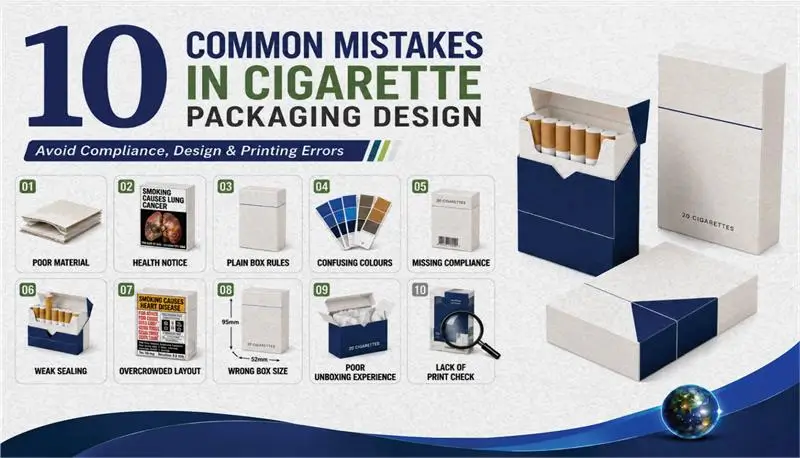
A Quick Overview At A Glance:
- Sustainable Material Skipped: eco-conscious alternatives are ignored in favour of lower cost.
- Wrong Size of the Box: market-specific pack rules are not matched correctly
- Health Notice Added at the End: information is squeezed into the layout without proper planning.
- Wrong Plain Box Rules: standardized colour and font requirements are misunderstood.
- Colours That Confuse Buyers: soft tones are used without compliance.
- Missing Compliance Information: important details are left incomplete.
- Weak Sealing: tamper-evident packaging sealing is left out of the design.
- Overcrowded or Empty Layouts: visual balance is lost on the surface.
- Unboxing Experience Ignored: interior consistency is missing.
- No Final Print Check: mistakes are not carefully checked before mass production.
Each of these points reflects a recurring pattern within 10 common mistakes in cigarette packaging design, and a closer look at each one is provided below.
Mistake 01: Poor Material Selection
Poor material selection has become one of the top 10 common mistakes in cigarette packaging design, with weak cardboard chosen over sturdier alternatives for short-term savings. Kraft packaging and rigid packaging options are available for brands seeking better pack durability and moisture resistance. Many brands are also shifting toward Custom Size Kraft Boxes to achieve better product fit, improved protection, and more efficient packaging performance.
Particularly important for products that are transported across long distances or stored in humid conditions. The reputation of the brand is changed when sustainable, well-structured materials are skipped in favour of cheaper, less reliable alternatives, and damaged stock on retail shelves often does more harm to consumer trust than the cost saved during production.
This is especially important when choosing Custom Packaging For Small Companies, where balancing cost, durability, and presentation of brand is important for long-term growth.
Mistake 02: Size Not Matching Market Rules
Minimum counts and pack-size restrictions vary widely between regions, and this detail is frequently overlooked within 10 common mistakes in cigarette packaging design. Smaller, cheaper pack formats are restricted in several countries specifically to limit youth access, an issue tied closely to broader market competition dynamics across regions where pricing strategy is influenced directly by permitted pack sizes. Region-specific sizing research is suggested before any new format is approved for production, since a design that performs well in one market is sometimes entirely non-compliant in another due to differing minimum unit laws.
Mistake 03: Health Notice Added at the End
In many projects related to Cigarette Packaging Design, the health notice is treated as a last-minute addition instead of a core part of the layout. When this information is squeezed in without proper planning, the overall structure of the box is disturbed. Issues such as incorrect sizing, wrong placement, and labeling mistakes are common outcomes of this category within the 10 common mistakes in cigarette packaging design.
Correct placement at the planning stage depends on the rest of the layout to be built around it smoothly, and a clearer look is achieved between the notice and the surrounding once this step is given proper attention. In several cases, an entire print run is rejected simply because the proportion of the notice on the panel does not meet the minimum requirement, or added at the end where it is simply overlooked, leading to additional cost and delay for the manufacturer.
“My motto is strong packaging, clear addressing.” — Halldór Laxness
Mistake 04: Wrong Plain Box Rules
Regulatory packaging requirements are followed in several regions, and these rules are often misunderstood during the process of cigarette packaging design, contributing to one of the most repeated 10 common mistakes in cigarette packaging design. A single background plain colour, a standardized typeface, and the removal of logo are required under such regulations. When packaging compliance is not matched precisely, the entire batch is rejected during quality checks, and the cost of correcting the error after production is far higher than addressing it at the design stage. Plain box requirements should be checked early, especially when different markets are being targeted. In this way, one issue from the 10 common mistakes in cigarette packaging design is avoided.
Attention to plain box requirements is one of the most important steps to consider, particularly for brands operating across multiple regions where the rules are not identical from one market to the next. Want to know how colour choices add to this problem? The next point explains it in detail.
Mistake 05: Colours That Confuse Buyers
Soft tones, pastel shades, and gold finishes are sometimes selected to imply softness or a premium feel. Colour inconsistency is a common mistake in today’s packaging industry. The perception of the brand is affected when colours are used to imply something that is not clearly stated, and this often leads to closer scrutiny from regulatory bodies during routine packaging audits.
A balanced and compliant colour palette is recommended within 10 common mistakes in cigarette packaging design to avoid this confusion, since even a slight shift in shade is sometimes interpreted as an attempt to bypass labeling restrictions. Missing details are another silent issue; find out which ones in the next section.
Mistake 06: Missing Compliance Information
Nicotine content and country-specific rules are sometimes left out or updated incorrectly, raising concerns around FDA compliance. This gap is one of the more technical entries within 10 common mistakes in cigarette packaging design, usually caused by exporting a single design across multiple markets without adjusting it for local requirements. The identity of the product is affected when compliance details are inconsistent from one region to another, and in some cases the entire shipment is held at customs until it is resolved. A region review is suggested before any print run is finalized, with particular attention given to language, measurement units, and rule sets that differ between countries.
Mistake 07: Weak Tamper-Evident Features
A cluttered surface with too much text or an overly empty layout is often caused by poor planning. This is counted among the 10 common mistakes in cigarette packaging design. A professional appearance is maintained through design consistency and minimalist packaging principles, while shelf appeal and packaging functionality are also considered. When visual hierarchy is overlooked, the presentation of the product is weakened, and important details such as the name of the brand or mandatory notice are lost among competing graphics.
This issue is included in the 10 common mistakes in cigarette packaging design because balanced layouts are important for clear communication. Box sizing has its own regional complications, which are explored in the next part. This becomes even more important in Custom Retail Display Boxes, where visual balance directly affects visibility and customer attention. The unboxing moment matters more than expected; the next section explains why.
Mistake 08: Overcrowded or Under-Designed Surfaces
A cluttered surface filled with excessive text, or an overly minimal layout with too much space, are both common outcomes of poor planning within 10 common mistakes in cigarette packaging design. Design consistency and minimalist packaging principles are recommended to maintain a professional appearance, alongside attention to shelf appeal and overall packaging functionality, since both extremes tend to confuse the buyer rather than guide their attention.
The presentation of the product suffers when visual hierarchy is overlooked, and elements that should stand out, such as the brand name or the mandatory notice, are often lost among competing graphics. Box sizing carries its own set of regional complications explored in the next part. This becomes even more important in Custom Retail Display Boxes, where visual balance directly affects visibility and customer attention. The unboxing moment matters more than expected; the next section explains why.
Mistake 09: Opening Experience Often Overlooked
The interior of the box, opening flow, and visual consistency between inside and outside surfaces are sometimes ignored during cigarette packaging design. This is counted as another point in the 10 common mistakes in cigarette packaging design. Customer perception is affected when the opening experience feels rough or inconsistent, even if the exterior design looks polished. Premium presentation of the product is enhanced through embossing, foil stamping, and spot UV, while stronger customer engagement is created at the point of interaction.
This mistake is often included in the 10 common mistakes in cigarette packaging design because the first interaction is closely linked to how the product is presented. One last step is often skipped before printing, covered in the final point. Protection features also matter in Custom Box For Tincture, where tamper-resistant packaging helps maintain product integrity and consumer trust.
“Packaging can be theater, it can create a story.” — Steve Jobs
Mistake 10: No Final Check Before Print
A pre-print review is sometimes skipped because of tight production timelines. This is counted as one of the costliest points in the 10 common mistakes in cigarette packaging design. Printing defects, low-quality printing, uneven matte finish, gloss coating, and colour calibration are checked at this stage. Delays and reprints are avoided when a structured final review is added to the production timeline. In this way, one major issue from the 10 common mistakes in cigarette packaging design is avoided, while cost and reputation are protected. Now, let’s take a quick look at the new future trends below.
Future Trends In Cigarette Packaging Design
Beyond the 10 common mistakes in cigarette packaging design, several new packaging trends are shaping the future. These trends are discussed below.
- Premium and Luxury Finishing: Luxury packaging finishes are increasingly paired with retail display packaging strategies to strengthen point-of-sale impact. To gain deeper insights into luxury packaging strategies, explore Custom Cigarette Boxes for Premium Brands, where premium finishing plays a key role in shelf appeal and brand positioning.
- Smart and Advanced Packaging: Smart packaging such as QR code packaging is introduced to support packaging innovation and consumer trust.
- Sustainable Materials: Eco-friendly packaging built from recyclable materials continues to make sustainable packaging goals across the industry, while also contributing to stronger differentiation within a crowded retail environment.

For brands looking to stand out in a competitive market and want to avoided these 10 common mistakes in cigarette packaging design, get Custom E Cigarette Packaging Boxes from here, produced for durability, compliance, and stronger shelf presence. Contact us today to explore custom packaging solutions.
Conclusion
Designing a cigarette box involves far more than visuals; it demands attention to compliance, material strength, and consumer trust at every stage. Throughout this blog, every major issue tied to 10 common mistakes in cigarette packaging design has been broken down, from health notice placement and plain box rules to sealing features, material selection, and the final pre-print review. Avoiding these recurring 10 common mistakes in cigarette packaging design results in packaging that is more professional, compliant, and consumer-friendly, while the reputation of the brand is strengthened through every consistent, well-planned decision made along the way.
Frequently Asked Questions (FAQs)
What is the most common mistake in cigarette packaging design?
Health notices being added without proper planning is included in 10 common mistakes in cigarette packaging design at the top.
Why are plain packaging rules important?
Standardized colours, fonts, and the removal of logo are required under plain packaging laws, and non-compliance results in rejected production batches across regulated markets.
Why is sustainable material considered necessary now?
Recyclable and eco-conscious materials are increasingly expected by consumers now, and the reputation of the brand is raised by this choice, as sustainability becomes a stronger purchasing factor.
What role do sealing features play?
Tamper-evident seals and marks are used to reduce unsealing risks and strengthen the protection of the cigarette throughout the supply chain.
How does overcrowding affect a box design?
Too much text or too little structure disrupts visual balance, and the presentation of the product is weakened as a result, making it harder for buyers to locate key information.
Why does box size matter across different countries?
Minimum pack sizes are regulated in several regions to limit youth access, and these requirements differ by market, making a single global design impractical.
Is the unboxing experience really that important?
Yes, the interior layout and opening flow are noticed by consumers and contribute directly to the overall impression of the box, even after the purchase decision has already been made.
Can cigarette box designs be customized for different markets?
Yes, customization is offered based on the different requirements of the products and the brand. In Universal Packaging, these packaging options are well customized according to the specific requirements and all according to the rules in making its design.
Where should businesses start when redesigning their packaging?
A compliance review is typically recommended as the first step, followed by material, layout, and sealing assessments to ensure every element works together, a foundation that helps avoid most 10 common mistakes in cigarette packaging design before production even begins. So, go through again!