Today, we’re looking at an important consideration for Canadian food manufacturers: suitable packaging for sauces and condiments. A Sauce Pouch Packaging Checklist for Food Manufacturers covers a checklist every manufacturer should read before purchasing packaging, including: selection of materials, dimensions of the pouch, strength of the seals, printing quality, labelling accuracy, and storage conditions. Each detail deserves careful review before production begins. For Canadian food businesses, a sauce pouch packaging checklist for food manufacturers should also address applicable food-contact regulations and labelling requirements.
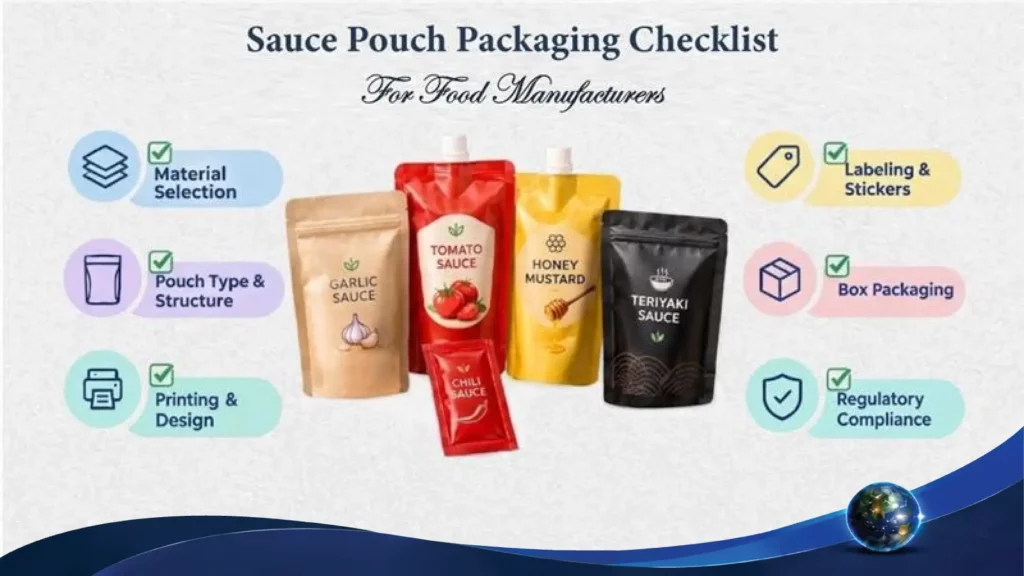
Discover the Essentials of Sauce Pouch Packaging
Before approving an order, review the following checkpoints. A sauce pouch packaging checklist for food manufacturers should include:
- Compatibility of the material: Confirm suitability for the sauce formulation.
- Dimensions of the pouch: Verify the width, height, and filling capacity.
- Strength of the seals: Check the resistance of the seals to leakage.
- Selection of the closure: Compare spouts, tear notches, and resealable zippers.
- Printing quality: Review colour consistency, graphics, and text legibility.
- Storage conditions: Assess exposure to heat, moisture, and light.
These checkpoints establish a practical foundation for a sauce pouch packaging checklist for food manufacturers. Record the approved specifications before production begins. Explore Retorted Pouch For Sauce Packaging to discover their heat-resistant materials, protective features, and design options for reliable sauce packaging.
Evaluate Food-Grade Materials for Sauce Protection
The selection of food-grade materials is an important part of sauce packaging planning. Depending on the formulation and storage conditions, suitable structures may include polyethylene (PE), polyethylene terephthalate (PET), aluminium foil for Custom Foil Pouch Packaging Bulk, and laminated films. Each material structure has different barrier properties, flexibility, and sealing characteristics. For example, oxygen-sensitive sauces may need packaging with an appropriate oxygen barrier.
A sauce pouch packaging checklist for food manufacturers should inc ude an assessment of acidity, oil content, filling temperature, and expected shelf life. Food-contact suitability must be verified for the complete packaging structure, including relevant inks and other components. A sauce pouch packaging checklist for food manufacturers should document the specifications of the material and the supporting sauce pouch packaging suppliers information before approval.
Determine the Correct Sauce Pouch Size
The dimensions of the pouch affect filling accuracy, storage efficiency, transportation, and the presentation of the product. Begin by establishing the intended serving size, fill weight, sauce density, and available storage space. Small sachets may suit single servings, while larger Stand Up Pouches Food Packaging may suit household or food-service portions. There are alot of different viscosities of sauces; you should have a look at Empty Apple Sauce Pouches with their conveniently available sizes. Consider the filling equipment, required headspace, and space for seals or closures.
A sauce pouch packaging checklist for food manufacturers should include dimensional tolerances and filling specifications. Before approving the final sauce spout pouch tomato packaging, review samples and production drawings. A sauce pouch packaging checklist for food manufacturers should record the approved dimensions of the spout pouch for tomato sauce packaging, filling capacity, and position of the closure.
Verify Sealing Strength and Leak Prevention
Reliable seals are essential for protecting sauce during filling, storage, distribution, and handling. Weak seals or incompatible materials may result in leakage, damaged cartons, product waste, and contamination concerns. The strength of the seals should therefore be assessed under conditions representative of the intended application. Review seal width, sealing temperature, pressure, dwell time, and compatibility between packaging layers. A sauce pouch packaging checklist for food manufacturers should include suitable testing procedures and acceptance criteria. Depending on the sauce packaging pouch design, assessments may include leak tests, burst tests, or seal-integrity testing. A sauce pouch packaging checklist for food manufacturers should also cover relevant transportation and handling conditions before final production approval.
Assess Printing Quality and Product Presentation
Printing quality contributes to the presentation of the product and the reputation of the brand. Clear graphics, readable text, consistent colours, and accurate product information support a professional appearance. Printed details may include the name, details of the flavour, ingredients, and preparation instructions for Custom Packets For Hot Sauce. Digital printing may suit shorter production runs, while other printing methods may be appropriate for larger volumes.
A sauce pouch packaging checklist for food manufacturers should cover colour consistency, registration accuracy, legibility, and artwork approval. Review the final artwork proof before production. A sauce pouch packaging checklist for food manufacturers should include documented approval of colours, graphics, and all required printed information. Designer “William Crooks”: “The upgraded digital printing process is designed for greater consistency in presentation across formats.”
Confirm Labelling Accuracy and Canadian Compliance
Canadian food packaging may be subject to several federal laws and regulations, depending on the product and business activities. Manufacturers should confirm the applicable requirements before approving the final artwork for a stand up spout pouch for tomato sauce packaging. These requirements may include applicable provisions under the Food and Drug Regulations, including Division 23 for food-contact packaging, the Safe Food for Canadians Regulations (SOR/2018-108), and the Consumer Packaging and Labelling Act (R.S.C., 1985, c. C-38), together with the Consumer Packaging and Labelling Regulations (C.R.C., c. 417).
A sauce pouch packaging checklist for food manufacturers should cover applicable bilingual labelling, ingredient lists, allergen declarations, Nutrition Facts, net quantity, and food-contact documentation. Environmental claims must also be accurate and non-misleading. A sauce pouch packaging checklist for food manufacturers should include a final compliance review. Let’s discover Sachet Condiments by exploring their compact formats, portion sizes, and custom printing options for single-serving applications.
Inspect Closure Options for Safe Handling
The selection of the closure should reflect the sauce, portion size, dispensing method, and intended application. Flat sachets may suit single servings, while spouted pouches may suit controlled pouring. Resealable zippers may be appropriate for products intended for repeated opening and closing. Assess ease of opening, control of dispensing, reseal performance, and the risk of leakage after opening. A sauce pouch packaging checklist for food manufacturers should also cover compatibility with filling equipment and the dimensions of the closure.
Request samples when several options are under consideration. A sauce pouch packaging checklist for food manufacturers should document the selected closure, handling considerations, and relevant performance tests before approval. Managing Director of UP “Danial James”: “Our continued expansion across Canada brings us closer to customers, with advanced printing technology supporting flexible packaging solutions and ongoing growth.
Review Shelf Life and Storage Conditions
The expected shelf life of a sauce depends on its formulation, processing, packaging, and storage conditions. Packaging alone cannot establish product safety or shelf life. Appropriate food-safety controls and product-specific testing remain essential. Review exposure to oxygen, moisture, light, temperature changes, and physical handling. A sauce pouch packaging checklist for food manufacturers should identify the recommended storage conditions and relevant transportation limitations. Conduct suitable shelf-life studies with the final product and approved packaging configuration. Retain the results and supporting documentation. A sauce pouch packaging checklist for food manufacturers should be reviewed whenever changes to the formulation, structure of the material, or processing conditions may affect product stability.
Compare Sustainability Standards and Recycling Options
Environmental considerations are increasingly important for food manufacturers and consumers. However, recycling suitability depends on the complete packaging structure and the collection and processing facilities available in the intended market. Multilayer standing sauce pouch packaging may face different recycling limitations from mono-material structures. Request information about material composition, recycled content where applicable, and available end-of-life options. A sauce pouch packaging checklist for food manufacturers should include evidence supporting environmental claims.
Discover Food Condiment Packaging by exploring its different formats, custom printing options, and presentation of the product for food businesses. Material reduction may also be considered when adequate product protection is maintained. A sauce pouch packaging checklist for food manufacturers should balance environmental objectives with food safety, durability of the packaging, and realistic disposal options within the Canadian market.
“Recycling, packaging, businesses are changing all of those things because that’s what consumers want.” — Jerry Greenfield
Strengthen Packaging Consistency Before Market Launch
Before approving an order, conduct a documented review of all packaging specifications. Confirm the structure of the material, dimensions of the standing up pouch with spout for sauce packaging, closure type, artwork, seal performance, labelling, and storage requirements. Accurate records reduce inconsistencies between approved samples and finished tomato sauce packaging stand up pouch. A sauce pouch packaging checklist for food manufacturers should include sample approval, quality-control criteria, supplier documentation, and procedures for reviewing design or material changes.
For custom sauce pouch packaging in Canada, contact Universal Packaging to discuss material options, printing preferences, pouch dimensions, order quantities, and finishing requirements. Explore Commercial Sauce Packaging to understand its packaging formats, material specifications, and printing options for large-scale food production. A sauce pouch packaging checklist for food manufacturers can serve as a reference during packaging consultations. Contact experts to get the best option.
Conclusion
A thorough packaging review supports product protection, consistent presentation, and informed purchasing decisions. From food-contact materials and dimensions of the custom sauce pouches to sealing strength, labelling accuracy, and recycling considerations, every checkpoint deserves attention before market launch. Keep a sauce pouch packaging checklist for food manufacturers as a working document and update it whenever the product, packaging structure, or applicable requirements change. Careful planning and consultation with a suitable packaging supplier for Custom Packaging For Small Companies support the preparation of specifications that reflect the needs of Canadian food manufacturers.
Frequently Asked Questions (FAQs)
What should a sauce pouch packaging checklist include?
A checklist should cover compatibility of the material, pouch dimensions, seal strength, closures, printing, Canadian labelling requirements, storage conditions, and recycling considerations before approval.
Which materials are suitable for custom printed sauce pouches?
Suitable materials depend on the formulation, barrier requirements, filling conditions, and storage needs. PE, PET, aluminium foil, and laminated films may be considered.
How do I choose the correct sauce pouch size?
Consider serving size, fill weight, sauce density, headspace, closure dimensions, and filling equipment compatibility before approving the final pouch specifications.
How can retorted pouch for sauce packaging leakage be prevented?
Choose compatible materials, establish suitable sealing parameters, and conduct leak and seal-integrity tests under representative filling, storage, and distribution conditions.
What Canadian labelling requirements apply to sauce pouches?
Applicable requirements may cover bilingual labelling, ingredients, allergens, Nutrition Facts, net quantity, and food-contact suitability, depending on the product and circumstances.
Are sauce pouches recyclable in Canada?
Recycling depends on material composition and local facilities. Confirm local acceptance and ensure environmental claims are accurate, specific, and supported by evidence.
How can manufacturers check sauce pouch shelf life?
Conduct product-specific shelf-life studies with the final packaging, appropriate food-safety controls, and storage conditions representative of the intended distribution environment.
Where can i get custom printed sauce packaging pouches?
Contact Universal Packaging to discuss custom sauce pouch options, materials, printing, dimensions, closures, and order specifications for your food manufacturing business.
Which closure is best for sauce packaging?
Flat sachets suit single servings, spouted pouches suit pouring, and resealable zippers suit repeated access. The appropriate option depends on the application.