Freshness, aroma, and the quality of the product are preserved when basmati rice packaging is chosen with care. However, moisture, insects, and stale odours are common worries, yet these are solved through the right choices covered in Basmati Rice Packaging: Materials, Styles and Design. In this article, basmati rice packaging: materials, styles and design is discussed, together with safety, shelf appeal and cost. Keep reading to find the right pouch or bag for your rice.
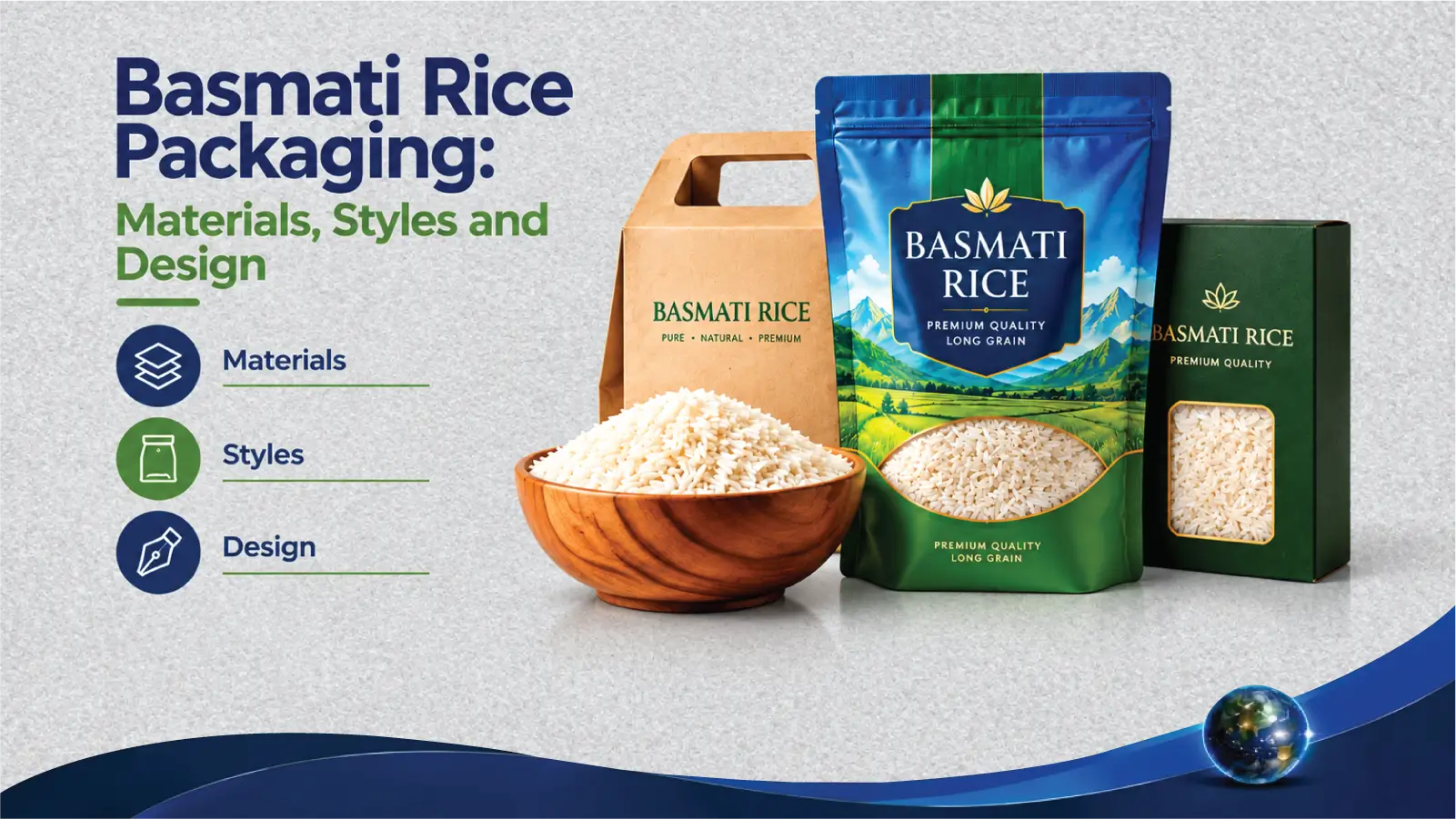
Materials Used For Basmati Rice Packaging
Many options are seen in rice packaging, and each option is chosen according to budget and storage time. Moreover, the choices in materials in basmati rice packaging: materials, styles and design are matched to the needs of the brand.
- Polypropylene (PP): Strength and resistance to moisture are offered.
- Laminated Pouches: Several film layers are bonded together for dependable protection of the product.
- Kraft Material: A natural, earthy look is offered, and eco-conscious buyers are attracted.
- Vacuum-Sealed Films: Air is removed, and the freshness of the grain is extended.
- Mylar: A strong barrier against light and oxygen is formed.
- Metallized Film: A shiny finish is added, and moisture is blocked.
- BOPET-Based Laminates: Clarity and stiffness are added, and sharp graphics are displayed.
- Foil Films: The highest barrier against air, light, and odour is offered.
- Cardstock: Light cartons are made from it.
- Cardboard: Secondary cartons are made from it.
- Corrugated Board: Shipping cartons are made from it, and impact is absorbed.
- Rigid Paperboard: Premium gift boxes are made from it, and a luxury feel is offered.
Bags and boxes are made from these materials, so buyers who are unsure whether to choose pouches or boxes can read Rice Bags vs Rice Boxes: Which Packaging Is Better? before deciding. Keep reading to see how these materials are shaped into popular styles.
Popular Styles Of Basmati Rice Packaging
Several pouch styles are chosen according to the size of the pack, so read on to compare them.
1. Stand Up Pouches With a Bottom Gusset
A standing display is achieved through stand-up pouches because a bottom Gusseted Mylar Bag is opened when the pouch is filled. As a result, this style is widely chosen for retail packs in basmati rice packaging: materials, styles and design. Read on to see the flat bottom style.
2. Flat Bottom Pouches
Five panels are formed in a flat bottom pouch, so a neat, box-like shape is obtained. Furthermore, Custom Logo Food Pouch orders are often placed by buyers who want an upscale look in basmati rice packaging: materials, styles and design. Next, the three side seal style is explained.
3. Three Side Seal (Flat) Pouches
Film is sealed on three sides, so plastic rice bags of this type are produced at a low cost. However, no self-standing display is offered, so this format is chosen in basmati rice packaging: materials, styles and design for budget lines. Continue to learn about gusseted side fold pouches.
4. Gusseted Side Fold Pouches
Side folds are added, and more volume is held. Larger quantities such as 5 kg and 10 kg are therefore packed in gusseted bags in basmati rice packaging: materials, styles and design. Read on to see the vacuum-sealed style.
5. Vacuum Sealed Pouches
Air is removed before sealing, and a firm block is formed. Therefore, vacuum packaging is preferred for aged basmati in basmati rice packaging: materials, styles and design. Keep reading to discover die cut shaped pouches.
6. Custom Die Cut Shaped Pouches
Unique outlines are formed through die cutting. Festive editions are often packed in a Customized Stand Up Pouch, so the perception of the brand is strengthened in basmati rice packaging: materials, styles and design. Continue reading to see the last pouch style.
7. Kraft Paper Laminated Pouches
An earthy look is obtained when kraft paper is laminated with an inner barrier film. Therefore, the reputation of the brand is improved in basmati rice packaging: materials, styles and design.
Rigid Rice Boxes
A firm box structure is formed for premium rice collections and gift packs. The thicker board adds a more substantial presentation, while printed surfaces are used for branding and product details.
Window Rice Boxes
A clear window is added to the front panel, so the grains are visible without opening the pack. This style is suitable where product visibility is important alongside printed branding.
Corrugated Rice Shipping Boxes
Several layers of corrugated board are combined for shipping and bulk orders. Added protection is obtained during handling and transportation, particularly for larger rice quantities.
Paperboard Rice Boxes
A lightweight paperboard structure is formed for retail rice packs, so a clean presentation is obtained. Printed panels are used for the rice variety, weight, ingredients, and other details of product.
Several pouch styles are chosen according to the size of the pack, so read on to compare them. A Child Resistant Reclosable Bag is another packaging format considered when a resealable closure and controlled access are required.
“Good things come in small packages.” — Aesop
Design Considerations For Basmati Rice Packaging
Colour, layout and printing are planned before a pack is finalized. These points are explained below, so keep reading.
Colour and Layout Choices
Gold, deep green and red are often seen on premium packs, since richness and tradition are conveyed through these colours. Likewise, a matte or gloss finish is applied on woven polypropylene sacks in basmati rice packaging: materials, styles and design. Read on to see how logos and graphics are added.
Adding Branding and Graphics
Recognition of the brand is designed when the logo is placed at the top centre. Moreover, Custom Clear BOPET Bags are often chosen in basmati rice packaging: materials, styles and design, so the grain is seen through a transparent panel. Move on to see how printing methods are chosen.
Printing Methods Used for Basmati Rice Packaging
Screen and UV printing are used for bold colours and a glossy finish. Moreover, Custom Printed Foil Pouches are printed through this method, so the presentation of the product is kept attractive in basmati rice packaging: materials, styles and design. Continue to the next section to see the practical points.
Practical Considerations for Basmati Rice Packaging
Safety, protection and cost are checked before a final choice is made. Each point is explained below, so keep reading.
Barrier Protection Against Moisture, Insects and Odour
Protection of the product is needed against three threats. For ready-to-eat rice, Retort Bags are chosen because heat sterilization. Therefore, the choices in basmati rice packaging: materials, styles and design are judged by these three barriers:
- Moisture: Clumping and mould are avoided when laminated films and foil layers are chosen.
- Insects: Entry of pests is blocked by sealed seams and tightly closed layers.
- Odour: Outside smells are kept away, and the natural aroma of the rice is preserved.
Next, food safety rules are explained, so keep reading.
Food-Grade Safety Standards
Only food-grade packaging is accepted for grain, because direct contact with food is involved. Moreover, compliance is checked by suppliers in basmati rice packaging: materials, styles and design.
“Customers will occasionally buy products not because they want them but because of how they are presented to them.” — James Clear
Sustainability and Recyclable Options
Eco-friendly choices are now expected by many shoppers. Therefore, a Custom Kraft Stand Up Pouch with a recyclable film is chosen in basmati rice packaging: materials, styles and design. Continuing to the last practical point, which is the balance of cost and quality.
Balancing Cost and Quality
Budget limits are faced by every seller, yet the quality of the product should not be reduced. Consequently, simple laminated packaging is chosen for bulk supply in basmati rice packaging: materials, styles and design. Read on to see the rules and standards followed in Canada.
Low prices do not have to mean low quality when the right supplier is chosen. Buyers who are comparing Cheap Custom Packaging Companies will find that printed pouches are available at bulk rates without any loss in barrier strength. Request a quote and see how much can be saved on the next order.
Regulations, Certifications And Canadian Specifications For Basmati Rice Packaging
Rules, certifications and relevant test specifications are followed in Canada before rice packs are sold. These are listed below, so keep reading.
- Regulations: Food packaging is covered by Division 23, Section B.23.001, of the Food and Drug Regulations (C.R.C., c. 870). Food labelling is also governed by the Food and Drugs Act and Regulations, the Safe Food for Canadians Act and Regulations (SOR/2018-108), and the Consumer Packaging and Labelling Act (R.S.C. 1985, c. C-38).
- Certifications: BRCGS Packaging Materials Issue 7, FSSC 22000, ISO 22000:2018, and ISO 22002-4 are internationally used food-safety and packaging standards that may be requested from packaging suppliers. FSSC 22000 specifically covers manufacturers of primary and secondary food packaging, including flexible plastics, paper, cartons, boxes, and sacks.
- Specifications: ASTM F1249 for water vapour transmission, ASTM D3985 for oxygen transmission, ASTM F88/F88M for seal strength, and ASTM D882 for tensile properties are relevant packaging test methods. These are testing standards rather than Canadian laws, so their use depends on the packaging specification and supplier testing requirements.
Conclusion
In this blog, we covered everything about basmati rice packaging: materials, styles and design in a different style, from material to design. Protection of the product, visibility of the product, and the reputation of the brand are strengthened by careful choices. Moreover, food contact and clear print are ensured through tested films. Therefore, packs are planned around grain type, storage time, and budget. Strong, food-safe pouches for rice are made to match the size and look of each brand at Rice Bags. Samples are reviewed before bulk production begins, so nothing is left to chance. Start your custom pouch order today and give your rice the protection it deserves.
Frequently Asked Questions (FAQs)
What is the best packaging material for basmati rice?
The best material is selected according to storage time, pack size, and budget. Polypropylene (PP), laminated films, BOPET, and foil-based structures are commonly considered for different rice packaging requirements.
Which pouch size is suitable for 1 kg, 5 kg, and 10 kg of basmati rice?
Retail quantities such as 1 kg are commonly packed in flat-bottom or stand-up pouches, while 5 kg and 10 kg quantities are often packed in larger gusseted bags or woven sacks. The final size is selected according to the quantity and storage requirements.
How long does basmati rice stay fresh in sealed packs?
Freshness is retained for a longer period when the grain is packed dry and sealed tightly. A suitable barrier against moisture, oxygen, and odours, together with cool and dry storage, is important for maintaining the quality of the product.
Are kraft pouches suitable for long-term rice storage?
Kraft pouches are suitable when an inner barrier layer is added. The kraft outer layer provides the desired natural appearance, while the inner film is selected for moisture and oxygen protection.
How is moisture kept out of rice pouches?
Moisture is blocked through barrier layers such as foil and BOPET. Laminated Flexible Bags are often selected for this purpose, while tight heat seals reduce the risk of moisture entering through the seams.
Which printing method is used for rice pouches?
Screen and UV printing are widely used for bold colours and clear graphics. Digital printing is also considered for shorter runs and personalized designs, depending on the order requirements.
Are recyclable rice pouches offered?
Yes, recyclable pouches are offered by some suppliers. The material structure should be checked against local recycling requirements to ensure that the selected packaging is suitable for the intended recycling stream.
Are custom sizes and shapes offered for rice pouches?
Yes, sizes, shapes, and windows are personalized according to the requirements of the pack. Custom Packaging Mylar Bags are also produced in different sizes, with samples reviewed before full production.
Where to buy basmati rice packaging?
Universal Packaging supplies custom pouches, bags, and boxes for rice in different sizes and material structures. Packaging options are selected according to the quantity.