Crispness, flavour, and long-term freshness of freeze-dried food are preserved when the right packaging is chosen from the start. Staleness, moisture damage, and customer complaints are avoided when the Common Freeze-Dried Food Packaging Mistakes are identified before production is started. Material selection, portion sizes, sealing, printing quality, durability, sustainability, packaging formats, and Canadian compliance requirements are discussed in this article. Scroll further, because the details below show where these mistakes are found and how they are avoided.
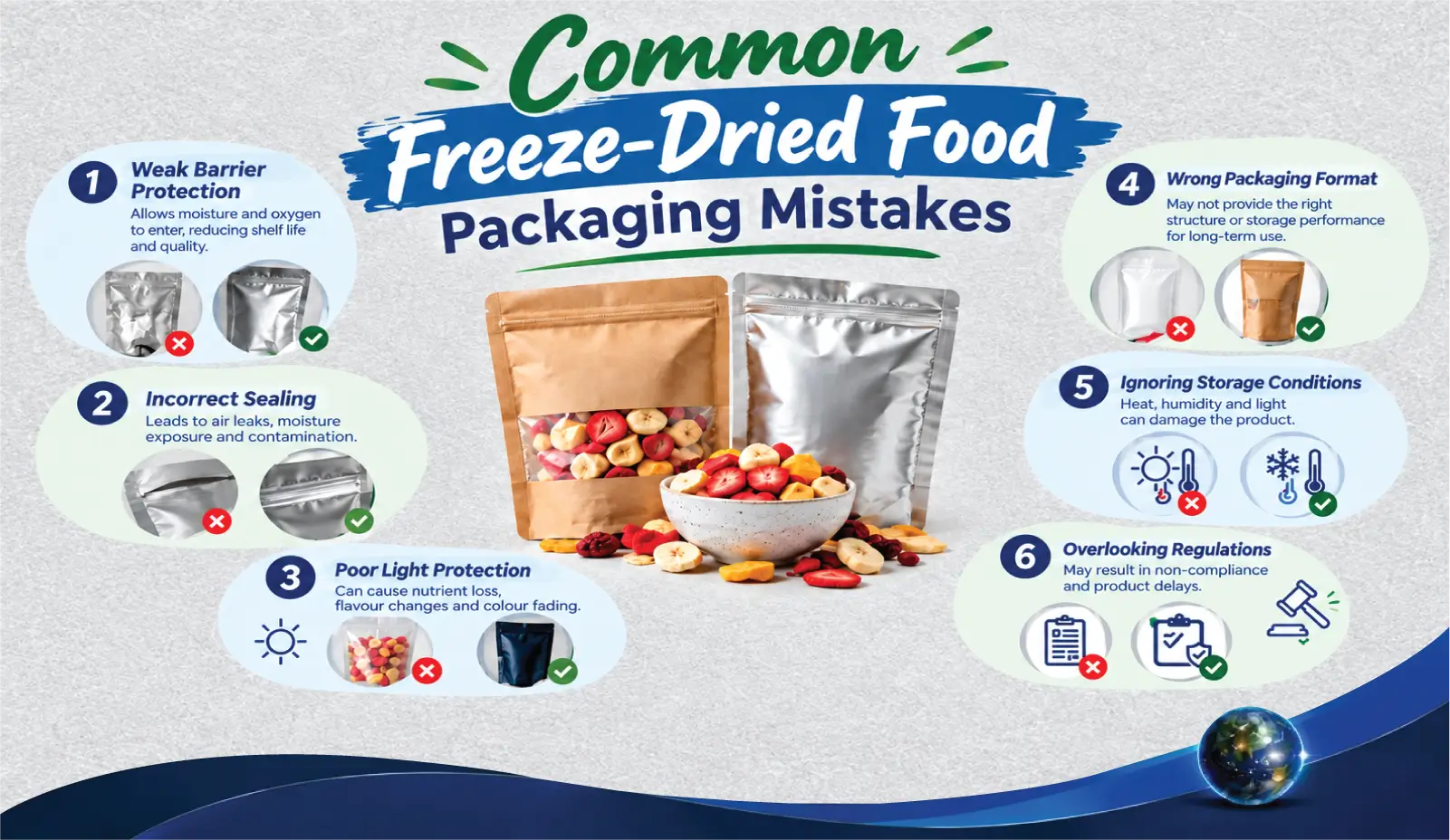
1. The Wrong Material Is Selected
A poor start is often made when food-grade packaging is not confirmed at the material stage, and this is counted among the common freeze-dried food packaging mistakes.
- Moisture and oxygen barrier: crispness is preserved for a longer period when a reliable barrier is incorporated into the structure of the pouch, such as Mylar Food Pouches.
- Light protection: colour, flavour, and nutrients are protected when an opaque or foil-based layer is selected.
- Food safety: compliance is treated as required, since food-grade standards are attached to every material in direct contact with the food.
- Kraft-based structures: kraft paper alone is not sufficient for freeze-dried food, so Flexible Kraft Pouches are chosen only when a barrier layer is included in the structure. A detailed comparison of both materials is found in Kraft vs Mylar Packaging for Freeze-Dried Food, where the differences in barrier strength, shelf life, and cost are explained.
2. Portion Sizes Are Ignored
Portion control is often treated as an afterthought, yet it is counted among the common freeze-dried food packaging mistakes, since customer satisfaction is directly affected by this oversight.
- Portion control: consistent serving sizes are maintained across single-serve, family-size, and bulk formats.
- Consumer convenience: repeat purchases are encouraged when measured servings and clear rehydration instructions are placed ahead of guesswork.
- Bulk portions: Larger quantities are packed more efficiently when a suitable bulk format is selected. For higher-volume requirements, Side Gusseted Bags are considered because additional filling space is created through the gusseted sides while practical handling is maintained.
3. Freshness And Quality Are Affected By Poor Design
Loss of crunch and staleness are among the most complained-about outcomes, and these are repeatedly listed among the common freeze-dried food packaging mistakes.
- Oxygen barrier and oxygen absorber: freshness is locked in when the barrier is balanced correctly against the residual moisture and fat content of the food.
- Heat sealing: an even, airtight seal is achieved through heat sealing, by which pinholes, leaks, and moisture entry are prevented.
- Resealable closure: an airtight seal is maintained after opening when a zipper or lock top is fitted, by which clumping caused by humidity is avoided.
4. Printing Quality Is Overlooked
Weak visuals are counted among the common freeze-dried food packaging mistakes, especially where the reputation of the brand is meant to stand out on a crowded shelf.
- Screen and UV printing: sharp, long-lasting graphics are produced through screen and UV printing, which are preferred over older, lower-definition methods.
- Printing techniques: consistent colour reproduction is achieved through CMYK, digital printing, rotogravure printing, UV printing, and screen printing.
- High-quality printing: the reputation of the brand is strengthened when high-quality printing is paired with Custom Mylar Bags With Logo and a clear presentation of key claims such as gluten-free or high-protein.
“Customers will occasionally buy products not because they want them but because of how they are presented to them.” — James Clear
5. Finish And Design Details Are Rushed
A rushed finish is one of the common freeze-dried food packaging mistakes, and it is often noticed only after production is complete.
- Matte finish and gloss finish: a distinct shelf presence is created when the finish is matched to the intended positioning, from premium boutique lines to everyday value lines.
- Foil stamping and embossing: a premium feel is added through foil stamping and embossing, particularly for limited-edition or gift-style freeze-dried snacks.
The cost of correcting a finish is lowest at an early stage and highest once a full print run is stored in a warehouse.
6. Durability Is Underestimated
Structural weakness is repeatedly named among the common freeze-dried food packaging mistakes, since freeze-dried pieces are brittle and sharp-edged.
- PET film and BOPP film: added strength is provided when PET film, BOPP film, or BOPET Flexible Packaging is layered with foil or kraft paper, by which tearing and puncture risk is reduced.
- Material durability: protection of the product is maintained through corrugated outer cartons that are tested under handling, storage, and shipping conditions.
- Heat-stable pouches: stability under hot water is required for meals rehydrated inside the pouch, which is why Retort Pouches For Sale are considered over standard laminated film.
7. Sustainable Packaging Is Overlooked
Eco-conscious buyers are lost over this issue, and it is counted as one of the common freeze-dried food packaging mistakes in the current market.
- Recyclable and compostable materials: long-term appeal is built when these materials are selected over standard multi-layer plastic, with the barrier level confirmed first.
- Eco-friendly inks: environmental impact is reduced when eco-friendly inks are used across the entire print run.
8. The Wrong Format Is Chosen
Format mismatches are counted among the common freeze-dried food packaging mistakes, since different formats are needed for different selling environments.
- Bags & Pouches: stand-up pouches, Flexible Kraft Pouches, Mylar bags, and resealable bags are considered for freeze-dried fruits, meals, and snacks, where flexible packaging is preferred.
- Boxes: cardboard and corrugated boxes are considered where added structure and stacking strength are required.
- Labels: adhesive labels and shrink labels are considered where an existing container is only required to carry brand and regulatory information.
- Tags: swing tags and hang tags are considered where a small piece of information is attached to loose or bulk items without a full covering.
- Sleeves: shrink sleeves and paperboard sleeves are considered where a can, jar, or tray is wrapped around its outer surface for branding and tamper protection.
- Wrappers: flow wraps and twist wraps are considered for individually portioned treats and bars, where a lightweight covering is preferred over a full pouch.
- Packets: single-serve packets and sachets are considered for sample sizes and single-use portions, where minimal material is preferred.
For small freeze-dried food brands, personalized packaging is considered an important part of the presentation of the product and the reputation of the brand. Custom Freeze Dried Food Bags are a practical option when professional presentation and suitable barrier protection are required.
9. Quality And Cost Are Poorly Balanced
An imbalance between cost and quality is frequently cited among the common freeze-dried food packaging mistakes, especially by smaller brands. Poor budgeting is noticed as thin margins months later; cost decisions are only finalized once samples are tested under real storage and shipping conditions. For small and growing brands, practical options are considered according to limited budgets, order volumes, and the needs of the brand. If affordable options are being explored, useful guidance on formats and design approaches is found in Freeze-Dried Food Packaging Ideas For Small Businesses.
10. Labelling And Compliance Are Missed
The final and most costly of the common freeze-dried food packaging mistakes is a missed labelling or compliance requirement.
- Nutrition Facts table and ingredient list: shopper trust is maintained when both are displayed clearly, in a bilingual (English and French) format.
- Allergen declaration: confusion and complaints are reduced when priority allergens, gluten sources, and sulphites are declared clearly, whether on a standard pouch or Custom Mylar Bags With Logo.
- Net quantity and barcode: accurate identification and retail scanning are supported when the net quantity in metric units, the name and address of the dealer, and a correctly formatted barcode are printed on the packaging of the product.
11. Canadian Packaging Certifications And Regulations Are Overlooked
Compliance in Canada is not treated as optional, and fines, rejected shipments, or removal from shelves are faced when the common freeze-dried food packaging mistakes are made.
- Food and Drug Regulations (Division 23, Section B.23.001): the sale of food in a package by which harmful substances may be yielded to the food is prohibited, and this responsibility is held by the food seller.
- Letter of No Objection (LONO): a voluntary safety opinion on packaging materials is issued by Health Canada, though the responsibilities of the food seller are not removed by it.
- Safe Food for Canadians Regulations (SFCR): licensing, traceability, and labelling requirements are administered by the Canadian Food Inspection Agency (CFIA) for foods that are imported, exported, or traded between provinces.
- Consumer Packaging and Labelling Act (CPLA): net quantity, dealer information, and bilingual labelling requirements are specified under this act and enforced by the CFIA for food.
- Extended Producer Responsibility (EPR): recycling fees and packaging-recovery obligations are applied province by province, and the choice of recyclable film structures is affected by them.
Looking for packaging that avoids the common freeze-dried food packaging mistakes? Explore Custom Packaging Solutions Companies for personalized packaging options, material guidance, and practical formats for your business. Let’s bring your packaging requirements to life. Get in touch with us today.
“Good things come in small packages.” — Aesop
Conclusion
The common freeze-dried food packaging mistakes discussed in this guide include poor material selection, unsuitable portion sizes, weak freshness protection, rushed printing and finishing, underestimated durability, overlooked sustainability, incorrect packaging formats, poor cost and quality balance, and missed labelling or Canadian compliance requirements. These factors are considered together to support better product protection, clearer packaging information, regulatory compliance, and a consistent presentation of the product from production to storage and retail.
Frequently Asked Questions (FAQs)
Are stand-up pouches suitable for freeze-dried food packaging?
Yes, stand-up pouches are widely considered for freeze-dried fruits, snacks, and meals because a strong moisture barrier and practical storage format are provided. For example, Custom Stand Up Pouches With Window provide product visibility while suitable barrier protection is maintained.
By how much is shelf life improved with a moisture and oxygen barrier?
Shelf life is extended noticeably when a strong barrier is combined with correct heat sealing and a suitable oxygen absorber. Faster staleness and loss of crunch are experienced when this barrier is overlooked, which is one of the common freeze-dried food packaging mistakes.
Why is a window cutout popular for freeze-dried snacks and meals?
A window cutout is preferred, including on a White Kraft Stand Up Pouch With Window, because the visibility of the product is offered without a fully transparent front panel. Colour and texture are judged by buyers before purchase, while light exposure is limited through a partial window.
Is freeze-dried food packaging personalized for a specific brand?
Yes, personalization is offered through custom printed packaging, personalized artwork, and formats such as custom mylar bags with a logo. The logo, colours, and finishes are adjusted to match the requirements of the brand.
Is good print durability offered through kraft paper packaging?
Kraft paper is generally strong, though print durability is improved further when it is paired with a laminated film or BOPET flexible packaging layer. Ignoring suitable print protection is among the common freeze-dried food packaging mistakes, particularly in humid storage.
Where are child-resistant formats positioned within freeze-dried food packaging?
Child-resistant formats are considered for supplement-infused freeze-dried snacks and functional food products where child-resistant packaging requirements apply. For these applications, a Childproof Mylar Bag is considered according to the product, intended use, and applicable regulations.
How are Side Gusseted Bags used for bulk freeze-dried food packaging?
Side Gusseted Bags are considered practical for bulk packaging because extra volume is accommodated by the gusset while resealing convenience is maintained. Skipping this format for bulk orders is one of the common freeze-dried food packaging mistakes made when scaling up.
Which pouch format is associated with strong barrier protection for freeze-dried meals?
High-barrier foil pouches are considered for freeze-dried meals and long-term storage because protection against oxygen, moisture, and light is provided through a suitable multilayer structure. For applications requiring stronger barrier protection, Best Foil Pouches are considered according to the food product and storage requirements.