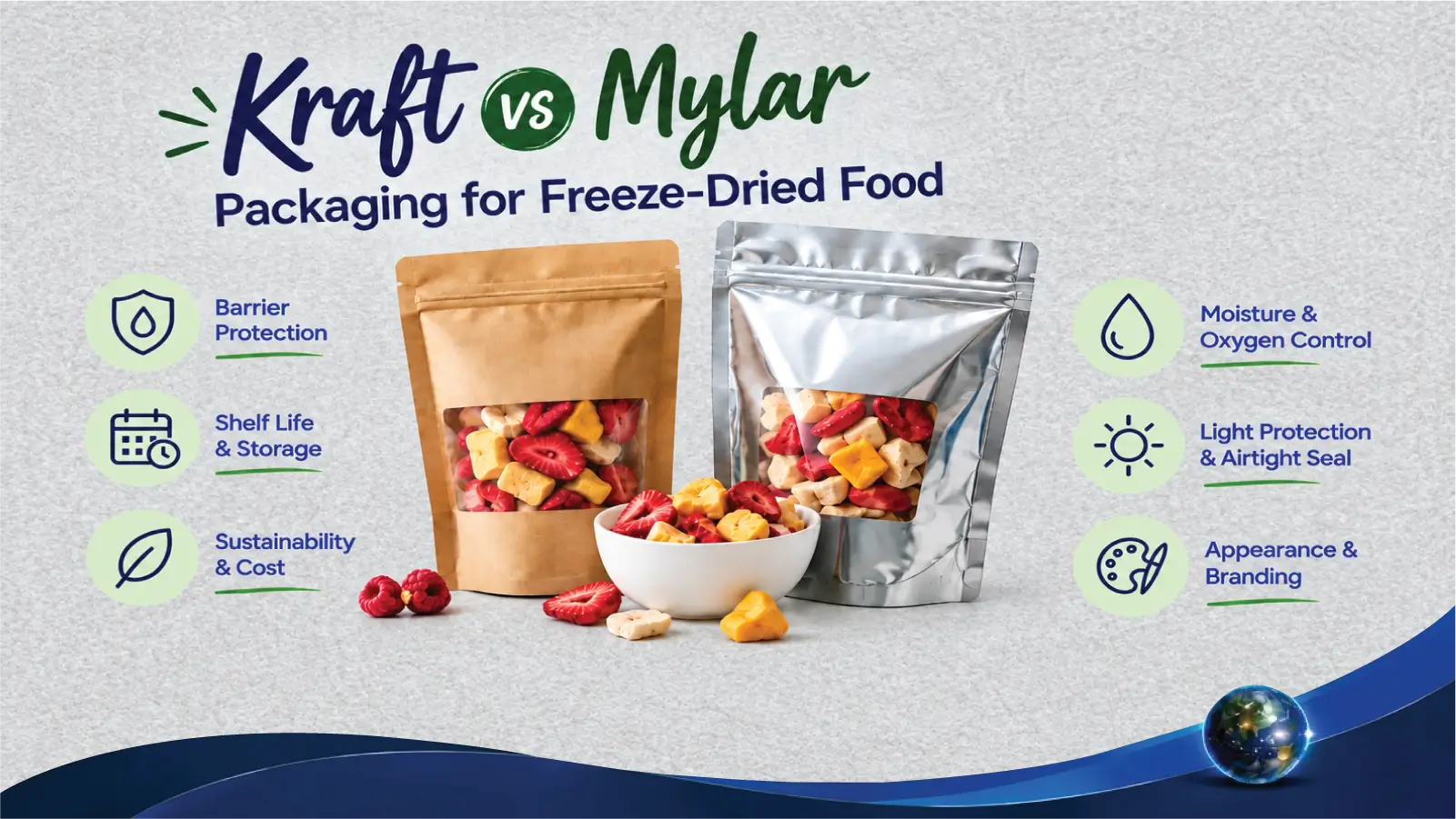
Kraft Vs Mylar Packaging For Freeze-Dried Food is an important consideration for long-term storage, moisture control, oxygen protection, shelf life, and reduced food waste. For households and food businesses, the main challenge arises after freeze-drying, when the packaging format and barrier performance are considered. The quality of the product may be reduced within a short period when the moisture or oxygen barrier is weak. In this guide, materials, sealing methods, barrier performance, storage conditions, sustainability, cost, and Canadian food packaging requirements are covered in detail.
Material Basics Of Kraft And Mylar Packaging
When kraft vs mylar packaging for freeze-dried food is compared, the main difference is found in the material structure and barrier performance. Kraft paper is produced from wood pulp and is generally recognized by its natural brown colour and texture. Limited resistance to moisture and oxygen is offered by basic kraft paper, so an additional barrier layer is often included when stronger protection is needed. Where a paper-based exterior is preferred together with a structured, upright base, Stand Up Pouches Custom Printed are commonly considered, since a natural presentation of the product is maintained alongside a barrier lining.
Mylar is commonly used as a general term for polyester-based packaging films, and long-term storage structures are often formed with a polyester outer layer, an aluminium foil barrier layer, and a food-contact-safe polyethylene inner layer, through which greater protection from moisture, oxygen, and light is achieved.
Oxygen And Moisture Barrier Performance
Moisture control is one of the most important considerations in kraft vs mylar packaging for freeze-dried food, since the texture, flavour, and quality of the product may be affected when humidity is present. More limited moisture protection is offered through basic kraft paper, while stronger resistance is achieved when suitable coatings or barrier films are incorporated. Oxygen transmission rate is commonly evaluated through ASTM D3985 testing, and water vapour transmission rate is commonly evaluated through ASTM F1249 testing. For products that are heat-processed or require additional structural strength, Retortable Pouch Packaging is generally considered, as elevated temperature resistance is combined with a strong oxygen and moisture barrier.
Light Protection And Airtight Sealing
Light exposure is also an important factor within kraft vs mylar packaging for freeze-dried food, particularly when ingredients are sensitive to light. Stronger light protection is achieved through opaque structures and aluminium foil barrier layers, while airtight sealing remains equally important, since storage performance may be lost when the seal is weak. Where households with children are a consideration, Mylar Bags Child Resistant formats are often selected, since an additional layer of opening control is built into the closure.
Shelf Life And Storage Conditions
The expected shelf life within kraft vs mylar packaging for freeze-dried food is generally influenced by residual moisture, oxygen exposure, seal quality, temperature, humidity, and light. Cool, dry, and dark storage areas are preferred, and periods of 10 to 25 years are cited in some storage guides under ideal high-barrier conditions, though actual results are influenced by the product and environment. For repeated opening and resealing across regular use, Custom Lock Top Flexible Pouches are also considered, since a secure reclose is combined with everyday convenience.
Appearance And Branding Differences
The visual difference between the materials is also considered when kraft vs mylar packaging for freeze-dried food is selected for retail presentation. Kraft packaging is recognized through its natural, matte, and earthy appearance, while Mylar-based structures are commonly seen with smooth, metallic, glossy, or opaque finishes. Screen and UV printing are suitable for logos, information, and graphics, through which the recognition of the brand is improved. For branding that stays consistent across a full product line, Custom Food Pouches With Logo are frequently chosen, since the presentation of the product is maintained across different package sizes.
Cost Of Kraft And Mylar Packaging
Basic kraft paper structures are generally less expensive than multilayer high-barrier structures, although the final cost is influenced by material thickness, coatings, printing, closures, and order quantity. A higher material cost is generally associated with Mylar structures, since several layers are incorporated for stronger barrier performance. This cost difference is an important consideration when comparing kraft vs mylar packaging for freeze-dried food.
Sustainable Kraft And Mylar Packaging For Freeze-Dried Food
Uncoated kraft paper is generally easier to process through established paper recycling systems, while multilayer Mylar structures are more difficult to process through conventional recycling systems, since different material layers are bonded together. Recycled-content paper and reduced material thickness may be considered where sustainability is a priority when evaluating kraft vs mylar packaging for freeze-dried food.
Common Use Cases: Kraft Vs Mylar
Different applications within kraft vs mylar packaging for freeze-dried food are determined according to storage duration, barrier requirements, product sensitivity, and presentation needs.
FOR KRAFT
- Kraft pouches: more suitable when a natural paper appearance is preferred, and the required barrier protection is achieved through the selected structure.
- Lined kraft pouches: suitable when a paper-based exterior is preferred together with improved moisture resistance.
FOR MYLAR:
- Mylar bags: commonly considered for longer storage periods where stronger moisture, oxygen, and light protection is needed; a Custom Mylar Bags With Window format is often chosen when visual inspection of the contents is preferred without the seal being broken.
- Foil-based multilayer pouches: suitable when high-barrier protection is needed against environmental exposure; Aluminium Foil Pouches are commonly selected for this purpose, since strong light, moisture, and oxygen resistance is combined in a single structure.
“Good things come in small packages. — Aesop”
For businesses looking to match a specific format to their product line, Custom Freeze Dried Snack Bags are offered through Packaging with a barrier structure, closure type, and print finish suited to long-term storage. Material and thickness options are reviewed together with the expected storage duration before a final structure is confirmed. Sizing, sealing method, and branding elements are adjusted according to the specific requirements of the product being packaged.
Structural Differences And Closures
The structure selected for kraft vs mylar packaging for freeze-dried food is determined according to the type of food, storage period, and sealing method. Flat pouches are suitable for compact storage, while gusseted structures provide additional filling space, for which reason Gusseted Resealable Bags are frequently chosen, since expanded capacity is combined with repeated-use convenience. Where a rigid, high-clarity film is preferred for retail display, Custom Printed BOPET Bags are also considered, since a strong barrier is combined with a bright, shelf-ready finish, and Mylar thickness is generally chosen between 3.5 mil for lighter needs and 7 mil for stronger puncture resistance.
A suitable structure and closure type for these formats is offered through Universal Packaging, matched to the storage duration and handling needs of the product. Sample options are reviewed before a final structure is confirmed for production. Contact Now to get the right closure and material combination for your freeze-dried packaging.
Canadian Food Packaging Regulations
Canadian requirements should also be considered as part of kraft vs mylar packaging for freeze-dried food. Food packaging materials and food labelling are subject to federal requirements under the Food and Drugs Act and the Food and Drug Regulations. The Safe Food for Canadians Regulations also apply to food businesses within their scope, with requirements related to food safety, packaging, traceability, and preventive controls depending on the type of food business and activity. For consumer prepackaged foods, required information is generally presented according to Canadian labelling requirements, including applicable English and French requirements. Packaging materials should also be suitable for food contact and appropriate for the intended storage conditions.
Kraft Vs Mylar Packaging For Freeze-Dried Food Comparison
A direct comparison of kraft vs mylar packaging for freeze-dried food is useful when moisture protection, oxygen protection, light protection, cost, sustainability, and storage duration are considered together.
| Feature | Kraft Packaging | Mylar Packaging |
| Moisture protection | Limited | High |
| Oxygen protection | Limited | High |
| Light protection | Moderate | High |
| Appearance | Natural, matte | Metallic, glossy, opaque |
| Long-term storage | With barrier layers | High-barrier structure |
| Recycling | Easier | More difficult |
| Cost | Lower | Higher |
| Puncture resistance | Depends on thickness | Depends on thickness |
Conclusion
The final decision in kraft vs mylar packaging for freeze-dried food should be based on the storage period, moisture sensitivity, oxygen sensitivity, light exposure, sealing method, and transportation conditions. For long-term storage, stronger moisture and oxygen barriers are generally given greater consideration, while lined or coated kraft structures may be considered when a natural paper presentation is preferred. The final packaging structure is determined by the actual requirements of the product, with suitable food-contact materials, reliable sealing, and appropriate storage conditions remaining important for the quality of the product to be maintained. These factors are also important when Common Freeze-Dried Food Packaging Mistakes are considered, as they may affect storage performance.
Frequently Asked Questions (FAQs)
What is the main difference between Kraft and Mylar packaging?
The main difference in kraft vs mylar packaging for freeze-dried food is found in the barrier structure. Kraft paper is primarily paper-based and generally requires an additional barrier layer for stronger moisture and oxygen protection, while multilayer Mylar structures are commonly designed with higher barrier performance.
Is Mylar suitable for long-term freeze-dried food storage?
Within kraft vs mylar packaging for freeze-dried food, Mylar is commonly considered for long-term storage because stronger protection from moisture, oxygen, and light is achieved through suitable multilayer construction. Actual storage performance still depends on sealing quality and storage conditions.
Is kraft packaging suitable for freeze-dried food?
Kraft packaging is suitable when the selected structure provides the barrier performance required for the product. Where a paper-based look is preferred together with visual inspection, a Kraft Stand Up Pouch With Window is often chosen, since a natural exterior is combined with a clear view of the contents.
Does aluminium foil improve protection in Mylar packaging?
Greater protection from light, moisture, and oxygen is achieved through suitable aluminium foil barrier structures. The actual performance depends on the complete multilayer construction, material thickness, and quality of the seal, making this an important consideration when selecting kraft vs mylar packaging for freeze-dried food.
What thickness of Mylar is suitable for freeze-dried food?
Common thickness options include around 3.5 mil, 5 mil, and 7 mil, with the suitable thickness determined according to puncture resistance, handling conditions, and storage duration. For a rigid, high-clarity finish on retail shelves, Custom Printed BOPET Bags are also considered, since strength is combined with a bright, shelf-ready appearance when comparing kraft vs mylar packaging for freeze-dried food.
What storage conditions are recommended for freeze-dried food?
Cool, dry, and dark storage conditions are generally preferred. Low humidity, limited oxygen exposure, and strong airtight seals are important considerations in kraft vs mylar packaging for freeze-dried food when long-term quality of the product is being maintained.
Is kraft packaging more recyclable than Mylar?
Uncoated kraft paper is generally easier to process through paper recycling systems. Multilayer Mylar structures containing polyester, foil, and polyethylene are more difficult to process through conventional recycling systems because several material layers are bonded together.
Which packaging is suitable for long-term storage?
The selection between kraft vs mylar packaging for freeze-dried food depends on the required barrier performance, food characteristics, sealing method, and storage environment. High-barrier multilayer structures are generally considered when extended protection from moisture, oxygen, and light is needed.