Searching for the right packaging for freeze-dried food? Freeze-Dried Food Packaging For Long-Term Storage is an important consideration for shelf life, protection of the product, moisture control, and reduced food waste. For many households and food businesses, the main challenge comes after freeze-drying, when the packaging format and barrier performance are considered. In this guide, materials, sealing methods, barrier performance, common mistakes, and Canadian compliance requirements are covered to support an informed packaging decision.
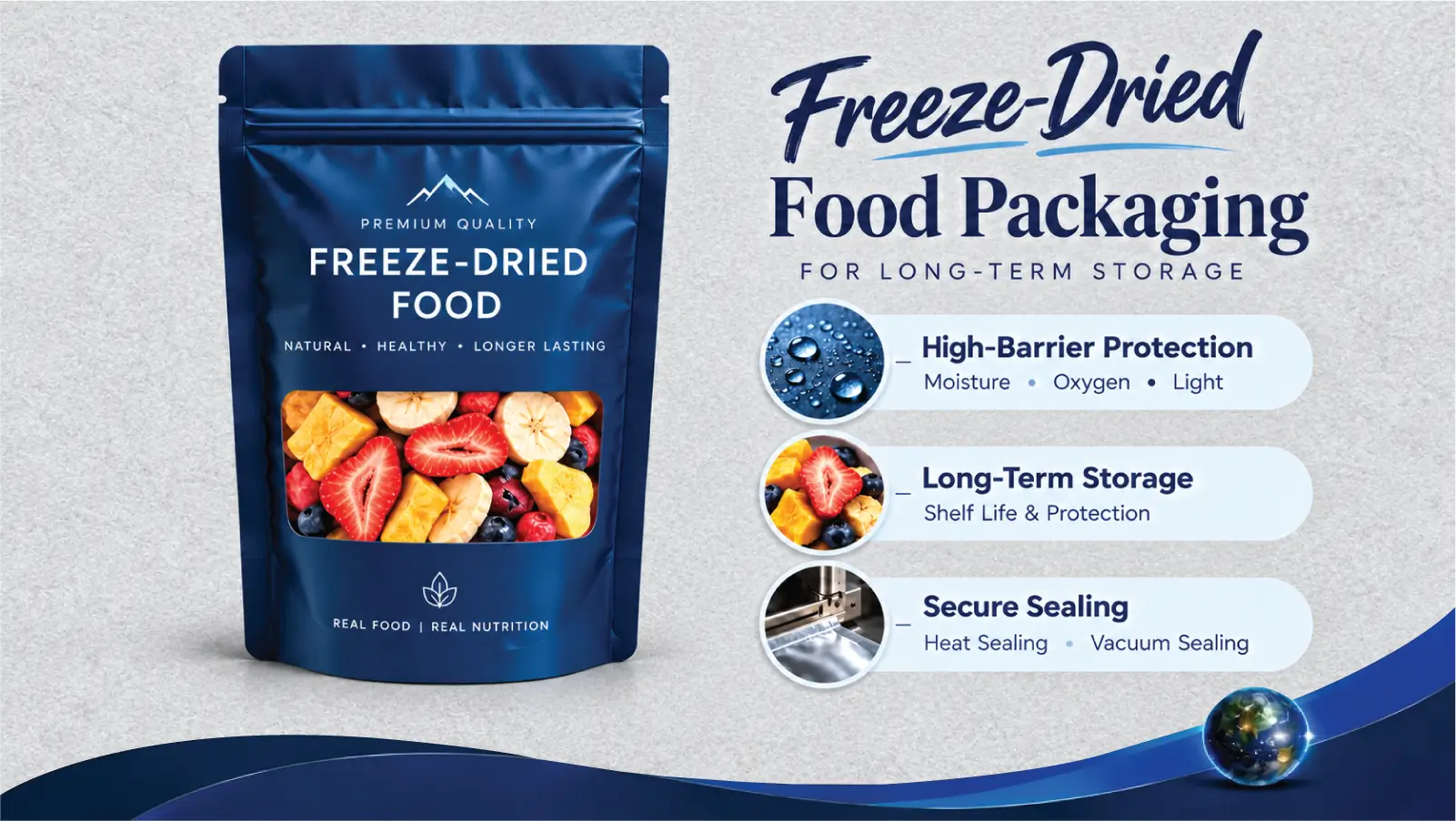
Choosing The Right Packaging For Long-Term Storage
Before a single bag is filled, the packaging format itself is decided first, since this choice governs barrier strength, shelf presentation, and handling convenience together. Consequently, five main categories are considered by most packers, and each one plays a distinct role within freeze-dried food packaging for long-term storage.
Bags and Pouches for Long-Term Storage
Bags and pouches are treated as the primary barrier around the food, and several specific types are used depending on material and end use:
- Mylar bags: designed from a laminate structure, these are relied upon wherever oxygen barrier, moisture barrier, and light barrier performance are all required in a single wall.
- Stand-up pouch formats: a flat base is formed here, so an upright stance on a shelf is achieved without a secondary container, and a Stand Up Pouch Custom designed is often chosen for retail-ready lines.
- Gusseted bag styles: folded side panels are added, so extra volume is offered without a change to the footprint, and side gusset bags in particular are packed tightly into cases for efficient bulk storage.
- Retort-style pouches: heat processing is supported through this format, and Retortable Pouches Food Packaging is specified wherever a heat-treated product line is part of the plan.
- Foil-based pouches: a dedicated foil liner is designed into these, and foil pouches are chosen where board stock alone would not meet sufficient barrier requirements, and custom printed packaging is often applied directly onto this same liner for branding.
- BoPET film pouches: biaxially oriented film is used as the base layer here, and bopet bags wholesale orders are placed where consistent supply across large batches is needed.
- Child-resistant formats: a stiffer zipper is designed into these, and Childproof Bags are specified wherever a household with small children is the intended market.
- Flexible custom formats: a flexible pouch construction is selected where a lighter, brand-adaptable alternative to rigid packaging is preferred.
- Kraft-based pouches: a natural, tactile finish is combined with an inner barrier layer, and a Kraft Stand Up Pouch With Window is frequently requested so that the product inside is shown without the pack being opened.
This single category alone accounts for most of the decisions made within freeze-dried food packaging for long-term storage, which is exactly why the next format, boxes, is considered as a complementary rather than a competing option.
“Good things come in small packages.” — Aesop
Boxes for Bulk Storage
Boxes are used as outer protection rather than as the primary barrier, and consistent structure matters here just as much as it does inside a bag:
- Corrugated cases: crush resistance is offered through this structure, so inner pouches are shielded during transit and stacking.
- Bulk cartons: multiple sealed bags or jars are held together here for palletized, long-term storage. Side Gusset Bags are commonly packed into these cartons, so that space is used efficiently during palletized storage.
- Rigid retail boxes: a printed outer box is placed around a single pouch or jar wherever shelf presentation is prioritized within any format designed for freeze-dried food packaging for long-term storage.
Boxes are rarely used alone, since an inner pouch or liner is still required for genuine barrier performance, and this connection carries directly into the discussion of wrappers below.
Wrappers for Portion Protection
Wrappers are typically single-layer and suited to individual portions rather than bulk quantities:
- Single-serve wrappers: individual bars or small portions are wrapped here before an outer pouch or box is added, and portion packaging of this kind is common across snack-sized formats. Once wrapped, portions are often placed inside a Flexible Pouch, so that lightweight handling and easy storage are maintained.
- Film wrappers: a first layer of protection is offered through thin plastic or foil film, though this layer is rarely relied upon as the sole barrier.
Once individual portions are addressed, attention naturally turns toward how a pack is presented on a shelf within freeze-dried food packaging for long-term storage, which is where sleeves come into the discussion.
Best Materials For Long-Term Storage Packaging
For freeze-dried food packaging for long-term storage, high-barrier multilayer materials are preferred for moisture, oxygen, light, and puncture resistance. Common material options include PET/BoPET, aluminium foil, PE, EVOH, nylon (PA), and metallized films, with suitable combinations selected according to storage duration and packaging requirements.
1. Polyester Film (PET) and BoPET
PET/BoPET is used as an outer structural layer in multilayer packaging, with printing placed on the film for branding and required information. For large production runs, BOPET Bags Wholesale orders are placed so that consistency of the film is maintained across batches.
2. Aluminium Foil Laminate
Aluminium foil is included in high-barrier structures for strong protection against oxygen, moisture, and light, making it suitable for extended storage periods. Such structures are commonly formed into Foil Pouches, where oxygen, moisture, and light are blocked across extended storage periods.
3. Polyethylene (PE)
PE is used as the inner sealing layer, with heat sealing applied at the package seams. Puncture resistance is also supported through suitable PE thickness.
4. Metallized Films
Metallized PET and other metallized films are used where light and moisture barriers are required with a lighter construction than aluminium foil.
5. High-Barrier Multilayer Laminates
Structures such as PET/Aluminium Foil/PE, PET/EVOH/PE, and PET/Metallized PET/PE are commonly selected for long-term freeze-dried food storage according to the required barrier performance and storage conditions.
6. Corrugated Board
Corrugated board is formed from fluted paper placed between flat liners, and is used for bulk cases, since crush resistance is offered during stacking and transit. No barrier is offered by corrugated board on its own, so an inner pouch or liner is still required.
7. Rigid Paperboard
Rigid paperboard is used for printed retail boxes, where the presentation of the product is prioritized. No barrier is offered by rigid paperboard on its own, so an inner pouch or liner is still required.
8. Folding Carton Board
Folding carton board is used for lightweight printed boxes, where shelf presentation and clear printing are prioritized. Folding cartons are supplied flat and assembled at the time of packing, so that storage space is saved.
Looking for reliable Freeze Dried Packaging Bags for long-term food storage? Custom sizes, high-barrier materials, printing options, and sealing formats are offered for different storage requirements.
Sealing Methods For Long-Term Storage
A perfect barrier film is only as good as the seal placed across it within freeze-dried food packaging for long-term storage, since even a small gap undoes every layer described above.
Step 1: Heat Sealing
For Freeze-Dried Food Packaging for Long-Term Storage, heat sealing is used as the primary permanent sealing method. A continuous seal is formed through controlled heat and pressure, with proper sealing applied after the package is filled and any oxygen absorber is inserted.
Step 2: Vacuum Sealing
When considering Freeze-Dried Food Packaging for Long-Term Storage, vacuum sealing is performed by removing air from the package before the opening is sealed. The suitability of this method depends on the film structure, puncture resistance, and quality of the final seal.
Shelf Life And Barrier Performance For Long-Term Storage
Shelf life is not a fixed number; it is the combined result of material grade, sealing quality, and storage conditions. Oxygen transmission rate (OTR) and water vapour transmission rate (WVTR) values show exactly how much air and moisture pass through a wall over time. Low readings on both fronts are what make decades-long storage claims realistic rather than optimistic. Barrier grade is matched to the intended storage period, whether that is months or decades. Freeze-dried food needs a stronger barrier than most dry goods, since it stays porous and moisture-sensitive even after processing. This one decision, barrier grade, is what separates true long-term containers from those meant only for pantry rotation.
Common Packaging Mistakes That Affect Long-Term Storage
Most failures within this category are traced back to a small, repeated set of errors rather than to bad luck, and each one is directly relevant to freeze-dried food packaging for long-term storage:
- Thin film selection: a lighter laminate is chosen to save cost, and barrier protection is compromised well before the intended storage period ends.
- Overfilled pouches: headspace is skipped before sealing, and both the weld quality and absorber airflow are affected as a result.
- Early absorber exposure: packets are left open too long before use, and their oxygen capacity is reduced before the pack is even closed.
- Warm packing: food is sealed before it fully cools, and internal condensation is created inside the pack as a direct consequence.
- Reliance on a single method: a vacuum seal is trusted alone, even though roughly one percent residual oxygen typically remains without an absorber added alongside it.
Once these mistakes are avoided consistently, freeze-dried food packaging for long-term storage is relied upon for its full intended term, and this reliability is exactly what Canadian and FDA regulations, discussed next, are designed to protect.
Canada And FDA Regulations For Long-Term Storage Packaging
Compliance is expected before any pack reaches a retail shelf, and several requirements apply specifically to freeze-dried food packaging for long-term storage:
- Food-contact safe materials: any layer touching the food directly is required to meet this standard, and FDA-compliant packaging benchmarks are referenced by many Canadian brands as an added measure.
- Labelling and disclosure: product labelling, nutritional details, and allergen warnings are required on nearly every pouch sold under Canadian packaging law. Custom Food Stand Up Pouches are therefore planned with sufficient panel space, so that mandatory information is displayed clearly.
- Recycling disclosure: recycling symbols are placed on the pack wherever recyclable packaging or a mono-material pouch is used, and recycling instructions are added so that disposal is handled correctly by the buyer.
- Recycled content transparency: recycled-content materials, where present, are disclosed clearly rather than implied through general marketing language.
Once these regulatory points are addressed, confidence in the pack is reinforced well before the product ever reaches a shelf, and this same confidence carries directly into the sustainability discussion below.
As material, barrier, sealing, and sustainability considerations are reviewed, attention naturally turns toward the visual and structural planning of the packaging. For a deeper look at this process, How To Design Custom Freeze-Dried Food Packaging covers the main design considerations, including size, layout, printing, finishes, and functional features.
Sustainable Packaging Options For Long-Term Storage
Environmental impact is increasingly weighed alongside barrier performance, particularly as lower-impact materials become a standard rather than an exception across the category. Compostable and mono-material films are incorporated wherever barrier strength permits, though a balance between sustainability and genuine long-term protection is still required rather than assumed. As sustainability expectations continue to rise, freeze-dried food packaging for long-term storage is expected to evolve alongside them, which naturally leads into a side-by-side comparison of the formats already discussed.
Comparison Table
The differences across the main formats used within freeze-dried food packaging for long-term storage are summarized below.
| Feature | Bags | Boxes | Wrappers |
| Barrier | High | Low–moderate | High |
| Shelf Life | Long-term | Depends on liner | Short–long |
| Best Paired With | Absorbers, heat sealing | Inner pouches | Foil laminates |
| Common Use | Long-term storage | Bulk shipping | Individual portions |
With this comparison reviewed, most of the practical questions around freeze-dried food packaging for long-term storage are already answered ahead of the conclusion below.
For businesses seeking dependable packaging solutions in Calgary, Custom Packaging Calgary is a practical option for custom sizes, materials, printing, and finishing requirements. Requirements of packaging vary by product, storage conditions, and presentation needs, so the right format is selected accordingly. Contact Now to discuss your packaging requirements and request a quote.
Conclusion
In this blog, freeze-dried food packaging for long-term storage has been explained from material selection through sealing, barrier performance, common mistakes, and Canadian compliance. Bags, boxes, wrappers, sleeves, and labels were each placed in context, and shelf life expectations were grounded in OTR and WVTR figures rather than guesswork. Whichever format is chosen, correct material grade, a proper seal, and consistent regulatory compliance remain what genuine long-term protection is designed upon.
Frequently Asked Questions (FAQs)
How long does food actually last inside freeze-dried food packaging for long-term storage?
Fifteen to twenty-five years is generally reported when a thick foil laminate, correct absorber sizing, and a clean weld are combined. Shorter periods are expected whenever any one of these three elements is weaker than recommended.
Are custom branding and compliance information handled on the same pack?
Yes, within freeze-dried food packaging for long-term storage, artwork, required disclosures, and recognition of brand features are all displayed on the same surface, provided that legal information remains legible alongside the design.
What printing method is recommended for detailed graphics?
Screen and UV printing are generally recommended for sharper, more durable graphics within freeze-dried food packaging for long-term storage, and full-colour printing is achieved through either method depending on the run size and finish required. Custom Mylar Bag Printing is commonly carried out through these methods, so that both branding and compliance details are reproduced sharply.
Is a matte finish or a clear window better for retail shelves?
A softer, low-glare surface is generally chosen for a premium look, while a see-through panel is chosen wherever the product itself is meant to be shown directly to the buyer.
Where is freeze-dried food packaging for long-term storage bought in bulk?
This type of packaging is bought directly through Universal Packaging, where custom sizes, materials, and finishes are offered under one roof for orders of any scale.
Are recyclable materials realistic for high-barrier applications?
Lower-impact material options are increasingly incorporated, although a genuine balance between sustainability and barrier performance is still required for anything intended for decades of storage.
Are oxygen absorbers necessary inside freeze-dried food packaging for long-term storage?
Yes, oxygen absorbers are generally added alongside a high-barrier pouch, since a small amount of residual oxygen is typically left inside the pack after sealing. The capacity of the absorber is matched to the volume of the pouch, so that oxidation of the food is limited.
Which storage conditions are preferred for sealed freeze-dried food pouches?
A cool, dry, and dark location is generally preferred, since the shelf life of the food is reduced by exposure to heat, humidity, and light. Sealed pouches are also kept away from direct sunlight and damp areas, so that the barrier layers are protected.
How is the seal of a pouch checked before long-term storage?
A visual inspection is carried out first, so that wrinkles, gaps, or trapped food particles are identified before storage. Gentle pressure is then applied to the filled pouch, so that any leakage of air is detected.
Are resealable zippers suitable for long-term storage pouches?
Resealable zippers are generally added for convenience once a pouch is opened, whereas the heat seal is relied upon for unopened packs. A zipper-equipped pouch is therefore chosen wherever repeated access to the food is expected.