Longer freshness, a stronger barrier against oxygen and moisture, and a premium shelf presence are gained when How To Design Custom Freeze-Dried Food Packaging is approached with the right format and materials from the start. Spoilage, weak seals, and a forgettable presentation of the product are avoided once format, barrier film, and branding are planned together rather than separately. In this article, format selection, material options, design layout, branding, printing methods, compliance, and practical production steps are walked through for how to design custom freeze-dried food packaging. Keep reading, because every decision behind a trusted pouch on the shelf is explained below.
Choosing The Right Format For Freeze-Dried Food Packaging
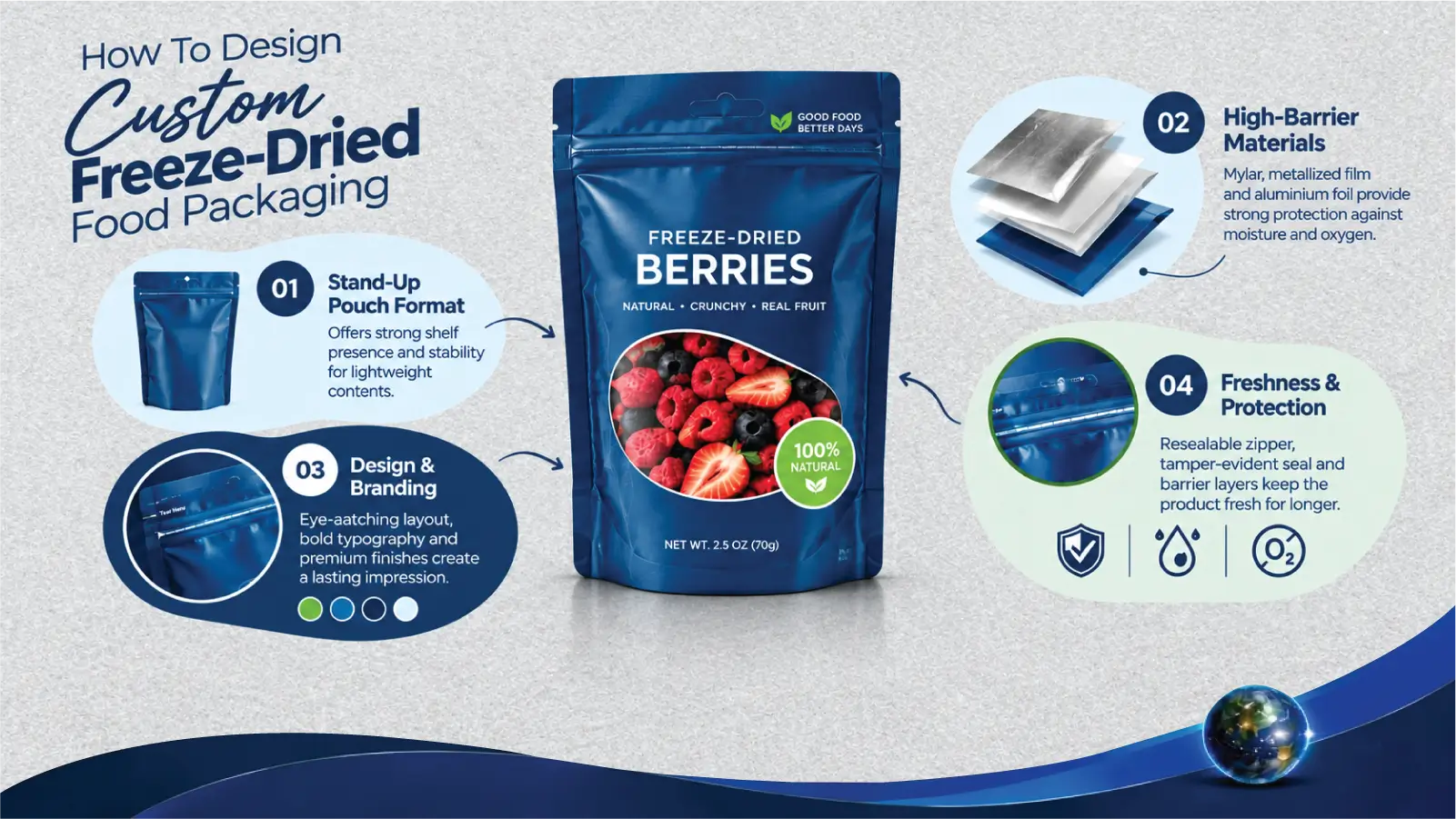
When designing custom freeze-dried food packaging, the format is treated as the foundation of the whole project, and almost every choice that follows is shaped by this decision. Custom Stand Up Pouches No Minimum are frequently chosen at this stage because shelf presence is strengthened through this format, and balance is maintained even when the pouch is filled with lightweight, porous contents.
A gusseted base is also considered in many cases, since stability on a retail shelf is offered through Wholesale Gusset Bags, and a premium look is achieved without extra cost. Once a format is narrowed down, attention is shifted toward the materials by which moisture and oxygen are kept out. Ready to see what those materials involve? Read on.
Material Options For Freeze-Dried Food Packaging
In How to Design Custom Freeze-Dried Food Packaging, material selection is treated as a science rather than a guess, and several layers are commonly combined to protect what is inside, since freeze-dried contents are made highly sensitive to moisture by their porous structure:
- Kraft Paper and Polyethylene (PE): A rustic outer layer is combined with a moisture-resistant inner lining, and this combination is frequently offered through Kraft Stand Up Barrier Pouches.
- Metallized Film: A strong barrier against light, oxygen, and moisture is achieved through a metallized layer, while weight is kept lower than foil.
- Aluminum Foil: A near-total barrier against light, oxygen, moisture, and external contaminants is achieved through an aluminum layer, and this structure is often offered through a Bag Custom Foil Pouch.
- Polypropylene (PP): A lightweight and heat-resistant plastic material is commonly used in pouches, containers, films, and lids.
- Polyethylene (PE): Flexibility, heat-sealing properties, and moisture resistance are associated with PE films and inner packaging layers.
- BOPET / Polyester (PET): High strength, clarity, and dimensional stability are offered through BOPET Packaging Bags, and this structure is made suitable for pouch outer layers and flexible packaging films as a result.
- Mylar Film: High barrier performance against moisture, oxygen, and light is achieved through Mylar Pouches Food Storage, and long-term storage needs are supported well by this material.
- Laminated Films: Multiple film layers combine to improve moisture, oxygen, light, sealing, and mechanical barrier properties, and maintain consistent quality across Flexible Pouches Canada.
With materials settled, attention turns to how to achieve a clear, effective product presentation. For readers focused purely on shelf stability, Freeze-Dried Food Packaging For Long-Term Storage breaks down barrier grades and absorber pairing in more depth. Continue below to find out.
Design Considerations In Freeze-Dried Food Packaging
Within how to design custom freeze-dried food packaging, layout choices are never left to chance. An oxygen absorber pocket or indicator window is often included so that freshness is confirmed at a glance. A role is also held by colour psychology at this stage, since natural, earthy tones are associated with wholesome ingredients, while bold typography is used so that flavour identification is made simple.
Portion control and storage convenience are also considered, as a resealable zipper is combined with consumer convenience in mind, since freeze-dried products are frequently reopened over several servings. Flexible Pouches Canada are often brought into this stage as well, since a lightweight, adaptable structure is preferred for freeze-dried snacks, meals, and pet treats alike. Similarly, a tamper-evident seal is added so that safety is never questioned. Once the layout is settled, attention is naturally drawn toward branding. Keep reading to see how that unfolds.
“Customers will occasionally buy products not because they want them but because of how they are presented to them.” — James Clear
But how is a barrier made truly reliable against long-term moisture exposure? Why Multi-Layer Barrier Packaging Is Effective for Freeze-Dried Goods is worth exploring. Freshness and shelf stability remain closely connected with this choice.
Add Branding And Graphics In Freeze-Dried Food Packaging
When how to design custom freeze-dried food packaging is discussed from a branding angle, the reputation of the brand is treated as the top priority. Custom branding with a personalized logo is often offered at this stage, so consistency is carried across a whole product line, including Custom Mylar Bag Design projects. Custom packaging design and custom printed packaging are also considered at this stage, since greater recognition of the brand is developed over time and the perception of the brand is shaped with every repeat purchase.
High resolution graphics are used so that photographic detail is achieved on freeze-dried fruit, meal, and snack packaging alike, while a clear and consistent presentation of the product is maintained. A matte finish, glossy finish, or soft touch finish is selected according to the desired visual tone, with the needs of the brand reflected through texture as much as colour. The next stage of how to design custom freeze-dried food packaging focuses on printing methods for these packaging designs.
Printing Methods Used In Freeze-Dried Food Packaging
In this stage of How to Design Custom Freeze-Dried Food Packaging, six methods are considered for durability, clarity, and finish. Screen Printing, UV Printing, Digital Printing, Rotogravure Printing, Offset Printing, and PMS / Pantone Spot Colour Printing are each offered for different reasons:
- Screen Printing: Bold, solid colours are achieved on Kraft Stand Up Barrier Pouches and matte film surfaces, and a handcrafted feel is offered to the packaging of the product.
- UV Printing: Sharp detail is delivered on Laminated and Metallized Films, and a Glossy Finish is preserved even after repeated handling on BOPET Packaging Bags.
- Digital Printing: High-quality, detailed printing is made suitable for short runs and personalized designs, so smaller batches are accommodated without long setup times.
- Rotogravure Printing: Consistent, high-volume printing is made suitable for large packaging orders, and uniform colour is maintained across long production runs.
- Offset Printing: Sharp and detailed printing is commonly applied to paperboard and carton packaging, so fine text and graphics are reproduced cleanly.
- PMS / Pantone Spot Colour Printing: Specific brand colours are reproduced with greater colour consistency, so the recognition of the brand is protected across every batch.
Neither method is chosen at random; each is matched to the barrier film, order volume, and finish already selected. With printing addressed, the conversation is turned toward compliance. Stay with us for that part.
Regulations and Certification Check For Freeze-Dried Food Packaging
Under how to design custom freeze-dried food packaging, compliance is never treated as optional, and the specifications, regulations, and laws are applied fully according to the packaging product itself. Food Labelling is reviewed closely, since ingredients, net weight, and nutritional information are listed clearly, and Storage Instructions are made easy to locate. Recycling Symbols and Recycling Instructions are also included where the material allows, so clear guidance is offered to the end user and responsible disposal behaviour is encouraged.
Furthermore, Child Resistant Mylar Pouches are often required for households with children or pets, and safety standards are met while reassurance is offered to cautious buyers. Once compliance is confirmed, the practical side of production is addressed. The next stage of how to design custom freeze-dried food packaging focuses on the production steps involved in bringing the final design together.
Practical Steps To Finalize Freeze-Dried Food Packaging
At this stage of how to design custom freeze-dried food packaging, a structured sequence is generally followed:
- Sample Approval: A prototype is reviewed before bulk production, and required adjustments are completed.
- Barrier and Seal Testing: Flexible Retort Pouch Packaging Distributors are consulted where heat resistance is required, while packaging solutions for wet, semi-moist, or freeze-dried formulas are evaluated for durability under demanding conditions.
- Final Approval: Colour accuracy, sealing strength, and labelling accuracy are confirmed before shipment.
“Good things come in small packages.” — Aesop
For broader dried and dehydrated food needs, related packaging formats are also considered for personalized formats, materials, and closures.
Understanding MOQ And Budget Planning
In how to design custom freeze-dried food packaging, minimum order quantity and budget are handled together rather than separately. Custom Mylar Bag Design orders are offered at varying quantities, and smaller MOQs are sometimes offered for new brands still testing the market. Pricing also varies by format and finish, since a different cost structure is often carried by high-barrier options compared with standard dry food bags.
A slightly higher upfront cost is often carried by high-barrier and sustainable materials, though extended shelf life and long-term loyalty of the brand are gained in return. Bag Custom Foil Pouch pricing is offered at higher volumes, and long-term savings are achieved through careful bulk planning, a practical consideration throughout how to design custom freeze-dried food packaging. These Freeze Dried Food Bags are quoted at flexible quantities once format and barrier grade are confirmed, so budget planning is completed without guesswork. Ready to lock in your pricing? Reach out today.
Target Audience And Market Research
Within how to design custom freeze-dried food packaging, audience research is treated as the compass for every other decision. Outdoor and emergency-preparedness buyers tend to prioritize durability and long shelf life, and consumer convenience is placed above decorative detail. Wholesale Gusset Bags are often favoured by this group, since a wider base is associated with reliability during storage and transport.
Health-conscious and premium shoppers notice recyclable materials and clean label cues quickly, while gift and snack buyers respond to a window pouch or a soft touch finish instead. Market research is never treated as a one-time exercise, since preferences are subject to shifts with trends and seasons. The next stage in how to design custom freeze-dried food packaging focuses on turning these audience insights into practical design choices.
For budget-friendly personalized packaging, cost-effective options are considered according to the required format, material, quantity, and finish, suitable Custom Packaging Companies. Contact us today to discuss your requirements of packaging and production needs.
Unboxing Experience By Audience
To conclude How to Design Custom Freeze-Dried Food Packaging, the opening moment is considered just as important as the shelf moment. Distinct experiences are offered across different buyer types:
- First Time Buyers: Clear Storage and Rehydration Instructions are offered right on opening, and confidence is built through simple, guided steps.
- Loyal Repeat Customers: A familiar Resealable Zipper and consistent presentation of the product are offered through these pouches, and comfort is reinforced through routine.
- Gift and Outdoor Buyers: A Glossy Finish or Window Pouch is unwrapped with visible excitement, while Kraft Stand Up Barrier Pouches are also considered when a natural appearance and practical storage format are preferred.
Conclusion
From packaging formats and material choices to printing, compliance, and the unboxing experience, several connected decisions are involved in how to design custom freeze-dried food packaging. Each factor, from a high oxygen barrier to a tamper-evident seal, is considered according to the specific requirements of the product. When these choices are carefully planned together, the final packaging is better prepared for the protection of the product, clear information, and a positive customer experience.
Frequently Asked Questions (FAQs)
What is the most common format used for freeze-dried food?
Custom Stand Up Pouches and Wholesale Gusset Bags are typically offered for freeze-dried food, since shelf stability and long-term freshness are both maintained through these structures. These formats are also commonly considered when planning how to design custom freeze-dried food packaging for retail-ready products.
Why is a high oxygen barrier so important for freeze-dried products?
A high oxygen barrier is required because freeze-dried contents are made highly porous during processing, and rapid moisture absorption or spoilage is otherwise risked without adequate protection. This is treated as a central decision within how to design custom freeze-dried food packaging for kraft-based and Mylar-based formats alike.
How is freshness maintained inside a sealed freeze-dried pouch?
Freshness is maintained through a combination of a moisture barrier, an oxygen barrier, and proper heat sealing along every edge, with Mylar Pouches Food Storage frequently selected for this purpose. Shelf life is treated as a central concern throughout how to design custom freeze-dried food packaging for long-term storage.
Is a resealable zipper necessary for freeze-dried food packaging?
Yes, a resealable zipper is strongly recommended, since portion control and storage convenience are both improved through repeated use after opening. This detail is considered an essential step in how to design custom freeze-dried food packaging for repeat-use pouches.
What printing methods are recommended for custom freeze-dried designs?
Screen printing and UV printing are recommended, since both are known for durability, sharp detail, and long-lasting colour retention on high-barrier films. The choice of printing method is also an important part of how to design custom freeze-dried food packaging according to the desired visual presentation.
What role is played by material choice in freeze-dried packaging?
A critical role is played by material choice, since Custom Mylar Bag Design, metallized film, and BOPET Packaging Bags are commonly selected for their combined moisture, oxygen, and light barrier properties. This decision is treated as a foundational part of how to design custom freeze-dried food packaging for barrier performance.
How are storage and guide instructions printed on a bag?
Storage and guide instructions are communicated through clear, simple text placed on the back or side panel, so that guidance is offered to the end user immediately upon opening. This labelling detail is treated as an important step in how to design custom freeze-dried food packaging for consumer guidance.
Where is custom freeze-dried food packaging ordered?
Custom freeze-dried food packaging, including Custom Stand Up Pouches No Minimum, Flexible Retort Pouch Packaging Distributors, and Child Resistant Mylar Pouches, is offered through Universal Packaging, where personalized solutions are provided for a range of formats and budgets. These options are also relevant when considering how to design custom freeze-dried food packaging around specific product and branding requirements.