Why does one pet food bag need a completely different packaging approach from another? A small bag of dog treats may be opened several times a day, while a larger dry pet food pack may be handled, stored, and resealed for weeks. These differences make the comparison of Dog Treat Bags Vs Pet Food Bags more important than it first appears. Material choice, barrier protection, closure style, portion size, and presentation all become part of the decision. But which packaging features actually matter most for each product? The differences are explored below, starting with the details that are easiest to overlook.
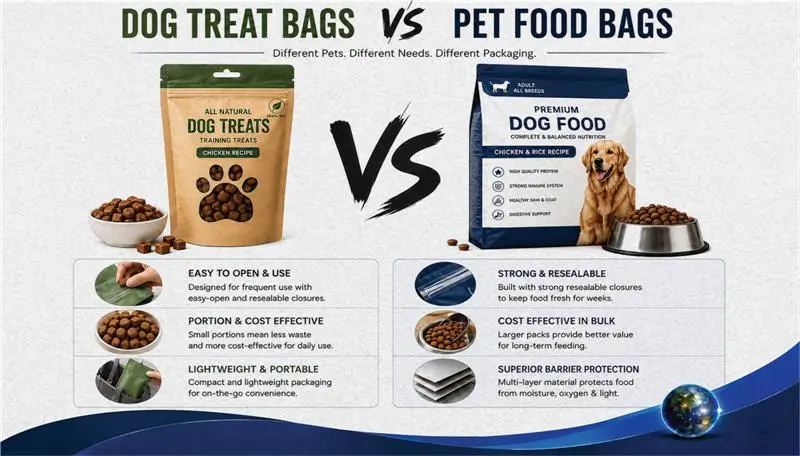
Treat Bags Vs Food Bags: Purpose
When dog treat bags vs pet food bags are compared, purpose is the very first difference noticed. Treat bags are designed for small, frequent servings, while bulk food bags are meant for larger, less frequent purchases. Portability is prioritized in treat packaging, whereas storage efficiency is prioritized in bulk packaging. As a result, dog treat brands are guided toward compact pouches, while pet food manufacturers are guided toward gusseted formats with larger capacity. This distinction sets the tone for every comparison that follows. Interested in how materials are chosen for pet treat packaging and dog food packaging? That is covered next.
Materials Used In Treat And Food Bags
Material selection is where dog treat bags vs pet food bags begin to diverge, since durability needs are not identical. Lighter films are often preferred for treat bags, while bulk bags call for stronger, multilayer structures. The following materials are commonly applied across both formats:
- Polyethylene (PE): flexibility is offered along with a reliable moisture barrier for daily-use treat pouches.
- BOPET Film: strength, clarity, and dimensional stability are offered in a BOPET Packaging Bag structure where enhanced barrier performance is required.
- Polypropylene (PP): a crisp, glossy surface is provided, and clarity for window packaging is achieved.
- PET Film: strength and puncture resistance are added to multilayer structures.
- Aluminium Foil Laminate: light and oxygen exposure are blocked effectively in long shelf-life bulk food bags.
- Metallized Film: a shiny barrier layer is added where cost efficiency is also required.
- Kraft Paper: a natural, eco-conscious material is offered for premium treat lines, with the material being formed into a Custom Kraft Stand Up Pouch format where required.
The right material selection is followed by careful supplier evaluation, especially when different barrier levels and custom formats are required. For suitable materials, custom sizes, and flexible packaging options.
Size & Capacity: Treats Vs Bulk Food
Size and capacity are where dog treat bags vs pet food bags are most visibly separated on a retail shelf. Treat portion sizes are generally kept small, often between 100 and 500 grams, since treats are consumed gradually. Dry pet food, in contrast, is packaged in far larger formats, sometimes exceeding 10 kilograms for household use. Structural reinforcement is required for large-format bags, while smaller treat pouches stay light for pet owner convenience. Stand-up pouches are frequently chosen for mid-sized portions, whereas flat-bottom bags are selected when shelf stability is prioritized for dry pet food packaging. Once size is settled, freshness becomes the next concern worth exploring.
Dog Treats Bag: Average size 100–500 grams per pack, kept small for gradual consumption.
Pet Food Bag: Average size 2–10+ kilograms per bag, packaged large for household/bulk use.
“Good things come in small packages.” — Aesop
Freshness & Barrier Protection Compared
Freshness is protected differently depending on format, and this is another place where dog treat bags vs pet food bags show clear contrast. A strong moisture barrier is essential for both formats, while oxygen and odour barriers are especially important for products requiring extended freshness. Custom Foil Pouch Packaging is also considered where protection against light, oxygen, and moisture is required. Multilayer structures are commonly formed with barrier layers and printable outer surfaces, helping freshness to be maintained throughout storage and use.
Customization Options For Treats And Bulk Packaging
Customization is approached more creatively in treat packaging, and this is another area where dog treat bags vs pet food bags take noticeably different directions. Custom sizes and custom shapes are commonly requested by dog treat brands seeking shelf appeal, while bulk food bags are customized primarily for practical branding. Custom printed bags, window packaging, and resealable zippers are among the most requested features across both formats. A kraft pouch design is frequently chosen when a natural, premium look is desired, while a Custom Printed Stand Up Pouches format is selected when bold colour is prioritized. With customization explored, printing is examined next.
“Customers will occasionally buy products not because they want them but because of how they are presented to them.” — James Clear
Printing And Branding Across Both Types Of Bag
Printing is treated as a core branding tool, not just a decorative step, when dog treat bags vs pet food bags are placed side by side in a retail aisle. Screen printing is often selected for simpler, high-contrast designs, while UV printing is chosen when vibrant colour and a premium finish are required. A matte finish is preferred by brands seeking a softer feel, whereas a gloss finish is chosen when shelf appeal is prioritized. Foil stamping and spot UV are added when a luxury presentation of the product is desired, particularly on premium treat lines. Reputation of the brand is strengthened through consistent colour and finish choices across the range. With printing clarified, closure designs are examined next.
Closure Types: Treat Bags Vs Food Bags
Selection of closures depends on how frequently a bag is opened, and this is a practical area where dog treat bags vs pet food bags follow different priorities. The closure types most frequently applied are outlined below:
Resealable Zipper
Freshness is maintained between servings, and this is the most requested closure for treat pouches.
Heat Seal
A secure, tamper-evident seal is created for bulk bags during initial packing.
Tear Notch
Quick, tool-free opening is enabled for everyday treat bags.
Childproof Zippers
An added layer of safety is offered for households with small children or curious pets.
Once a suitable closure is chosen, cost naturally becomes the next factor to weigh carefully.
Pricing Breakdown: Treats Vs Bulk Food Bags
Cost is influenced by material choice, size, and finishing, and once again, dog treat bags vs pet food bags are compared differently depending on production volume. Smaller treat pouches often carry a higher per-unit printing cost, since intricate designs and premium finishes are applied to compact spaces. Larger bulk bags, on the other hand, benefit from economies of scale, even though more material is used per unit. Rotogravure printing is typically selected for high-volume runs, since cost efficiency is achieved at scale, while digital printing is preferred for smaller, personalized batches. Budget planning is guided by order volume just as much as by design complexity. With cost considered, attention now turns to how customers perceive these choices.
How Customers Perceive Each Type Of Packaging
Perception of the brand is shaped strongly by first impressions, and shelf appeal plays a major role whenever dog treat bags vs pet food bags are viewed together in a pet retail environment. A treat bag with a matte finish is often perceived as premium and natural, while a bulk food bag with bold graphics is perceived as practical and value-driven. Trust is built when the packaging of the product stays consistent across a product line, since pet owners associate visual consistency with reliability.
The reputation of the brand is increase when recyclable packaging and clear labelling are used, as sustainability is noticed by conscious pet owners. For businesses searching for Custom Mylar Bags Near Me, suitable materials, sizes, and finishes are also considered according to the packaging requirements. Once perception is understood, choosing the right bag for a specific use case is addressed next.
“Our pleasures are not material pleasures, but symbols of pleasure – attractively packaged but inferior in content.” — Alan Watts
Finding The Best Bag For Your Use Case
Choosing between dog treat bags vs pet food bags ultimately depends on product type, order volume, and how a product is intended to be used by the end customer. For small-batch, high-frequency products, a smaller pouch with a resealable zipper is generally recommended, while bulk products are better suited to gusseted or flat Bottom Gusset Bags formats. Pet retail environments with limited shelf space often benefit from stand-up pouches, since vertical display space is used efficiently.
For treats with specialised storage and freshness considerations, the packaging approach becomes even more important. If freeze-dried treats are being considered next, Best Packaging For Freeze-Dried Pet Treats (wrong link added) is worth exploring for a closer look at suitable formats, materials, and requirements for protection.
Quick Comparison
| Aspect | Dog Treat Bags | Pet Food Bags |
| Size | Smaller | Larger |
| Style | More decorative | More functional |
| Opening frequency | Opened frequently | Opened less often |
| Barrier priority | Odour barrier weighted heavily | Barrier protection prioritized |
| Shape & finish | Custom shapes, premium finishes | Standard, structural shapes |
| Structural focus | Style-driven | Strength-driven |
| Packaging basis | Flexible packaging principles | Flexible packaging principles |
Latest Trends In Pet Packaging Industry
Trends across the pet packaging industry increasingly reflect how dog treat bags vs pet food bags are evolving toward more sustainable, efficient formats. Post-Consumer Recycled (PCR) Material is being adopted at a growing rate, as recyclable packaging is requested more often by conscious pet owners. Mono-Material Packaging is also gaining traction, since recyclability is simplified when a single material type is used throughout a pouch.
Recycling symbols are being added to pouches more consistently, supporting sustainable packaging goals. Flexible Pouch Printing technology continues to advance, allowing shorter, personalized runs to be produced efficiently. A BOPET packaging bag structure is increasingly selected for its clarity and strength. As these trends evolve, regulatory compliance remains just as important, and that is addressed next.
Pet Food Packaging Suppliers are worth considering before moving to the next packaging decision. Material quality, printing requirements, and order specifications should be reviewed before final approval.
Regulations, Certifications & Canada Packaging Standards
Compliance is treated as a non-negotiable part of pet packaging, and this is one area where dog treat bags vs pet food bags are held to the same Canadian standards regardless of format. Packaging regulations for pet food are guided primarily by the Consumer Packaging and Labelling Act and its Regulations (C.R.C., c. 417), enforced by the Competition Bureau. The Safe Food for Canadians Regulations (SOR/2018-108) are also referenced where food-contact materials are involved.
Guidance is further offered through the CFIA-supported Guide for the Labelling and Advertising of Pet Foods, which outlines requirements such as common name, net weight, ingredients, and guaranteed analysis. In Quebec, Bill 96 applies to bilingual labelling, requiring French text with equal prominence. Food-grade materials used in pouch construction are expected to align with food-contact safety standards referenced under 21 CFR 176 and 177, alongside certifications such as FSC chain-of-custody and the BRC Packaging Standard. With compliance addressed, one final step remains: a practical checklist.
A Buyer’s Checklist Before Choosing Pet Packaging
Before a final decision is made between dog treat bags vs pet food bags, a short checklist is offered below to guide the process:
- Type of Product: portion size and consumption frequency are confirmed first.
- Barrier Needs: moisture, oxygen, and odour barrier requirements are matched to shelf life goals.
- Material Choice: food-grade materials are selected in line with compliance requirements.
- Printing Method: screen printing or UV printing is chosen based on design complexity.
- Closure Type: a resealable zipper, heat seal, or tear notch is selected for ease of use.
- Compliance: Canadian labelling and certification requirements are reviewed before final approval.
For personalized pet packaging solutions, material guidance, and custom bag options, explore Canadian Custom Packaging and find a suitable packaging approach for your product. When you are ready to finalize your packaging, contact us today to discuss your required size, material, printing, closure, and order specifications.
Conculsion
Across this guide, everything from purpose and materials to closures, cost, and Canadian regulations has been covered, all through the lens of dog treat bags vs pet food bags. Every section was built to move from one decision to the next, rather than leaving gaps along the way. Material choice, barrier protection, printing, and compliance all work together, not in isolation. Whenever a final packaging decision is approached, these comparisons are worth revisiting. With this understanding in place, a more confident, informed choice is made for treats, bulk food, or both.
Frequently Asked Questions (FAQs)
What is the main difference between dog treat bags vs pet food bags?
The main difference lies in portion size and frequency of use. Treat bags are designed for small, frequent servings, while pet food bags are for larger, less frequent bulk storage.
Which material is best for pet food packaging?
Food-grade materials such as polyethylene, polypropylene, and PET film are commonly recommended, since a strong moisture barrier and oxygen barrier are required for freshness. Across the dog treat bags vs pet food bags comparison, multilayer packaging is often preferred for long shelf life.
Are stand-up pouches suitable for both formats in the dog treat bags vs pet food bags comparison?
Yes, stand-up pouches are used across both categories, though gusseted bags and flat bottom bags are more common for bulk dry pet food packaging where extra stability is needed.
What printing method is used for custom pet packaging?
Screen printing and UV printing are the most commonly applied methods, depending on design complexity and the finish desired, whether matte or gloss.
Is childproof packaging required for pet treats?
Childproof Pouches are not required in most cases, but they are recommended for households with small children, adding a layer of safety alongside a standard resealable zipper.
What certifications matter most for dog treat bags vs pet food bags sold in Canada?
FSC chain-of-custody and BRC Packaging Standard certifications are commonly referenced, alongside compliance with the Consumer Packaging and Labelling Regulations and the Safe Food for Canadians Regulations (SOR/2018-108).
Are recyclable materials used for pet treat packaging?
Recyclable packaging, including mono-material packaging and PCR content, is increasingly offered across the pet packaging industry, supporting sustainability goals without compromising barrier performance.
How is shelf life extended in pet food packaging?
Shelf life is extended through multilayer barrier structures that block moisture, oxygen, and odour, combined with proper heat sealing, a factor weighed carefully in every dog treat bags vs pet food bags decision.
What closure type is suitable for treats freshest between uses?
A resealable zipper is generally considered the most practical closure for treat bags, since it is opened and closed frequently without freshness being compromised.
Where to buy custom pet treat and food bags?
Custom pet treat and food bags, including Custom Food Bags And Pouches, Gusseted Mylar Bags, and custom foil pouch packaging, are offered through Universal Packaging, where flexible packaging, custom sizes, and Canadian compliance support are provided under one roof.
What is the cost difference between dog treat bags vs pet food bags?
Treat bags often carry a higher per-unit printing cost due to smaller runs and detailed finishes, while bulk food bags benefit from economies of scale despite using more material overall.
Are retort pouches used in pet food packaging?
Flexible Retort Pouch Packaging is used for wet or semi-moist pet food products, since higher heat resistance and a stronger barrier are required during sterilization, a detail worth knowing beyond the usual dog treat bags vs pet food bags comparison.