Ever wondered why one beef jerky brand catches attention instantly while another goes unnoticed? The answer is often found in the design of the packaging rather than the product itself. Every detail, from colours and typography to materials and finishes, is noticed by shoppers before a single bite is taken. A strong first impression is built through thoughtful packaging design, and the perception of the brand is influenced from that very first glance. Scroll down to discover How To Design Packaging For A Beef Jerky Brand, with each important step explained below.
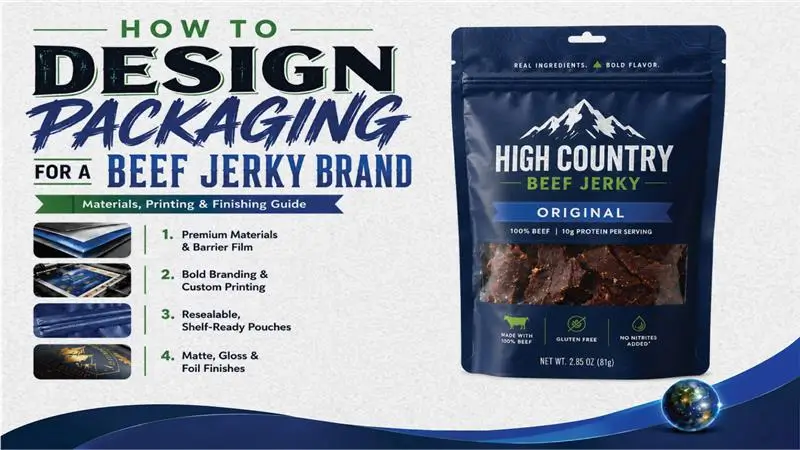
The Art of Premium Beef Jerky Packaging Design
A strong first impression is created through thoughtful custom packaging design, making it an essential part of how to design packaging for a beef jerky brand. A clear hierarchy of information is arranged so that the flavour, certifications, and key visual elements are noticed in the correct order by shoppers. A consistent design template is established first, while each flavour is distinguished through colour variations instead of a complete redesign. As a result, the presentation of the product and the perception of the brand are strengthened across the entire product range. Once the design foundation has been established, attention is turned toward the materials and barrier films that complete the packaging.
“Customers will occasionally buy products not because they want them but because of how they are presented to them.” — James Clear
Best Materials For Beef Jerky Packaging
- Mylar (PET) Film: A high-barrier material with strong resistance against oxygen, moisture, light, and odours. This material is commonly selected for beef jerky bags where freshness, texture protection, and extended shelf life are important factors.
- Aluminium Foil Laminates: Multi-layer foil structures are commonly incorporated into premium jerky bags due to excellent protection against oxygen, humidity, and UV exposure. These laminates are suitable for maintaining the quality of the product during storage and transportation.
- Polyethylene (PE): A food-grade plastic layer commonly applied as the inner sealing layer in flexible pouches. Heat-sealing performance and durability are supported through this material structure.
- Polypropylene (PP): A lightweight material with good moisture resistance and stiffness. This material is frequently included in food packaging structures where strength and barrier performance are required.
- Kraft Paper Laminates: Paper-based outer layers combined with barrier films are used for a natural appearance while protection of the product is maintained through the laminated structure.
- Biodegradable and Compostable Films: Plant-based packaging materials, including PLA and other compostable films, are considered for sustainability-focused beef jerky packaging applications where environmentally responsible packaging options are preferred.
- Vacuum Barrier Films: Specialised multi-layer films designed to reduce air exposure. Extended shelf life of the product is supported through vacuum sealing applications.
- High-Barrier Multi-Layer Laminates: Combination structures such as PET/PE and PET/AL/PE are widely used in beef jerky packaging. Each layer contributes specific functions, including strength, sealing performance, and barrier protection of the product.
Material selection in many ways is the practical side of how to design packaging for a beef jerky brand truly begins. Consequently, this material choice sets the stage for the barrier discussion that follows next.
Eco-Friendly Packaging Options for Beef Jerky Brands
Sustainable packaging is requested by environmentally conscious shoppers, and recyclable packaging options are now offered across most major suppliers. Compostable materials are chosen by brands positioned around a natural or clean-label identity, while broader eco-friendly packaging claims are backed with proper certification to avoid greenwashing concerns. Flexible Kraft Pouches are frequently paired with this positioning, since a soft, tactile finish is combined with a strong barrier layer inside without sacrificing an eco-conscious image. As sustainability expectations rise, so too does the range of formats available on today’s market, and this shift is reshaping how to design packaging for a beef jerky brand for a more conscious buyer.
Best Printing Ideas For Custom Beef Jerky Bags
Vivid graphics are achieved through digital printing, and this method is often selected for shorter runs or frequent flavour rotations. Meanwhile, custom printed pouches are treated as a canvas where photography, illustration, and typography are blended to separate a beef jerky brand from its neighbours on a shelf. A Retort Pouches For Sale category is also considered at this stage whenever a heat-processed product line is part of the plan, since print method and material are chosen together rather than separately.
Therefore, the printing method chosen has a direct effect on both the final look and the total production budget, and this is one more reminder of how to design packaging for a beef jerky brand in a way that is both visually strong and cost-aware, which naturally leads into a discussion of finishing techniques.
Top Finishes That Make Beef Jerky Packaging Stand Out
- Matte finish: a soft, premium touch is delivered, and fingerprints are hidden well during handling.
- Gloss finish: a bright, eye-catching shine is produced, and colour vibrancy is boosted under store lighting.
- Spot UV coating, foil stamping, and embossing: A layered, tactile feel is added through these techniques, and the appearance of the Best Foil Pouches is further enhanced, making a logo or flavour name stand apart from the rest of the panel.
A finish is rarely chosen in isolation; it is paired with the material underneath so that ink adhesion and durability are not compromised, which is a detail often overlooked when the focus of how to design packaging for a beef jerky brand stays only on appearance. With the outer layer settled, attention is now turned inward toward freshness.
Inner Barrier Layers For Beef Jerky Freshness
Extended shelf life is achieved through a properly added barrier film, and this inner layer is what truly separates a professional bag from an amateur one. An oxygen barrier is included to slow spoilage, while a moisture barrier is layered in to keep texture intact over weeks of storage. A BOPET Flexible Packaging structure is sometimes layered into this build for brands needing thinner, high-clarity film alongside a strong barrier.
This inner-layer engineering is a step that is rarely skipped in any serious plan for how to design packaging for a beef jerky brand. Once freshness is locked in, the next concern for most shoppers becomes convenience.
Choosing Perfect Style And Customization Option
A stand-up pouch is favoured by most jerky brands, since a flat base is offered for shelf display without the need for a secondary box. Custom Stand Up Pouches With Window are chosen when transparency around the product itself is valued above illustration, and a White Kraft Stand Up Pouch With Window is picked for a lighter, cleaner aesthetic within the natural-food category.
A gusset pouch is chosen when extra volume is required, while a flat pouch is kept for smaller, snack-sized portions. A hang hole is punched into many of these bags as well, since peg-hook display is common in convenience stores. Shape and structure, in this sense, form another core layer of how to design packaging for a beef jerky brand. Once a shape is settled, attention naturally turns toward compliance and labelling.
Why Resealable Pouches Matter For Jerky Brands?
A resealable zipper is added to almost every modern jerky bag, and consumer convenience is placed at the centre of this decision, since jerky is rarely finished in one sitting. A heat seal is applied along the base and sides during production, after which the zipper is left as the only reopened point. Because of this, freshness is maintained across multiple snacking sessions rather than a single one within any well-considered beef jerky packaging plan.
For brands looking to combine convenience with retail appeal, Custom Printed Ziplock Beef Jerky Packaging Bags are also widely preferred. This convenience factor is a small but telling example of how to design packaging for a beef jerky brand around real snacking habits, and it flows directly into the next consideration: how a bag is actually shaped.
Add Typography: Tips for Bold, Shelf-Ready Jerky Packaging
Bold, confident lettering is favoured across the category, since a bag is often scanned from several feet away rather than read up close. A product label is treated as more than decoration; it is where a nutrition facts label and required disclosures are placed under FDA compliance rules.
At the same time, a rugged or hand-lettered font is balanced against legibility, since style is never allowed to outweigh readability in packaging designed for a beef jerky brand. Legibility paired with compliance is, ultimately, a non-negotiable part of how to design packaging for a beef jerky brand correctly. This attention to compliance leads naturally into what is checked before a bulk production run begins.
Common Mistakes To Avoid In Beef Jerky Packaging Design
- Overcrowded panels: too much text is placed on a single side, and the flavour name is buried as a result.
- Ignored barrier quality: a low-cost film is chosen purely on price, and freshness is lost well before the sell-by date.
- Inconsistent branding: a target audience is left confused when colour or tone shifts across a product line without reason.
These mistakes are avoided through careful planning, which is exactly why trust-building is treated as its own dedicated topic within the wider strategy of designing packaging for a beef jerky brand.
How Packaging Builds Trust For A New Jerky Brand?
Trust is earned slowly, and a clean, well-sealed bag is often the very first signal a new customer receives before a product is even tasted. Side Gusseted Bags are considered here too, since extra internal volume is sometimes needed to fit an insert card without changing the outer footprint on a shelf. Over time, repeat purchases are driven less by flavour alone and more by the confidence built through consistent, reliable packaging.
Trust, in many ways, is the quiet payoff of getting how to design packaging for a beef jerky brand right from the very first run. This trust factor rolls directly into a discussion of cost.
What To Check Before Placing a Bulk Order?
Before a large batch is committed to, a sample run is requested so that colour accuracy and seal strength are confirmed firsthand. A tamper-evident seal is checked for consistency, and a private label packaging agreement is reviewed if a third-party supplier is involved. Custom Mylar Bags With Logo are inspected closely at this stage as well, since print alignment and zipper strength are two of the most common issues found in early sample runs.
In addition, minimum order quantities, lead times, and storage conditions are all confirmed in writing before payment is finalized. These pre-order checks are as much a part of how to design packaging for a beef jerky brand as the artwork itself. With these checks complete, a supplier relationship is the last piece left to settle.
Choosing A Reliable Supplier For Custom Jerky Packaging
A supplier is judged on more than price alone; consistency across batches, responsiveness, and material sourcing are all factored into the decision. Premium packaging and retail packaging capabilities are confirmed through past samples rather than promises, and references from other food brands are requested wherever possible. Mylar Food Pouches in bulk are also reviewed at this stage, since a supplier capable of scaling volume is essential once a beef jerky brand moves beyond a small test batch. Moreover, a supplier is expected to support both e-commerce packaging needs and traditional shelf formats, since most brands sell across both channels today.
This relationship, once established, becomes the backbone of every future production cycle, and it is often the most overlooked part of how to design packaging for a beef jerky brand successfully.
Cost Factors To Consider When Ordering Custom Jerky Bags
Cost is shaped by material, print method, and order volume together, rather than any single factor on its own. A QR code & barcode is added at minimal expense, yet real value is unlocked through traceability and interactive content. A Childproof Mylar Bag is priced slightly higher across most suppliers, since a safety-lock closure is factored into the material and assembly cost.
Meanwhile, a balance between finish quality and budget is struck early, since a beautiful bag is worthless if margins are eroded on every unit sold. Budget, alongside material and print, rounds out the practical core of how to design packaging for a beef jerky brand within a realistic spend. With budget addressed, sustainability is the final piece of the design method.
Canadian Regulations, Certifications, And Packaging Standards For Beef Jerky Packaging
For beef jerky packaging in Canada, compliance is required with the Safe Food for Canadians Regulations (SOR/2018-108) and the Food and Drug Regulations (C.R.C., c. 870). Packaging and labelling requirements are enforced by the Canadian Food Inspection Agency (CFIA), while Health Canada oversees the safety assessment of food-contact packaging materials.
Commonly adopted food safety and quality certifications include ISO 22000:2018, BRCGS Global Standard Packaging Materials Issue 7, HACCP-based food safety systems (Codex CXC 1:2020), and ISO 9001:2015. For recyclable plastic packaging, the ASTM D7611/D7611M Resin Identification Code system is widely used for material identification. Food-contact packaging materials are expected to comply with applicable Health Canada guidance and relevant requirements under the Food and Drug Regulations.
While the design process is important, the final packaging decision also depends on selecting the right pouch format. Since every style offers different advantages for freshness, storage, and retail display, the next guide, Best Pouch Styles For Beef Jerky Products, explains which option is best suited for different packaging needs.
“Good things come in small packages.”
Aesop
Need custom packaging for your beef jerky brand? Contact us today to explore the best Custom Packaging Solutions Companies. They will provide options all according to your specific demand.
Conclusion
The overall method of designing these according to your brand is discussed in this blog. From material selection to the best supplier all walked through in a single blog on how to design packaging for a beef jerky brand. A jerky bag is never just a pouch; it is a solution that reflects your reputation of the brand as well as the product. With the right structural format combined, both freshness and shelf appeal are secured together, and a lasting impression is left with every customer reached.
Frequently Asked Questions (FAQs)
What is the best material for beef jerky packaging?
A barrier film such as a mylar pouch is generally recommended, since both an oxygen barrier and a moisture barrier are needed to protect a meat-based snack over time. This is one of the first questions raised whenever how to design packaging for a beef jerky brand is discussed.
Are resealable pouches necessary for jerky bags?
Yes, a resealable zipper is considered close to essential, since jerky is rarely consumed in a single sitting and freshness is expected to be maintained across several days.
Where is beef jerky packaging bought from?
Beef jerky packaging is bought directly from Universal Packaging, where custom sizes, materials, and finishes are offered under one roof for a beef jerky brand of any scale.
Is custom packaging design offered for small or new jerky brands?
Yes, custom packaging design is offered regardless of order size, and a template is often built first so that future flavour additions are handled with minimal extra cost. This flexibility is central to how to design packaging for a beef jerky brand at any stage of growth.
What printing method is recommended for short production runs?
Digital printing is generally recommended for shorter runs, since flexibility across flavour variations is achieved without high setup costs.
Is FDA compliance required on jerky packaging?
Yes, FDA compliance is required, and a nutrition facts label along with allergen disclosures must be included on every product label.
How is shelf life extended for jerky products?
Shelf life is extended through a combination of vacuum packaging, a reliable barrier film, and a properly executed heat seal along every edge of a bag.
Can packaging be customized to match a specific brand identity?
Yes, customization is available across colour, finish, structure, and print, and a design is typically adjusted until the perception of the brand is reflected accurately on every panel used by a beef jerky brand.
Are eco-friendly packaging options offered for jerky brands?
Yes, recyclable packaging, compostable materials, and broader sustainable packaging formats are all available depending on the certification and budget required.